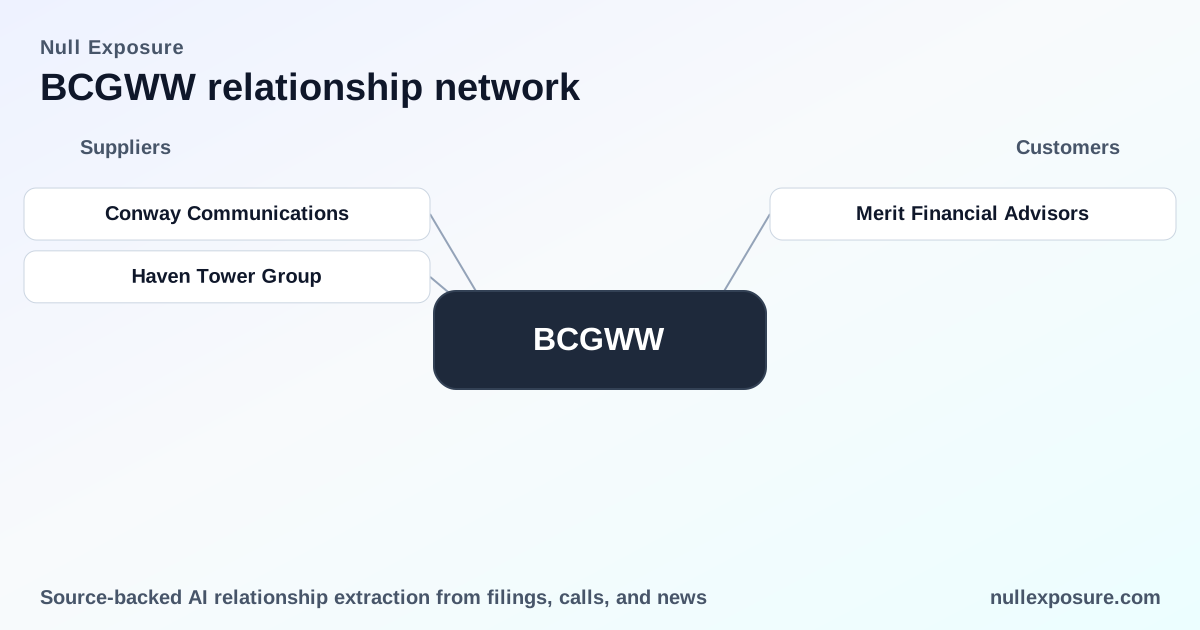
BCGWW Supplier Map: What Investors Should Know About Binah Capital’s Vendor Relationships
Binah Capital Group, Inc. (warrants traded as BCGWW) sits at the intersection of financial services and fintech operations. The firm generates operating revenue through its core capital-markets activities—reported Revenue TTM of $178.2 million and positive operating margins—while the warrant instrument gives investors leveraged exposure to that operating story. For investors evaluating supplier risk, the key question is how external service providers—especially investor-relations and media firms and critical clearing counterparties—impact continuity of market access and execution. For a concise view of vendor exposure and to follow this issuer across supplier relationships, visit the NullExposure homepage: https://nullexposure.com/.
Why supplier links matter for a warrant holder
Warrant holders are exposed indirectly to operational continuity and market access risks that flow through the issuer. Binah’s public filings show positive revenue, modest profitability, and a thin public float; those structural traits amplify the effect of vendor disruptions on liquidity and information flow. Additionally, company-level signals indicate critical dependence on clearing infrastructure and that key vendor ties are active—a profile that elevates operational concentration risk beyond ordinary PR and IR relationships.
What the company-level constraints tell investors
- Critical operational dependency: Management filings state plainly: “Each of our four broker-dealer subsidiaries depends on the operational capacity and ability of its clearing broker for the orderly processing of transactions.” This is a company-level signal of clearing-counterparty criticality, not tied to any single PR or media vendor.
- Active relationship posture: The same excerpt supports an active relationship stage: the firm currently relies on external operational partners to execute core functions.
- Concentration and maturity: Revenue and margin data paired with the clearing-broker statement imply high concentration around a small set of infrastructure counterparties and an operational model that is mature enough to require reliable third-party clearing services.
Together, these constraints imply that operational continuity and counterparty credit/operational risk are top supplier-risk vectors for investors in BCGWW.
Vendor-by-vendor: what the disclosures show
Below are the supplier mentions surfaced in company communications; every relationship in the provided results is covered with the corresponding source.
-
Conway Communications — mentioned in a press release regarding conference participation, listed as investor-relations contact with Mary T. Conway and an email address; this identifies Conway as Binah’s investor-relations provider in FY2025. Source: Sahm Capital press release, November 25, 2025 (https://www.sahmcapital.com/news/content/binah-capital-group-to-participate-in-noblecon21-conference-in-december-2025-11-25).
-
Haven Tower Group — listed in the same November 25, 2025 release as media relations contact (Donald Cutler or Lorene Yue) and an email address for media inquiries, indicating an active PR/media relationship in FY2025. Source: Sahm Capital press release, November 25, 2025 (https://www.sahmcapital.com/news/content/binah-capital-group-to-participate-in-noblecon21-conference-in-december-2025-11-25).
-
Conway Communications — named again in a subsequent Company announcement about executive recognition, the release lists Mary T. Conway as the investor-relations contact which confirms continuity of the IR engagement into late 2025. Source: Sahm Capital news item, December 2, 2025 (https://www.sahmcapital.com/news/content/binah-capital-group-chief-business-development-engagement-officer-ryan-marcus-named-finalist-in-the-thinkadvisor-2025-luminaries-awards-2025-12-02).
-
Haven Tower Group — reiterated as media relations contact in the December 2, 2025 announcement, with the same named representatives and contact details, signaling an ongoing media-relations arrangement. Source: Sahm Capital news item, December 2, 2025 (https://www.sahmcapital.com/news/content/binah-capital-group-chief-business-development-engagement-officer-ryan-marcus-named-finalist-in-the-thinkadvisor-2025-luminaries-awards-2025-12-02).
Key takeaway: public communications consistently list the same IR and media partners across consecutive releases in late 2025, establishing an active and stable external communications posture.
For a consolidated view of Binah’s supplier disclosures and to track changes over time, explore NullExposure’s issuer pages: https://nullexposure.com/.
Operational and counterparty risk implications for investors
Binah’s supplier profile is typical of lean financial-services operators that outsource market-facing functions while retaining custody/clearing exposure:
- Concentration risk: The filing language on broker-dealer subsidiaries and clearing brokers signals single-point-of-failure exposure in transaction processing. A disruption at a clearing partner would directly impair trade settlement and could reduce market liquidity in the underlying equity—relevant to warrant holders who rely on orderly markets to realize value.
- Information flow risk: Stable IR and media relationships (Conway Communications and Haven Tower Group) reduce the probability of communication lapses that can affect investor sentiment and short-term pricing—but they are not substitutes for resilient clearing infrastructure.
- Operational maturity: Revenue and margin figures show an operating entity with meaningful scale in revenue but limited public float and institutional ownership, which increases the market impact of any operational disruption.
Operational priorities for management should be redundancy in clearing arrangements, robust SLAs with critical counterparties, and verified continuity plans for trading and settlement channels.
How investors and operators should act now
- Investors should treat clearing-counterparty continuity as the dominant supplier risk for BCGWW; review filings and any subsequent notices for named clearing brokers or changes in clearing arrangements.
- For position sizing and liquidity planning, factor in the company’s small public float and the potential for volatility if communications or settlement channels are disrupted.
- Operators at Binah should codify redundancy in clearing and publicly disclose high-level continuity plans to limit information asymmetry with the market.
If you need an operational supplier audit or a tracking feed of Binah’s vendor disclosures, NullExposure centralizes these signals and updates them as filings and press materials are released: https://nullexposure.com/.
Bottom line
Binah Capital’s public communications in late 2025 show stable IR and media engagements but filings flag a critical dependence on clearing brokers for transaction processing. For warrant investors, that combination elevates operational and liquidity risk relative to peers with broader infrastructure diversification. Track disclosures for any named clearing counterparties and watch for changes in vendor SLAs or continuity statements—those are the supply-side inputs that will move the warrant’s liquidity and valuation dynamics.