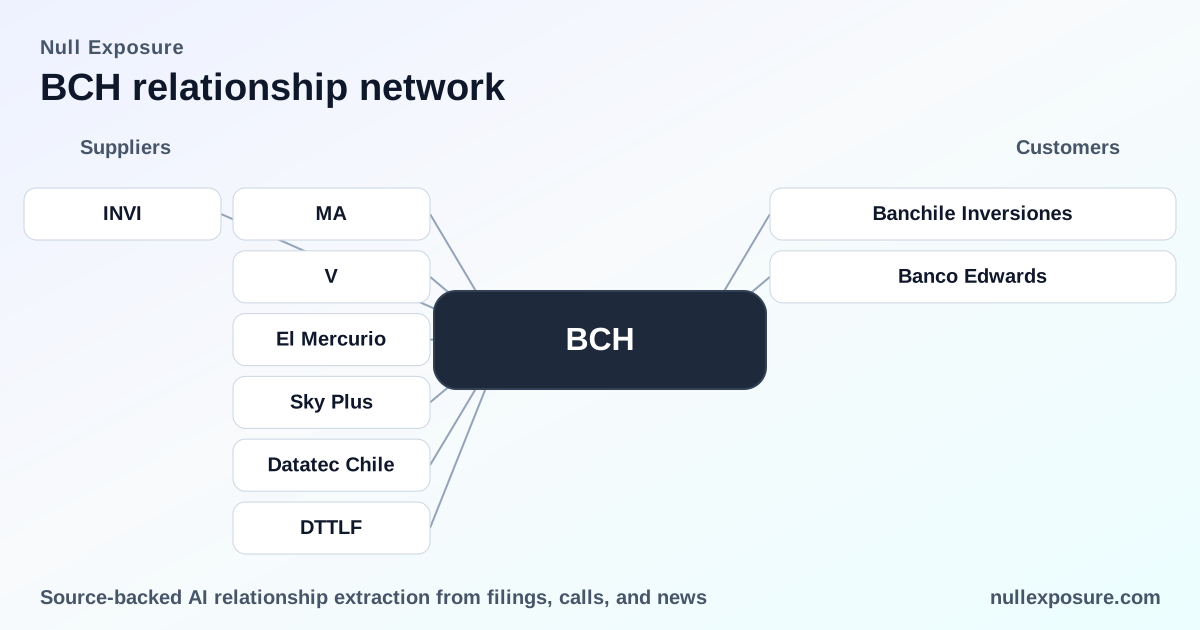
Banco de Chile (BCH) — supplier relationships that move the P&L
Banco de Chile runs a classic Chilean universal bank model focused on retail and commercial lending, deposit franchises, cards and FX services, and monetizes through net interest margin, fee income from payment and card products, and transaction-based FX and treasury revenues. The bank’s supplier posture is oriented toward platform partnerships (card networks, FX stacks, merchant ecosystem partners and local infrastructure providers) that directly influence fee capture and client experience. For investors and operators, tracking these third-party ties reveals where revenue lift and operational risk concentrate. Learn more about supplier risk and coverage at https://nullexposure.com/.
How Banco de Chile contracts and where concentration shows up
Banco de Chile’s visible supplier set shows a dual focus: global card networks for payments distribution and local FX infrastructure providers for market-making and client execution. That indicates a contracting posture that combines entrenched, non‑disruptable rails (Visa, Mastercard) with specialist vendors for technology-driven FX execution (Integral, Datatec). There are no explicit vendor constraints disclosed in the supplier record; this is a company-level signal that Banco de Chile relies on a mix of incumbent networks and targeted fintech suppliers to deliver differentiated services. Key characteristics for investors:
- Contracting posture: Hybrid — long-term reliance on card rails plus vendor-led integration for FX pricing and liquidity.
- Concentration: Moderate — global card networks are inevitabilities for payment distribution, while FX suppliers are fewer but replaceable.
- Criticality: High for payments and FX infrastructure because these suppliers are on the revenue path for fees and spreads.
- Maturity: Mixed — mature card relationships coexist with newer FX-platform integrations announced in FY2025.
Supplier map: the relationships you should know
Mastercard
Banco de Chile offers cardholder benefits tied to Mastercard-branded cards, driving card transactions and fee income. According to a consumer promotion note in August 2025, Banco de Chile debit and credit cards on Mastercard generate promotional benefits for clients (https://www.pauta.cl/dato-en-pauta/2025/08/01/descuentos-y-ofertas-del-banco-de-chile-en-agosto-2025.html).
Visa
Visa is the other principal card network supporting Banco de Chile’s debit and credit products, directly affecting interchange and acceptance economics. The same August 2025 promotion lists Visa as a payments partner for cardholder benefits (https://www.pauta.cl/dato-en-pauta/2025/08/01/descuentos-y-ofertas-del-banco-de-chile-en-agosto-2025.html).
El Mercurio
Banco de Chile uses Chile’s national press for regulatory and public disclosures; a corporate filing noted that the same information would be published in El Mercurio on specified March 2026 dates. This reflects the bank’s compliance channel for public notices (see the March 2026 filing published via StockTitan referencing El Mercurio).
Source: Banco de Chile current report and the notice published in El Mercurio (StockTitan reproduction, March 2026 — https://stocktitan.net/sec-filings/BCH/6-k-bank-of-chile-current-report-foreign-issuer-9169ab30dc71.html).
Sky Plus
Banco de Chile’s card promotions extend into merchant ecosystems such as Sky Plus, where cardholders can access discounts and offers in categories from travel to delivery, supporting card spend and merchant tie-ins. The promotional listing in August 2025 includes Sky Plus among the partner benefits (https://www.pauta.cl/dato-en-pauta/2025/08/01/descuentos-y-ofertas-del-banco-de-chile-en-agosto-2025.html).
Datatec Chile
For FX infrastructure, Banco de Chile has integrated with Datatec Chile’s interbank FX services to capture live spot pricing and create executable rates across client channels, underpinning the bank’s institutional and corporate FX flows. An FY2025 industry report noted Datatec Chile’s role as the primary local provider of interbank FX infrastructure in the integration (https://fxnewsgroup.com/forex-news/institutional/banco-de-chile-adopts-integral-fx-price-engine-and-liquidity-aggregation/).
Datatec (DTTLF)
Complementary reporting identifies Datatec (ticker DTTLF) as the Chilean interbank FX provider connected to Banco de Chile’s new FX stack, delivering live data and enabling pricing distribution across channels. The integration detail was described in an industry note covering the bank’s FY2025 FX rollout (https://thefullfx.com/banco-de-chile-rolls-out-integral-for-fx-operations/).
Integral (INVI) — report 1
Integral’s Price Engine and Liquidity Aggregation products were adopted by Banco de Chile to consolidate FX pricing logic and streamline execution workflows, which directly affects spread capture and operational efficiency in FX trading. An industry release in FY2025 described the adoption (https://fxnewsgroup.com/forex-news/institutional/banco-de-chile-adopts-integral-fx-price-engine-and-liquidity-aggregation/).
Integral (INVI) — report 2
Independent coverage corroborated the deployment of Integral’s platform at Banco de Chile, emphasizing the system’s role in consolidating pricing and delivering pricing across channels and client segments, reinforcing the bank’s ability to standardize FX client experiences (https://thefullfx.com/banco-de-chile-rolls-out-integral-for-fx-operations/).
What these relationships imply for revenue, risk and valuation
Payments networks (Visa, Mastercard) are foundational to Banco de Chile’s card fee and interchange economics; promotions and merchant tie‑ins (Sky Plus) lift transaction volumes and deepen client engagement, which supports fee income and cross‑sell. FX infrastructure (Integral, Datatec) is directly revenue‑relevant: consolidated pricing engines and live interbank feeds improve execution, compress internal operational cost and lengthen the value chain capture in FX client flows. Using media channels like El Mercurio for disclosures is standard for regulatory completeness and investor visibility.
Investor implications:
- Revenue upside mechanics: Enhanced card promotions and merchant partnerships boost card volume; better FX pricing systems increase spreads and client retention.
- Operational risk: Reliance on external FX and pricing vendors increases third‑party operational dependencies; integration execution and SLA management matter.
- Concentration risk: Card network dependency is natural and unavoidable; FX supplier count is small, increasing supplier criticality but not singular dominance based on the observed roster.
- Valuation sensitivity: Improvements in fee income and FX trading efficiency justify premium multiples if execution optimizes ROE and NIM; Banco de Chile’s FY2025–FY2026 announcements are consistent with this strategy.
For a deeper vendor risk audit or to map contractual exposures for portfolio companies, see https://nullexposure.com/ — our platform slices supplier exposure by contractual criticality.
Actionable takeaways for investors and operators
- Monitor card activation and merchant-promotion metrics as leading indicators for fee income growth tied to Mastercard/Visa and merchant ecosystems like Sky Plus.
- Track FX execution performance (hit rates, spreads and client retention) post-Integral/Datatec integration to quantify treasury revenue improvement.
- Prioritize third‑party oversight on the FX stack: vendor SLAs, contingency liquidity sources and data reconciliation are core to controlling operational risk.
For tailored due diligence and supplier-informed valuation adjustments visit https://nullexposure.com/ to start mapping supplier risk into investment decisions.
Closing summary
Banco de Chile’s supplier footprint shows a deliberate mix of global card rails and specialist FX vendors that drive both top-line fee generation and execution economics. Investors should treat these relationships as operational levers: card partners move volume and fee dynamics, while FX platform partners move spreads and execution cost. Close monitoring of integration outcomes and promotional effectiveness will translate directly into earnings quality and valuation upside. Explore supplier-driven risk and opportunity at https://nullexposure.com/.