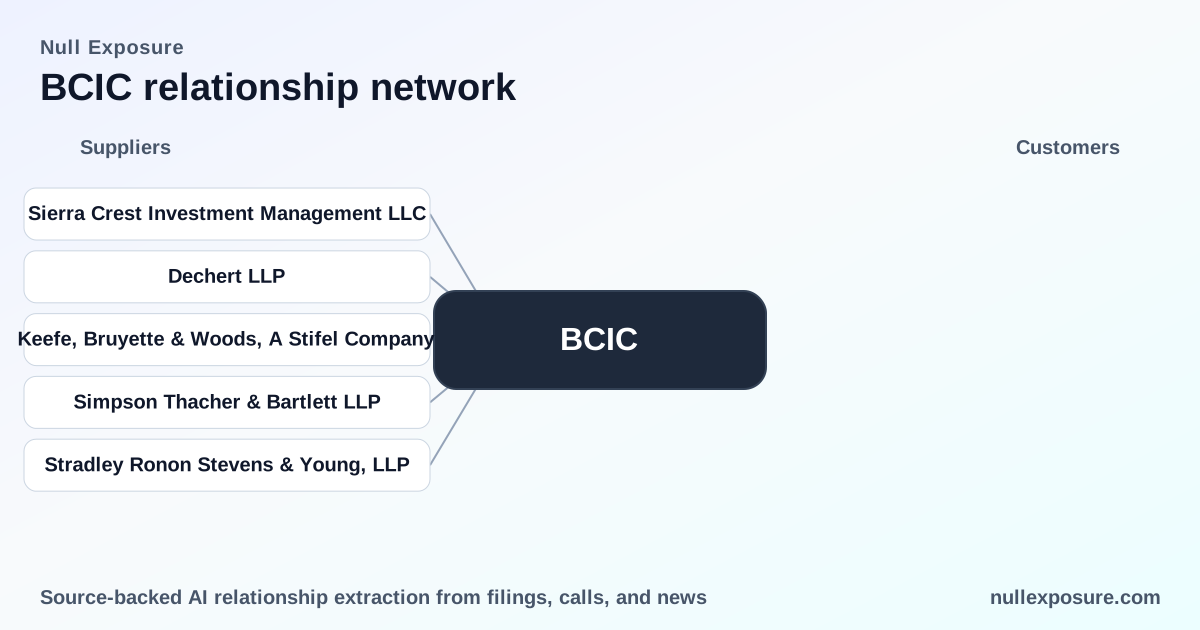
BCIC: How the supplier map explains where value and risk flow
BCP Investment Corporation (BCIC) operates as an externally managed, publicly listed investment vehicle that monetizes through management and incentive fees on its investment portfolio and by deploying capital into credit and CLO-linked assets while relying on affiliated and third‑party service providers for investment management, administration and transaction execution. The company's economics are concentrated on fee streams (base and incentive) and portfolio returns, while its operating model is built around long‑dated financing and an active adviser relationship with affiliates of BC Partners. For an independent supplier-risk view and deeper supplier intelligence, visit https://nullexposure.com/.
Why the supplier roster matters for investors
BCIC’s supplier list is not a laundry list of vendors — it defines governance, fee capture and operational dependency. The Adviser is the primary service provider, entrusted with sourcing, diligencing and managing investments; legal and financial advisers drive deal execution and structural outcomes. Contract terms and spend levels indicate a hybrid posture: long‑dated credit commitments underpin balance‑sheet flexibility, while administrative agreements are subject to annual reauthorization, preserving board oversight and dynamic counterparty choice.
Key company-level signals drawn from filings and press coverage:
- Long‑term financing: BCIC controls a revolving credit facility whose maturity was extended to August 29, 2027, giving the company multi-year funding certainty for portfolio activity and liquidity management (company filing disclosure, December 2019 amendment and July 2024 amendment).
- Rolling administration: The administration agreement renews annually if approved by the Board or stockholders, which signals a short‑term contracting posture for administrative services and preserves governance control (company filing, April 2019 and board action March 12, 2025).
- Fee profile and spend scale: The company incurred $6.6 million of base management fees and $5.0 million of incentive fees for 2024, plus $1.8 million of administrative services expense, placing supplier spend comfortably in the mid‑range for externally managed investment firms (company disclosures, FY2024).
- Service provider role: Multiple excerpts identify the Adviser and Administrator as service providers responsible for day‑to‑day investment management and fund administration, making those relationships operationally critical to investment performance and reporting (company filings).
- Portfolio concentration signal: CLO fund securities were a small portion — approximately 1.3% of the portfolio at fair value — indicating limited direct exposure to that segment (company filing).
For a vendor-level snapshot of BCIC’s counterparties, explore https://nullexposure.com/ to map supplier criticality and contract types.
The adviser at the center: Sierra Crest Investment Management LLC
Sierra Crest Investment Management LLC is the investment adviser responsible for managing BCIC’s investment activities; the firm is an affiliate of BC Partners and executes sourcing, diligence, structuring and portfolio monitoring on BCIC’s behalf. This relationship is central to how BCIC generates management and incentive fees and is explicitly referenced in both the company press release and transaction communications (GlobeNewswire, Sept 3, 2025; QuiverQuant transaction recap, March 2026). Source: GlobeNewswire (Sept 3, 2025) and QuiverQuant (March 2026) — https://www.globenewswire.com/news-release/2025/09/03/3144050/7512/en/BCP-Investment-Corporation-to-Ring-Nasdaq-Stock-Market-Opening-Bell-on-September-5-2025.html and https://www.quiverquant.com/news/Portman+Ridge+Finance+Corporation+Completes+Merger+with+Logan+Ridge+Finance+Corporation%2C+Slated+to+Rebrand+as+BCP+Investment+Corporation.
Legal counsel and deal advisors that executed the merger
- Simpson Thacher & Bartlett LLP served as legal counsel to one of the deal parties in BCIC’s merger and rebrand transaction, supporting transaction structuring and regulatory documentation. Source: QuiverQuant transaction coverage (March 2026) — https://www.quiverquant.com/news/Portman+Ridge+Finance+Corporation+Completes+Merger+with+Logan+Ridge+Finance+Corporation%2C+Slated+to+Rebrand+as+BCP+Investment+Corporation.
- Dechert LLP acted as legal counsel to the counterparty in the same transaction, providing buyer/seller representation and closing support. Source: QuiverQuant (March 2026) — https://www.quiverquant.com/news/Portman+Ridge+Finance+Corporation+Completes+Merger+with+Logan+Ridge+Finance+Corporation%2C+Slated+to+Rebrand+as+BCP+Investment+Corporation.
- Stradley Ronon Stevens & Young, LLP represented the Special Committee of PTMN as legal counsel, a role that implicates governance independence during the merger review. Source: QuiverQuant (March 2026) — https://www.quiverquant.com/news/Portman+Ridge+Finance+Corporation+Completes+Merger+with+Logan+Ridge+Finance+Corporation%2C+Slated+to+Rebrand+as+BCP+Investment+Corporation.
- Keefe, Bruyette & Woods (a Stifel company) served as financial advisor to the Special Committee of PTMN, providing valuation and fairness analysis that underpinned the transaction recommendation. Source: QuiverQuant (March 2026) — https://www.quiverquant.com/news/Portman+Ridge+Finance+Corporation+Completes+Merger+with+Logan+Ridge+Finance+Corporation%2C+Slated+to+Rebrand+as+BCP+Investment+Corporation.
Each of these advisers played a discrete role: legal risk containment, governance independence testing and financial valuation. Together they shaped the rebrand and integration of assets now operating under the BCIC umbrella.
If you want a structured supplier risk report or contract map for BCIC’s counterparties, start here: https://nullexposure.com/.
Governance, concentration and operational risk — what investors should watch
- Single‑adviser dependency is a governance lever. The Adviser handles core investment functions and collects the bulk of management and incentive compensation; board oversight and annual reapproval of the Advisory/Administration arrangements are the primary controls over that dependency.
- Contract mix is hybrid, not binary. The company runs both long‑term financing instruments (revolving credit facility extended to 2027) that stabilize liquidity and short‑term administrative contracts that are reauthorized annually, enabling tactical supplier changes if governance requires.
- Spend is material but not outsized. With combined base and incentive fees in the low tens of millions, supplier economics are significant for BCIC’s P&L and therefore deserve active monitoring, but the fee levels align with mid‑market externally managed investment companies.
- Legal and transaction advisors indicate an active M&A posture. Use of top‑tier law firms and a specialized financial advisor signals the company is prepared for further strategic transactions that could alter supplier mix or portfolio risk.
Bottom line — trade and governance implications
BCIC is an externally managed investment vehicle whose economics and operational continuity depend on an affiliate adviser relationship and a small roster of specialist legal and financial advisers. Investors should prioritize governance oversight over advisory fee structures and maintain visibility on financing maturities that influence liquidity and deal cadence.
For investor teams building a supplier diligence checklist or monitoring plan, review BCIC’s supplier footprint at https://nullexposure.com/ and consider subscribing for ongoing supplier change alerts.
Final actions:
- Monitor the Adviser and Administration Agreement renewals and fee disclosures at each quarterly filing.
- Track the revolving credit facility maturity and any amendments for liquidity signals.
- Maintain relationships with legal and financial advisers as indicators of transaction activity.
To get a tailored supplier exposure brief for BCIC or comparable issuers, visit https://nullexposure.com/ and request an analyst briefing.