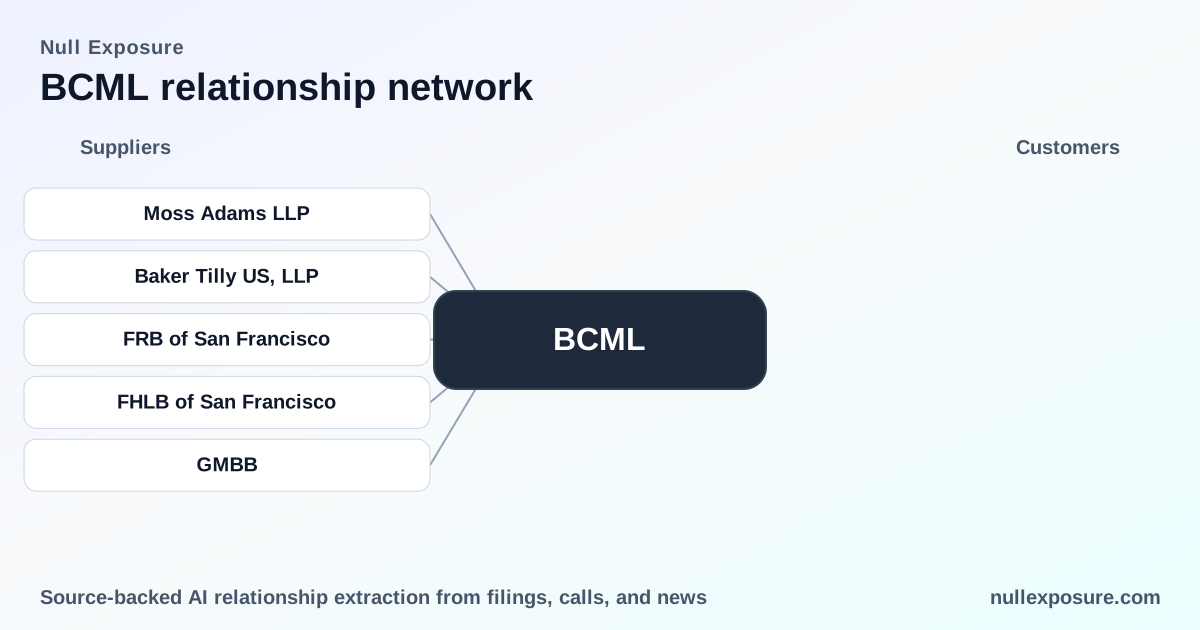
BayCom Corp (BCML): a supplier and counterparty archetype for regional banking relationships
BayCom Corp operates as the bank holding company for United Business Bank, generating revenue primarily through net interest income on commercial and consumer lending, supplemented by fee-based income from deposit and payment services. The company monetizes by originating, purchasing and managing loan portfolios, operating a branch network, and outsourcing non-core payment and IT functions to third-party vendors. Investors evaluating supplier relationships should view BayCom as a regional bank with conservative capitalization, diversified funding lines, and operational dependence on a small set of critical counterparties. For further supplier intelligence and relationship mapping, visit https://nullexposure.com/.
How BayCom makes money and where suppliers fit in
BayCom’s earnings profile is bank-like and straightforward: interest spread on loans and investment securities forms the backbone of revenue, supported by fee income and a modest dividend policy. Key financial signals: market capitalization roughly $316M, trailing P/E 13.3, price-to-book 0.93, trailing revenue about $96M, and a dividend yield around 3.1% (latest fiscal data to 2025). These numbers signal a stable, modest-growth regional bank where operational vendors and funding counterparties materially affect profitability through cost, availability of liquidity, and regulatory/compliance support.
Suppliers and counterparties influence three economic levers for BayCom:
- Funding resilience and contingent liquidity (discount window / FHLB access).
- Cost and risk of operations (outsourced card/payment processors and IT vendors).
- Governance and audit robustness (external auditor relationship).
For more on mapping counterparty risk for financial services firms, see https://nullexposure.com/.
Who BayCom actually works with — the counterparty list you must consider
Below are every supplier and counterparty identified in public materials and filings, each summarized with source context.
Moss Adams LLP
Shareholders ratified Moss Adams LLP as the independent registered public accounting firm for fiscal 2025, with a strong affirmative vote; the firm was subsequently succeeded by Baker Tilly U.S., LLP effective June 3, 2025. This reflects a near-term transition in external audit oversight. According to the company’s proxy filing reported on the SEC filings aggregator, this ratification carried 98.8% support (FY2025). Source: company SEC materials reported on StockTitan (page-3), FY2025.
Baker Tilly US, LLP
Baker Tilly U.S., LLP succeeded Moss Adams as BayCom’s independent auditor effective June 3, 2025, establishing the current external audit relationship for post-2025 reporting. The auditor transition is documented in the same shareholder materials that ratified the FY2025 auditor appointment. Source: company SEC materials reported on StockTitan (page-3), FY2025.
FRB of San Francisco
BayCom has approved access to discount window advances with the Federal Reserve Bank of San Francisco, secured by designated loan types, providing a backstop for short-term liquidity needs. This facility is described in BayCom’s public earnings commentary for its 2025 fourth quarter / FY2026 reporting. Source: BayCom press release reported on Yahoo Finance (Q4 2025 / FY2026).
FHLB of San Francisco
BayCom maintains an approved secured borrowing facility with the Federal Home Loan Bank of San Francisco for up to 25% of total assets with terms not to exceed five years under a blanket lien on certain loans; notably, no FHLB advances were outstanding as of December 31, 2025. This line is an important contingent wholesale funding source for the bank. Source: BayCom earnings release reported on Yahoo Finance (FY2026 disclosure).
Grand Mountain Bancshares (GMBB)
BayCom completed the acquisition of Grand Mountain Bancshares, the holding company for Grand Mountain Bank, in November 2020 in a cash transaction of approximately $14 million, expanding geographic lending reach and deposit footprint in targeted markets. This historical M&A underscores BayCom’s inorganic growth strategy and loan-purchase activity precedent. Source: regional coverage in SkyHiNews (reporting the November 2020 transaction).
What the public constraints say about BayCom’s operating model
A review of constraint excerpts from filings provides actionable signals about contracting posture, concentration, criticality and maturity:
-
Contracting posture — long-term branch real estate commitments. BayCom reported operating 35 branches at the end of 2024, owning 15 and leasing 20 with expirations through 2030 and renewal options of three to 12 years; this indicates a mix of owned and long-term leased physical infrastructure that creates durable fixed-cost exposure and a multi-year vendor/landlord relationship profile.
-
Concentration — active buyer of loan assets outside the primary market. Filings document $86.1 million of loan purchases concentrated in New Mexico and Colorado. This buyer posture increases dependency on third-party loan sellers and third-party due diligence providers and creates credit concentration to monitor.
-
Criticality — reliance on third-party service providers for payments and IT. BayCom outsources card payment services and other essential operational systems; these services are recorded as expense offsets to fee income and are explicitly identified as potential points of operational disruption or security risk. That makes payment processors and IT vendors operationally critical.
-
Maturity — established lines of contingent funding. The existence of discount window access and an FHLB facility up to 25% of assets indicates mature contingency planning for liquidity, reducing systemic single-point funding risk.
These constraints collectively portray a bank that balances stable branch footprint costs with active third-party sourcing for loan origination and payments, underpinned by formal liquidity backstops.
For a deeper supplier risk scorecard on BayCom, check https://nullexposure.com/.
Investment and operational implications for suppliers and potential partners
- Liquidity counterparties (FRB/FHLB) lower funding risk for counterparties that depend on BayCom’s deposit stability, but the lack of outstanding advances suggests currently conservative liquidity usage. Source-backed facilities improve creditworthiness in partner evaluations.
- Outsourced payments and IT are critical single threads — vendors in those categories have outsized operational leverage; contract terms, SLAs, and incident response plans should be scrutinized by both BayCom and any downstream partners.
- Audit transition is governance-relevant — the move from Moss Adams to Baker Tilly in mid-2025 is material for auditors’ continuity workpapers, restatement risk, and audit findings; procurement and compliance teams should validate the handover and open items from the transition.
What investors and operators should request in vendor diligence
- A current vendor roster with contractual terms, renewal dates, and termination rights for critical services.
- Copies of audit committee minutes or shareholder materials addressing the auditor transition and open governance items.
- Loan purchase diligence playbooks and concentration reports by geography and product.
BayCom is a classic regional bank with stable earnings, conservative liquidity tools, and targeted inorganic growth activity; suppliers and partners must prioritize operational continuity and contractual clarity when engaging. For practical supplier mapping and more counterparty analyses, visit https://nullexposure.com/.
Final takeaway: BayCom’s supplier risk is concentrated in long-term real estate commitments and a small number of critical service providers, while its liquidity posture is strengthened by formal FRB and FHLB facilities — these are the levers to monitor for operational and credit counterparties.