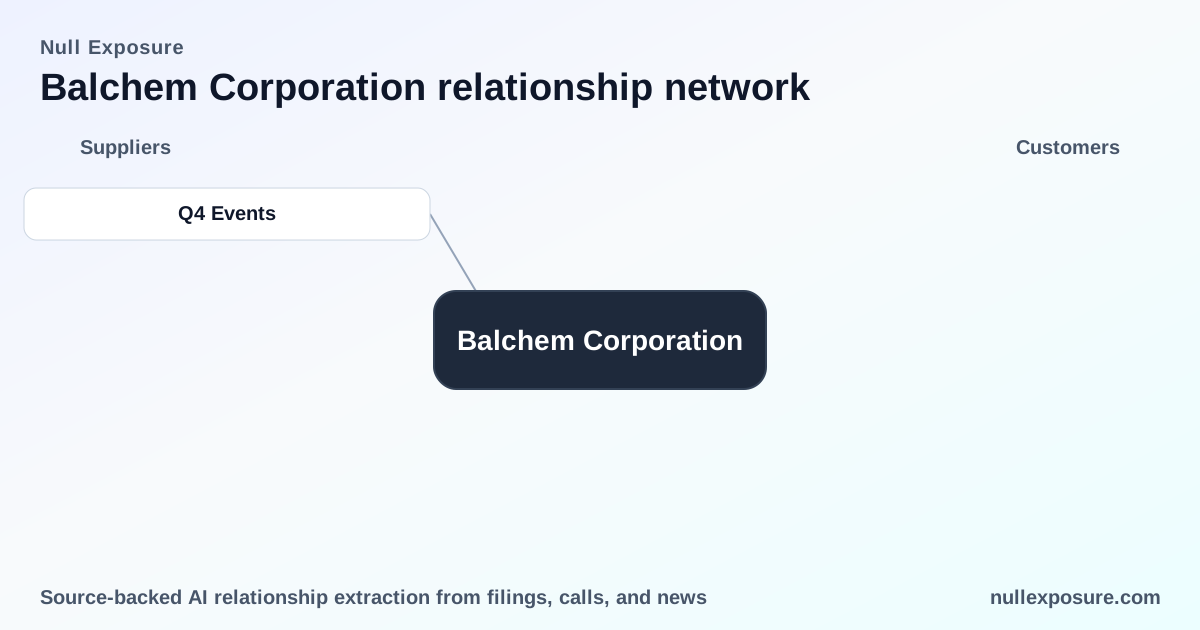
Balchem Corporation (BCPC): supplier posture and what investors should price in
Balchem Corporation manufactures and sells specialty ingredients and performance products across nutrition, pharmaceutical, animal health, medical-device sterilization, plant nutrition and industrial markets, monetizing through direct product sales to industrial and life‑science customers and aftermarket services tied to those products. With roughly $1.04 billion in trailing revenue and a market capitalization around $5.45 billion, Balchem operates as a mid‑cap specialty‑chemicals platform that converts engineered raw materials into higher‑margin, application‑specific solutions for health and industrial customers. For investors and procurement operators evaluating BCPC supplier relationships, the picture that matters is the company’s global sourcing footprint, its product criticality to end customers, and the transparency of its investor communications.
If you want a concise, data‑driven supplier view for portfolio or vendor management decisions, visit https://nullexposure.com/ for structured supplier intelligence and alerts.
One recent supplier‑relevant disclosure investors should note
Balchem continues routine investor engagement and public disclosures that provide windows into operations and supplier risk. A March 2026 news item flagged a Q4 investor webcast and replay with dial‑in details (Conference ID 4400943), which is a standard disclosure channel for quarterly results and operational commentary. This kind of event is where management typically discusses supply dynamics, material costs, and capital allocations. (Source: StockTitan news post, 2026‑03‑09 — https://www.stocktitan.net/news/BCPC/balchem-corporation-announces-quarterly-conference-call-for-fourth-v4gihdlcuvb5.html)
Every supplier relationship referenced in the available records
- Q4 Events — A StockTitan news post on March 9, 2026 announced Balchem’s quarterly conference call webcast and replay information, providing dial‑in details and a conference ID for investors and analysts. This disclosure is an investor‑relations notice rather than a supplier contract announcement but is a channel where management will discuss procurement and supply chain performance. (Source: StockTitan news post, 2026‑03‑09 — https://www.stocktitan.net/news/BCPC/balchem-corporation-announces-quarterly-conference-call-for-fourth-v4gihdlcuvb5.html)
Company‑level supplier constraint worth treating as a signal
The company explicitly states that raw materials are sourced both domestically and internationally, which establishes a company‑level signal of a global supplier footprint: "The raw materials utilized by us in the manufacture of our products are sourced from suppliers both domestically and internationally." This global sourcing posture has direct operational implications and should be treated as an intrinsic constraint on Balchem’s business model.
Implications of that constraint:
- Contracting posture: Global sourcing indicates the firm operates a geographically diversified vendor base. Expect a mix of short‑ and medium‑term purchase agreements across regions rather than single long‑term captive suppliers in most categories.
- Concentration: The disclosure does not identify supplier concentration metrics, so concentration remains an unknown that investors should probe in due diligence; global sourcing reduces single‑country dependency but can mask single‑supplier concentration within a region or product line.
- Criticality: Raw materials are critical inputs to Balchem’s specialty product lines; disruptions or quality failures in feedstock supply would flow through rapidly to production and revenue.
- Maturity: Balchem’s size and product breadth (trailing revenue ~$1.04B; market cap ~$5.45B) indicate a mature specialty‑chemicals operator with established procurement functions, but maturity does not remove exposure to commodity and logistical shocks.
(Disclosure quote derived from company sourcing statements in public filings.)
Why investors and operators should care — risk and opportunity map
Balchem’s business model converts commodity and semi‑processed inputs into differentiated specialty products that command higher operating margins (operating margin ~19.8%) and solid profitability (profit margin ~14.9%). That margin profile both cushions and concentrates supplier risk:
- Positive leverage: If Balchem secures stable, cost‑effective feedstock, gross margins expand quickly because product pricing sits above commodity inputs.
- Sourcing exposure: Global sourcing increases exposure to trade, tariff, and logistics volatility, which can compress margins unexpectedly when freight or input prices spike.
- Operational criticality: Many of Balchem’s end markets (pharma, medical device sterilization, nutrition) require consistent quality and regulatory documentation, elevating supplier qualification overhead and making a small number of certified suppliers more critical even within a geographically broad base.
Balchem’s financial scale (RevenueTTM $1,037,161,000; EBITDA ~$254.7M) supports investment in supplier qualification, inventory buffers and dual‑sourcing where economics justify it — but those investments erode return on deployed capital and should be tracked alongside margins and free cash flow. For vendor managers, prioritize visibility into specialty feedstocks that have long lead times or strict regulatory provenance.
If you want to map Balchem’s supplier footprint against logistics and geopolitical risk layers, get a tailored supplier risk brief at https://nullexposure.com/.
Practical takeaways for portfolio and procurement decisions
- Ask management for supplier concentration metrics in the next investor call or filing: which top suppliers account for the majority of spend, and what regions host them.
- Monitor quarterly commentary closely. The firm’s conference calls and webcasts (the Q4 event noted above) are the primary venue where management will disclose material shifts in input prices, supplier disruptions, or strategic sourcing changes. (Source: StockTitan news post, 2026‑03‑09 — https://www.stocktitan.net/news/BCPC/balchem-corporation-announces-quarterly-conference-call-for-fourth-v4gihdlcuvb5.html)
- Stress test margins for a 10–20% move in feedstock or freight and compare to historical operating margin volatility; Balchem’s current trailing operating margin (~19.8%) provides some buffer but not immunity.
Final read: how to position
Balchem is a mature specialty‑chemicals operator with global procurement that both enables product access and raises supply‑chain risk. For equity investors, the core question is whether management can translate scale and differentiated offerings into stable margin expansion while managing global input volatility. For contract and procurement operators, the work plan is straightforward: secure transparency on supplier concentration, validate dual‑sourcing where critical, and watch quarterly investor communications for early signs of stress.
For a concise, exportable supplier risk overview that connects disclosures like the Q4 webcast to procurement action items, visit https://nullexposure.com/ and request a supplier brief tailored to BCPC.
Key takeaways: global sourcing is real and material; supplier concentration is not disclosed and must be tested; investor calls are the practical window into management’s sourcing health.