BioCryst (BCRX) supplier relationships: who supplies the levers behind growth and risk
BioCryst Pharmaceuticals discovers and commercializes oral, small‑molecule drugs and monetizes through product sales, targeted acquisitions, licensing and strategic financings that support expansion. The company outsources core manufacturing, distribution and certain regulatory functions while using third‑party capital and advisors for deals — a model that compresses fixed cost but concentrates operational and counterparty risk. For investors and procurement leaders, the supplier map is therefore both a growth enabler and the primary operational vulnerability. For a quick view of our supplier intelligence and monitoring services, visit https://nullexposure.com/.
How BioCryst’s operating model turns suppliers into strategic assets
BioCryst runs a lean internal operating model: discovery and commercialization are core, while manufacturing, specialty distribution and international regulatory execution are outsourced. That structure supports capital efficiency — reflected in a trailing revenue of roughly $600M and a gross profit level that sustains margins — but creates single‑point dependencies that elevate execution risk when product volumes ramp.
Company‑level signals drawn from public disclosures indicate:
- Critical materiality: BioCryst reports reliance on limited or single sources for manufacturing and distribution, which makes certain suppliers functionally indispensable rather than optional.
- Manufacturer role: The firm contracts with foreign contract manufacturing organizations (CMOs) and relies on single‑source suppliers for active pharmaceutical ingredient and finished product, signaling concentration risk in the supply chain.
- Distributor and service‑provider exposure: The business depends on third‑party distributors and specialty pharmacies for U.S. product distribution and uses third parties to satisfy regulatory obligations in overseas markets such as Japan.
These characteristics define a contracting posture that is outsourced and concentrated, where supplier failure produces operational stoppage rather than incremental disruption. That reality is as much a commercial risk as it is a procurement priority.
Counterparties that matter right now
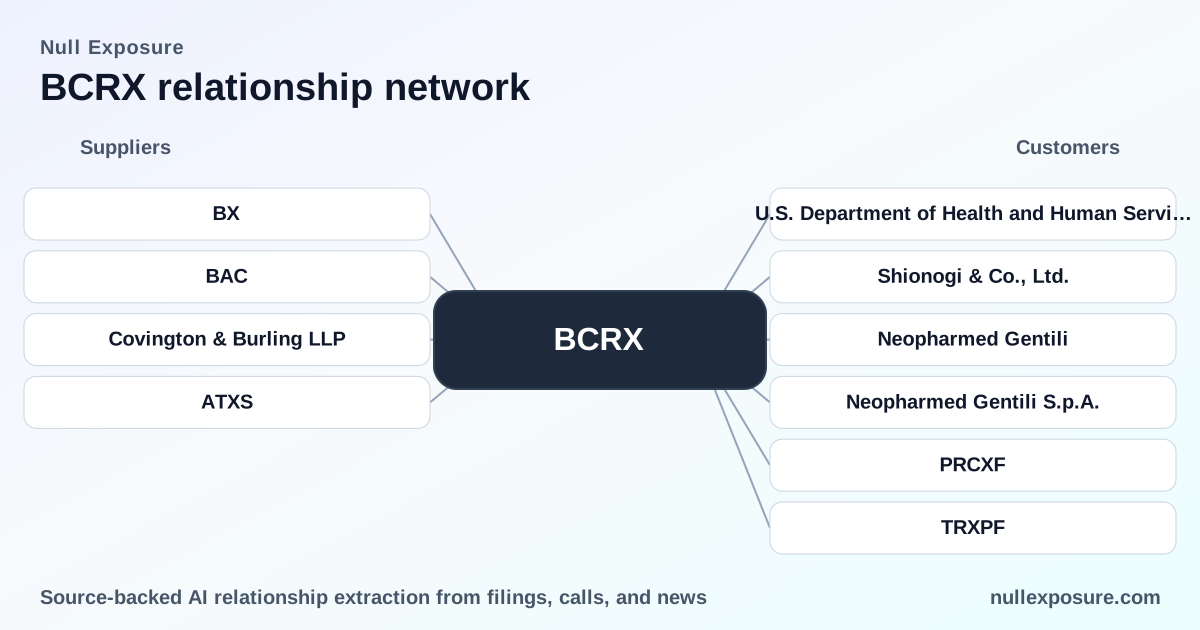
Below are every supplier/relationship listed in the available public results, with a concise, plain‑English summary and source note.
Blackstone — funding partner for a major acquisition
BioCryst entered a term loan facility of approximately $400 million with funds managed by Blackstone to finance the cash portion of its Astria Therapeutics acquisition and related transaction costs, supporting the company’s expansion in hereditary angioedema. According to a GlobeNewswire press release dated January 23, 2026, roughly $396.6 million was drawn from a financing facility managed by Blackstone. (GlobeNewswire, Jan 23, 2026)
BofA Securities, Inc. — exclusive financial advisor on the transaction
BofA Securities served as BioCryst’s exclusive financial advisor for the Astria acquisition, providing deal structuring and execution services that underpinned the strategic consolidation. The role is documented in the company’s January 23, 2026 announcement. (GlobeNewswire, Jan 23, 2026)
Covington & Burling LLP — legal counsel on the acquisition
Covington & Burling acted as legal counsel to BioCryst for the Astria transaction, handling the regulatory and transactional legal work inherent in a cross‑border pharma acquisition. This engagement is disclosed alongside the acquisition announcement. (GlobeNewswire, Jan 23, 2026)
Astria Therapeutics — acquisition target integrated into the portfolio
BioCryst completed the acquisition of Astria Therapeutics, broadening its hereditary angioedema product portfolio and adding leadership capabilities to the commercial bench; market commentary and press reporting highlighted the transaction as a strategic expansion. A SimplyWall analysis and the company press release both noted that the Astria deal broadened BioCryst’s HAE franchise. (SimplyWallSt; GlobeNewswire, Jan 23, 2026)
What those relationships imply for investors and operators
The financing and advisory relationships are normal for a growth‑stage biopharma executing M&A, but the supplier constraints convert ordinary vendor arrangements into critical governance and operational issues.
- Liquidity and deal execution: The Blackstone facility removes near‑term cash constraints and funds an immediate strategic objective — consolidation of the HAE portfolio — which directly increases revenue potential and commercial scale. BioCryst’s market capitalization (
$1.87B) and trailing revenue ($600M) show the company is operating at commercial scale and using external financing to accelerate growth rather than for survival; that is a constructive signal for investors focused on market expansion and ROI. - Operational concentration: The reliance on single‑source manufacturers and specialty distribution partners means supply continuity is a value lever; a disruption at a CMO or specialty pharmacy could stall shipments, regulatory filings or new market launches.
- Contracting posture: Outsourced manufacturing and distribution lower fixed costs but shift risk into counterparty performance and contract terms; BioCryst must manage warranties, supply guarantees, and change‑of‑control clauses aggressively to avoid operational bottlenecks.
- Governance and execution: Using top-tier advisors (BofA, Covington) and institutional financing (Blackstone) reduces transaction execution risk but does not change the underlying supply concentration — investors should treat deal execution competence and supply‑chain resilience as separate but related investment factors.
For more context on counterparty risk frameworks and continuous monitoring, explore our platform at https://nullexposure.com/.
A short risk checklist for procurement and commercial teams
- Supply concentration — map single‑source APIs and finished product manufacturers and prioritize redundancy for products with the highest revenue sensitivity.
- Regulatory outsourcing — ensure third‑party vendors handling international regulatory filings are contractually bound to timelines and remediation obligations.
- Financing linkage — treat major financing facilities and acquisition covenants as operational risk inputs; financing arrangements often include covenants that affect procurement flexibility.
- Advisor and counsel integration — retain external advisors for transaction execution but embed internal owners to translate deals into operational requirements (supply, distribution, regulatory).
Bottom line: scale with eyes open
BioCryst is executing a classic commercial‑stage biotech playbook — leveraging external capital, advisors and M&A to build a specialty franchise while outsourcing manufacturing and distribution to optimize capital allocation. That model accelerates growth but concentrates operational risk in a few suppliers; management’s ability to convert the Blackstone financing and Astria acquisition into durable sales gains depends on proactive supplier diversification and tight vendor governance.
If you evaluate counterparty exposure or manage supplier risk for life‑science investments, our coverage and monitoring tools provide continuous visibility into exactly these dynamics — start here: https://nullexposure.com/.
For investors and operators, the call to action is simple: value the deal execution signals, but prioritize supply‑chain resilience as the operational covenant that ultimately determines whether revenue scales as expected. For an ongoing feed of supplier intelligence relevant to pharmaceutical counterparties, see https://nullexposure.com/.