Bain Capital GSS Investment Corp. (BCSS): supplier relationships and what they mean for investors
Bain Capital GSS Investment Corp. operates as an investment vehicle that sources, acquires, and drives value in capital-efficient, growth-oriented companies; the firm monetizes through equity stakes and exit events coupled with active operational support from its management platform. For investors and operators underwriting exposure to BCSS, the supplier map—who they contract with to execute capital markets transactions and execution—is a direct proxy for how the company accesses liquidity and executes its strategy. BCSS relies on top-tier capital markets partners to underwrite and distribute transactions, and supplier concentration in those functions is a primary operational lever and risk. Learn more at https://nullexposure.com/.
Quick read: one relationship defines the public supplier footprint
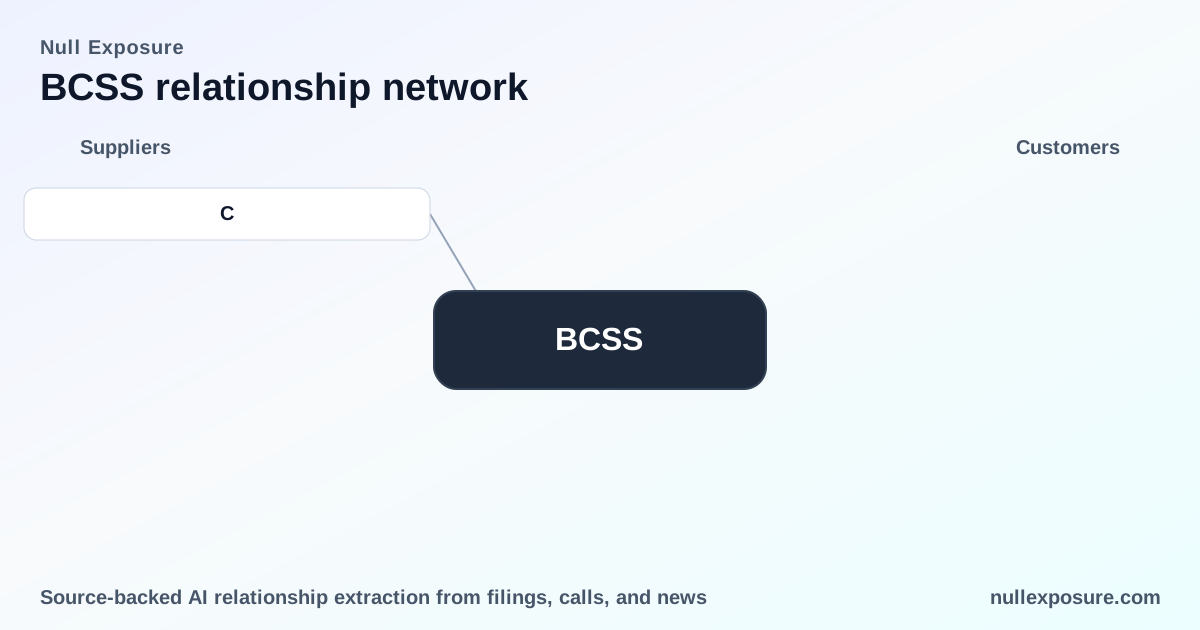
Publicly available relationship data shows a single documented supplier: a major global investment bank acted as the sole book-running manager for a recent offering. This relationship indicates BCSS uses established capital markets channels to bring transactions to market rather than distributing underwriting across numerous smaller banks. According to a StockTitan news item dated March 9, 2026, Citigroup Global Markets Inc. served as the sole book-running manager for the offering (StockTitan, March 9, 2026).
How that supplier choice translates into commercial reality
Choosing a single, large book-runner is an explicit contracting posture: the company prioritizes scale, distribution, and balance-sheet capacity over a dispersed syndicate model. That posture accelerates deal execution and market visibility but concentrates execution risk in a single counterparty. For an investment vehicle whose monetization depends on timely capital raises and clean distribution, the underwriting partner is operationally critical even if it is not a long-term strategic supplier.
Why investors should care about concentration and counterparty selection
- Execution velocity: A sole book-runner with significant distribution capability shortens the timeline from mandate to market, which benefits a firm focused on time-sensitive exits or roll-ups.
- Counterparty risk: Dependence on one underwriter concentrates reputational and operational risk; any dispute or capability gap at the bank could delay financing or increase execution cost.
- Cost of capital and pricing leverage: A dominant manager can improve price discovery and syndication terms in favorable markets, but will command underwriting economics that feed into transaction returns.
Company-level signals that shape the operating model
BCSS’s public profile shows sparse firm-level disclosures and zeroed financial line items in the overview provided. This creates a set of company-level signals that define the business model and operating constraints:
- Limited public financial visibility. Key financial metrics and fiscal reporting fields are empty or zero, which is a signal of either a privately-oriented balance sheet structure or a public vehicle that does not report substantive operating metrics in regularly published summaries.
- Capital markets dependency. The documented supplier role is one consistent with an entity that executes its strategy through periodic offerings and capital raises rather than recurring operating revenue.
- Concentration of critical functions. The available data highlights reliance on a small number of high-capability suppliers for transaction execution, elevating single-counterparty criticality.
- Relative maturity and governance posture. The absence of detailed operating metrics suggests the company is earlier in its capital deployment lifecycle or prefers limited public disclosure of operating detail, which places a premium on governance transparency in filings and manager commentary.
These company-level signals should be treated as structural attributes: they are features of how BCSS sources liquidity and realizes investor returns, and they affect diligence priorities when evaluating exposure.
Relationship-by-relationship: what investors need to know
Citigroup Global Markets Inc. — Citigroup acted as the sole book-running manager for BCSS’s offering, providing underwriting and distribution services that supported the company’s capital transaction. This single-manager relationship signals reliance on an institutional capital markets partner for execution and access to investor demand (StockTitan news report, March 9, 2026).
Operational constraints and monitoring checklist
Investors and operators should track a short list of concrete items because they directly affect execution risk and return realization:
- Counterparty concentration: Monitor whether future deals continue to use a single lead manager or expand to a broader syndicate; concentration amplifies both upside (speed) and downside (single-point failure).
- Disclosure cadence and depth: Demand more frequent and detailed reporting on portfolio deployments, realized exits, and capital raise mechanics given the lack of standard financial line items in public summaries.
- Underwriting economics: Capture and compare underwriting fees, overallotment behaviors, and placement discipline across offerings; underwriting cost directly reduces net investor returns.
- Governance and contingency planning: Ensure there are contractual fallback mechanisms (secondary managers, backstop facilities) documented in offering materials to mitigate the risk of a sole manager failing to perform.
Place these monitoring items into your investment memo and prioritize any evidence of broadened syndication or improved public financial disclosure.
Verdict: concentrated execution, scalable upside, measurable counterparty risk
BCSS’s public supplier footprint is small but strategically significant. A sole top-tier book-runner increases the speed and reach of market access, which is a positive for a firm whose business model depends on capital transactions. At the same time, that concentration is a discrete operational risk that investors must quantify and monitor through diligence on underwriting economics, fallback plans, and any changes in syndication strategy.
If you are evaluating exposure to BCSS or modeling scenarios for future capital raises, focus on counterparty diversification and disclosure improvements as primary risk mitigants. For actionable coverage and deeper supplier-mapping intelligence, visit https://nullexposure.com/.
Next steps for analysts and operators
- Request and review any offering documents, underwriting agreements, and placement statistics for the firm’s most recent transaction to confirm fee structures and indemnities.
- Track subsequent offerings to see whether BCSS broadens its syndicate or maintains single-manager execution as a formal strategy.
- Reassess model assumptions about cost of capital and execution timing in light of concentrated underwriting arrangements.
For ongoing monitoring and supplier intelligence on BCSS and comparable issuers, go to https://nullexposure.com/.