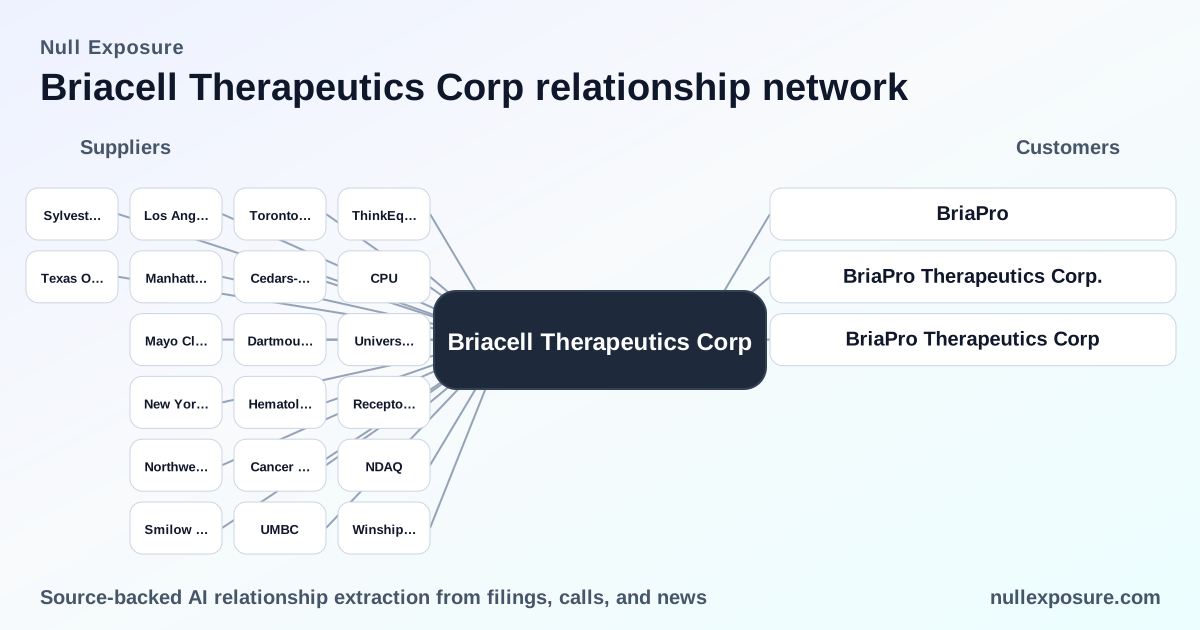
Briacell (BCTX) supplier map: who supplies what, who funds it, and what investors should watch
BriaCell Therapeutics Corp. is a clinical-stage immuno-oncology developer that monetizes through equity and licensing events while advancing proprietary cell- and small-molecule programs toward commercialization. The company outsources manufacturing and clinical operations, sells securities to raise cash when needed, and licenses technology where commercialization triggers royalty flows. For investors, the core value drivers are clinical progress and the company’s ability to fund trials via placement agents and capital markets activity; the core risks are supplier concentration in manufacturing and execution risk across a distributed clinical network. Learn more at https://nullexposure.com/.
How BriaCell runs the business and why supplier relationships matter
BriaCell does not operate its own manufacturing facilities and relies on third-party manufacturers and clinical partners to execute trials, which makes supplier contracts strategic rather than tactical. Public filings and press releases indicate a mixture of framework manufacturing agreements, placement/underwriting arrangements for capital raises, technology licenses that carry royalty obligations, and a broad set of academic and oncology centers serving as clinical sites. These relationships are mission-critical: manufacturing and CRO/clinical-site performance are gating factors for trial timelines and ultimately commercialization.
- Contracting posture: BriaCell uses master services/framework agreements for manufacturing and placement agreements for capital markets work, indicating multi-year, program-level commitments rather than single-use buys.
- Concentration and criticality: The company outsources manufacturing entirely and depends on clinical partners and placement agents for capital and trial execution—these are high-criticality suppliers with direct impact on regulatory timelines.
- Maturity and stage: Relationships range from early-stage research collaborations to active capital markets engagements and established transfer-agent arrangements, reflecting a company in active clinical development and capital formation.
Explore further supplier analysis at https://nullexposure.com/.
Supplier and partner map: what each relationship does for investors
ThinkEquity
ThinkEquity is acting as sole placement agent and book-running manager for BriaCell’s US $30 million offering and has executed underwriting agreements referenced in company disclosures. This places ThinkEquity at the center of BriaCell’s near-term capital strategy. (GlobeNewswire, January 14–15, 2026; company Form 8‑K filings referenced December 2024.)
Computershare Investor Services Inc.
Computershare is BriaCell’s transfer agent, responsible for issuing correspondence and managing the share exchange related to the company’s share consolidation. This is an operational, custodial relationship tied to corporate housekeeping and listing compliance. (GlobeNewswire, August 21, 2025.)
University of Maryland, Baltimore County (UMBC)
UMBC is the original licensor of the soluble CD80 technology and BriaCell (via BriaPro) completed an asset purchase/licensing arrangement; BriaPro is contractually obligated to remit a 2% royalty to UMBC upon commercialization. That creates a predictable, modest royalty burden on future product revenues. (GlobeNewswire and related releases, February 18, 2026; Intellectia.ai reporting, February 2026.)
Receptor.AI
Receptor.AI has a research collaboration with BriaPro (a BriaCell subsidiary) to design isoform-selective kinase inhibitors using its AI-driven discovery platform, supporting BriaCell’s small-molecule pipeline expansion. This is a discovery-stage relationship that potentially accelerates preclinical programs. (BriaCell press release on GlobeNewswire, November 20, 2025; InvestingNews coverage.)
Nasdaq
Nasdaq is cited in the context of a share consolidation instituted to maintain listing compliance on The Nasdaq Capital Market, a signal that BriaCell is actively managing float and market structure to meet exchange standards. (GlobeNewswire, August 21, 2025.)
Toronto Stock Exchange (TSX)
The TSX’s approval of the share consolidation is part of the same listing-compliance action affecting cross-listed shares and market access in Canada. This is corporate governance and market-access plumbing that investors should track for liquidity and cross-border listings. (GlobeNewswire, August 21, 2025.)
Winship Cancer Institute of Emory University
Winship joined BriaCell’s Phase 3 metastatic breast cancer trial network, strengthening the trial’s academic reach and patient accrual capabilities in the Southeast U.S. (StockTitan press coverage summarizing company announcements, FY2025.)
Cedars-Sinai Medical Center
Cedars‑Sinai is listed among key clinical sites added to BriaCell’s Phase 3 network, adding West Coast institutional weight and recruitment capability. (StockTitan coverage of BriaCell announcements, FY2025.)
Dartmouth Cancer Center
Dartmouth is another academic clinical site in the Phase 3 network, providing regional access in New England and additional investigator support. (StockTitan, FY2025.)
Hematology Oncology Associates of Fredericksburg
This practice is part of the expanded clinical network and contributes community-oncology recruitment capacity for BriaCell’s trials. (StockTitan, FY2025.)
Cancer Care Northwest
Cancer Care Northwest is included in the national network, broadening geographic reach in the Pacific Northwest for patient enrollment. (StockTitan, FY2025.)
Los Angeles Cancer Network
The Los Angeles Cancer Network’s participation improves urban recruitment depth for the Phase 3 program in Southern California. (StockTitan, FY2025.)
Manhattan Hematology/Oncology Associates
This New York-based practice adds community and regional investigator coverage to the trial footprint in the New York metro area. (StockTitan, FY2025.)
Mayo Clinic
The Mayo Clinic’s inclusion signals access to a high-volume tertiary referral center with robust clinical research infrastructure. (StockTitan, FY2025.)
New York Cancer and Bood Specialists
This clinic is listed among participating sites, adding to metropolitan New York recruitment and specialist support. (StockTitan, FY2025.)
Northwestern University
Northwestern brings academic trial infrastructure and investigator expertise to BriaCell’s trial network in the Midwest. (StockTitan, FY2025.)
Smilow Cancer Hospital at Yale New Haven
Smilow represents another Ivy-league academic center contributing investigator access and potential referral throughput in Connecticut. (StockTitan, FY2025.)
Sylvester Comprehensive Cancer Center
Sylvester’s participation augments enrollment and academic validation in Florida’s oncology community. (StockTitan, FY2025.)
Texas Oncology–Baylor Charles A. Sammons Cancer Center
Inclusion of Texas Oncology–Baylor enhances trial reach in the Texas oncology market and improves recruitment diversity. (StockTitan, FY2025.)
What the supplier landscape implies for investors
- Manufacturing is outsourced under framework agreements: company disclosures reference a master services agreement for GMP manufacturing (evidence of a program-level manufacturer relationship), which makes that supplier a single point of failure for clinical supply chains unless multiple CMOs are contracted. (Company disclosures; master services agreement language cited in constraints.)
- Capital markets execution is centralized with ThinkEquity serving as placement agent/book-runner and underwriter for recent offerings, meaning near-term funding is linked to that relationship and the success of marketed offerings. (Press releases and Form 8‑K exhibits, FY2025–FY2026.)
- Clinical execution risk is mitigated by a broad network of academic and community sites, which lowers single-site enrollment risk but raises coordination complexity and trial management costs.
- Royalty obligations to UMBC (2% post-commercialization) are a small but explicit drag on downstream revenues and should be modeled into long-term commercialization economics. (Press release and royalty reporting, February 2026.)
For a deeper supplier intelligence briefing and tailored counterparty risk scoring, visit https://nullexposure.com/.
Bottom line and next steps
BriaCell’s supplier ecosystem is typical for a capital-intensive clinical-stage biotech: outsourced manufacturing, an active placement-agent relationship for financing, a distributed clinical-site network, and a university license with a low-single-digit royalty. The primary investor levers are clinical readouts and capital raises; the primary operational risks are CMO performance and trial execution across many sites. Monitor ThinkEquity capital activity, CMO contract milestones, and any updates to UMBC royalty terms for immediate changes in cash runway or revenue economics.
If you evaluate counterparties or need a custom supplier risk memo on BCTX, start here: https://nullexposure.com/.