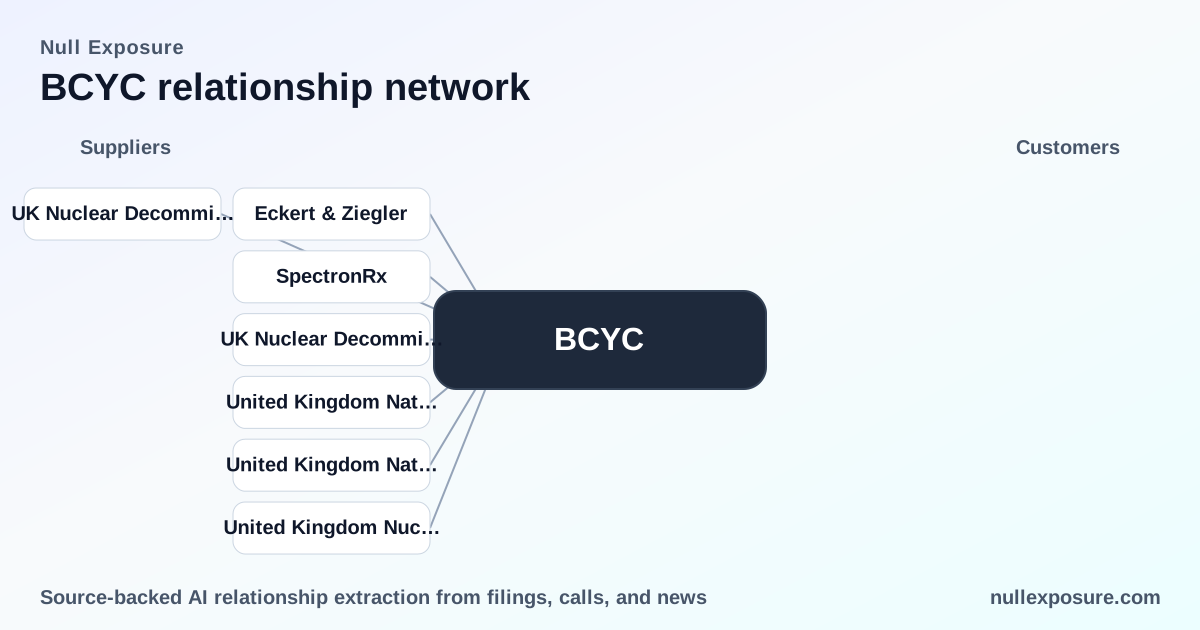
Bicycle Therapeutics (BCYC): strategic supplier relationships that reshape radiopharmaceutical execution
Bicycle Therapeutics operates as a clinical-stage biopharmaceutical company that commercializes its proprietary bicyclic peptide platform by developing targeted radiopharmaceuticals and partnering for specialized isotope supply and manufacturing. The company monetizes through R&D progress toward proprietary therapeutics, licensing/collaboration value capture and, ultimately, product sales once clinical and regulatory milestones are converted into commercial supply chains. For investors and operators, the critical signal is that Bicycle is explicitly building an end-to-end external supply chain for novel radioisotopes rather than internalizing production. Learn more at https://nullexposure.com/.
The concise operating thesis investors need
Bicycle outsources core production and isotope sourcing while retaining program ownership and clinical development leadership. That operating posture keeps capital intensity low but creates counterparty and supply concentration risk—a tradeoff that accelerates time-to-clinic if partners perform, and magnifies program vulnerability if a single supplier fails. Bicycle’s commercial path therefore depends as much on supplier execution as on biological readouts.
How Bicycle’s supplier strategy maps to business risk and value
Bicycle’s announcements show a deliberate strategy: secure long-tenor raw material access, couple it with nuclear science partners to extract and convert isotopes, and then lock a bespoke generator design to feed clinical manufacturing. This is a leveraged outsourcing model with four practical implications:
- Contracting posture: Bicycle pursues multi-year, exclusive or bespoke agreements (a 15‑year RepU contract is central) that prioritize continuity over vertical integration. That reduces capex but increases dependency on contracting terms and counterparty health.
- Concentration and criticality: A small set of specialized suppliers will be critical to program timelines for 212Pb and other radionuclides; a single supplier disruption would materially affect development and potential launch.
- Maturity and operational readiness: Bicycle does not own manufacturing scale; it relies on partners and CROs for GMP production and trial support, meaning near-term progress depends on established external capabilities rather than internal scale-up.
- Geography and forex exposure: Bicycle sources services across NA, EMEA and APAC and bills in US dollars, creating a multi-jurisdictional supply footprint that requires geopolitical and regulatory coordination.
For governance and sourcing diligence, these are actionable signals: verify contract security, supply redundancy, and regulatory readiness of partner facilities. If you want a structured view of supplier exposures and to track counterparties, visit https://nullexposure.com/.
Partnership roll call — every supplier relationship disclosed
Below are the supplier relationships disclosed in Bicycle’s public notices. Each item is a plain-English summary followed by the public source.
Eckert & Ziegler (FY2025)
Bicycle has a letter of intent and follow-on agreement with Eckert & Ziegler to supply a range of radioisotopes and to collaborate on development and manufacture of radiopharmaceutical candidates. This establishes Eckert & Ziegler as a principal isotope supplier and manufacturing partner in Bicycle’s planned radiopharmaceutical supply chain. Source: Biospace press release announcing strategic partnerships (Mar 9, 2026; FY2025).
SpectronRx (FY2025)
SpectronRx will develop and deliver a bespoke 212Pb generator for Bicycle, with 228Th processed into 224Ra then loaded into the generator as part of the supply chain. This positions SpectronRx as a technology partner providing a proprietary generator that converts upstream isotopes into clinic-ready 212Pb. Source: Biospace press release describing the generator development (Mar 9, 2026; FY2025).
UK Nuclear Decommissioning Authority (NDA) (FY2025)
Bicycle entered a 15‑year contract with the UK NDA to access up to 400 tonnes of reprocessed uranium (RepU), providing a long-term raw material stream for isotope extraction. The long tenor of this contract signals a strategic commitment to secure feedstock at scale over decades. Source: Biospace press release announcing the 15‑year RepU agreement (Mar 9, 2026; FY2025).
United Kingdom National Nuclear Laboratory (UKNNL) (FY2025)
Bicycle will collaborate with UKNNL to extract 228Th from RepU supplied under the NDA arrangement, creating the upstream extraction capability required for downstream generator production. This positions UKNNL as Bicycle’s extraction partner for thorium-228 processing. Source: Biospace press release describing the extraction collaboration (Mar 9, 2026; FY2025).
SpectronRx (FY2026)
Bicycle reiterated that its recent collaboration with SpectronRx contributes to an end-to-end supply chain for 212Pb, complementing established chains for 177Lu and 68Ga. SpectronRx is therefore part of Bicycle’s multi-isotope sourcing strategy across program years. Source: Bicycle Therapeutics corporate update/press release highlighting 2025 accomplishments and priorities (Mar 9, 2026; FY2026).
United Kingdom National Nuclear Laboratory (FY2026)
Bicycle’s FY2026 communications again identify UKNNL as a collaborator that helps create an end-to-end 212Pb supply chain, reinforcing the laboratory’s ongoing role in isotope extraction and development. This is consistent with Bicycle’s multi-year supply-chain buildout. Source: Bicycle Therapeutics corporate update/press release (Mar 9, 2026; FY2026).
United Kingdom Nuclear Decommissioning Authority (FY2026)
Bicycle’s FY2026 materials reaffirm the NDA agreement as a foundational feedstock arrangement enabling the 212Pb supply chain and complementing existing 177Lu and 68Ga relationships. The NDA contract remains a central structural element of Bicycle’s supply strategy. Source: Bicycle Therapeutics corporate update/press release (Mar 9, 2026; FY2026).
UK Nuclear Decommissioning Authority (Marketbeat/Instant alert, FY2025)
Broker and news alerts referenced Bicycle’s 15‑year uranium contract with the UK NDA in December 2025, underscoring investor attention to the long-term supply commitment as a material commercial development. This syndicated coverage amplified market visibility for Bicycle’s supply-chain commitments. Source: MarketBeat instant alert referencing December 16, 2025 coverage (published Oct 12, 2025 alert; FY2025).
What investors should watch next
Bicycle’s supplier approach de-risks capital needs while transferring execution risk to specialized partners. Key monitoring items for investors and operators:
- Contract durability and exclusivity: confirm renewal options, termination rights and force majeure protections in long-term agreements (the 15‑year NDA contract is a central legal construct).
- Redundancy and dual-sourcing: verify whether backup suppliers exist for critical isotopes and generator components.
- Regulatory and supply qualification timelines: partner facility GMP status and regulatory approvals will directly affect enrollment and commercialization windows.
- Geographic risk management: with sourcing across NA, EMEA and APAC and billing in USD, cross-border logistics and regulatory alignment are potential schedule drivers.
If you are tracking counterparty health or want to model supplier concentration into valuation or operational scenarios, explore tools and reports at https://nullexposure.com/.
Bottom line
Bicycle Therapeutics has transitioned from platform R&D to an explicit outsourced supply-chain strategy targeted at radiopharmaceutical commercialization. The company’s value realization now hinges on partner execution—notably the NDA feedstock agreement, UKNNL extraction capability, Eckert & Ziegler’s isotope manufacturing role, and SpectronRx’s bespoke generator technology. For investors, that creates both a path to lower capital intensity and a clear contingent risk bucket tied to supplier performance and regulatory qualification. For operators, contract terms, backup sourcing and regulatory readiness are the levers that will determine whether clinical progress converts into commercial value.
For a deeper supplier-risk breakdown and to track supplier relationships over time, visit https://nullexposure.com/.