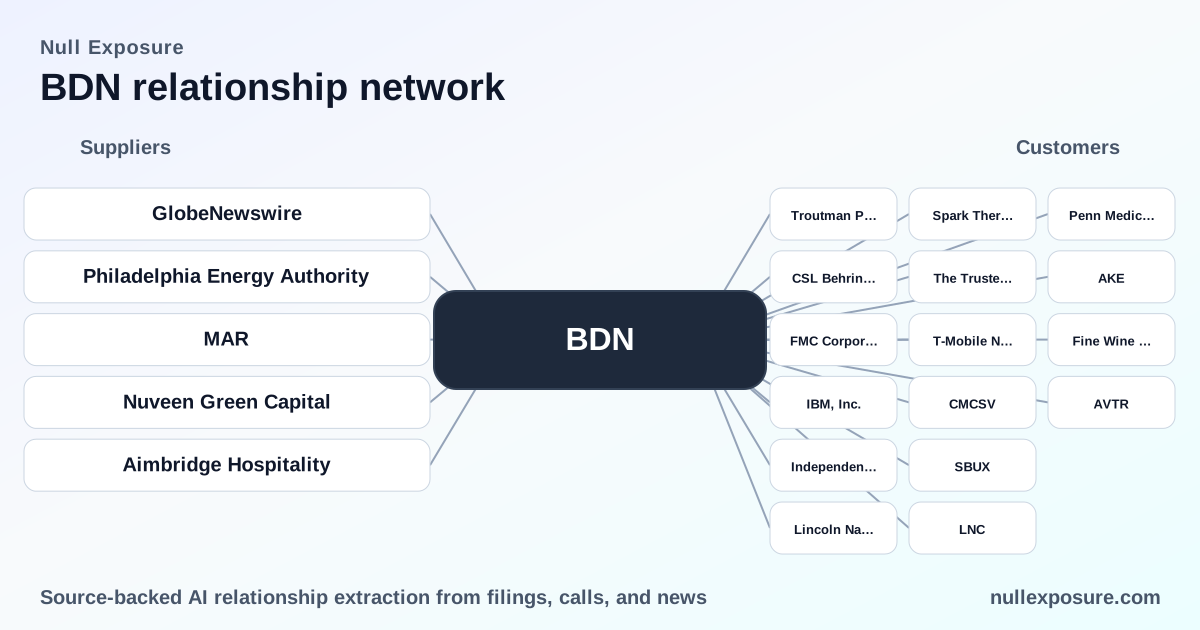
Brandywine Realty Trust (BDN) — supplier relationships and operational signals for investors
Brandywine Realty Trust operates as a real-estate owner-operator that monetizes stabilized office and hospitality assets through long-term leasing, fee and management relationships, and opportunistic financing to fund redevelopment and sustainability upgrades. The supplier relationships captured in public reporting in FY2025–FY2026 show how BDN sources project finance, hotel operating capability, and distribution partners to convert assets into recurring cash flow. For a consolidated view of counterparty risk and supplier exposure, see https://nullexposure.com/.
How BDN turns buildings into revenues
BDN’s core model is straightforward: acquire or redevelop assets, secure long-term leases or franchise agreements, and layer financing to improve yields. The company acts as lessee on long-term ground leases and increasingly leverages third-party sustainable financing to fund upgrades that preserve tenant demand and asset value. These commercial linkages — lenders, franchise platforms, and third‑party operators — are not peripheral: they are structural to how BDN projects are executed and monetized.
Explore more supplier mappings and counterparty insights at https://nullexposure.com/.
Direct relationship snapshots you should track
Below I cover every supplier relationship captured in the available results. Each entry is concise, investor‑oriented, and sourced to the underlying reporting.
GlobeNewswire — dividend distribution and corporate communications (FY2025)
GlobeNewswire distributed a press release announcing a quarterly cash dividend of $0.08 per share for Brandywine, with a disclaimer indicating the release used an AI-assisted summary. This confirms BDN’s shareholder distribution policy activity reported in FY2025. (Source: GlobeNewswire summary distributed via QuiverQuant, FY2025.)
Nuveen Green Capital — C-PACE financier on a major Philadelphia transaction (FY2026)
Nuveen Green Capital provided an $87.3 million C-PACE financing for 3151 Market Street, representing what the parties described as the largest C-PACE transaction in Pennsylvania history; the financing supports sustainability-oriented construction components and lowers borrowing cost relative to conventional debt. (Source: StockTitan and Philadelphia.today coverage of the Jan 27, 2026 closing, FY2026.)
Philadelphia Energy Authority — loan administrator for the C-PACE facility (FY2026)
The Philadelphia Energy Authority administered the $87.3 million C-PACE financing and included a $30 million allocation for future tenant improvements, indicating public‑sector participation in structuring and underwriting the financing program for BDN’s project. (Source: StockTitan and Philadelphia.today reporting, FY2026.)
Marriott International — brand/franchise affiliation for The Brandywine hotel (FY2026)
Marriott International added The Brandywine to its Tribute Portfolio, enabling the hotel to participate in Marriott Bonvoy loyalty and distribution, which directly supports room-rate resilience and national booking channels. (Source: HospitalityNet announcement, FY2026.)
Aimbridge Hospitality — third‑party hotel operator for the Tribute Portfolio property (FY2026)
Aimbridge Hospitality will operate the 121‑room Tribute Portfolio hotel on BDN’s property, delivering day‑to‑day hotel operations and food & beverage concepts that drive local revenue capture and operating margins. (Source: HospitalityNet property announcement, FY2026.)
What these supplier ties imply about BDN’s operating posture and risk profile
The relationships above are not just PR items; they reveal how BDN structures projects, where execution risk sits, and how revenues are stabilized.
-
Contracting posture — long-term and project-centric. BDN is the lessee under long-term ground leases and uses multi-year operator/franchise agreements for hospitality assets, indicating a contracting posture oriented toward long-dated, stable commitments rather than short-term flex. The company-level constraint flagged in filings — long-term ground leases classified as operating leases — is consistent with this approach. (Company-level signal from constraints, FY2026.)
-
Financing strategy — third‑party sustainability financing is front-and-center. The large C-PACE facility supplied by Nuveen Green Capital and administered by the Philadelphia Energy Authority shows BDN actively sources specialized financing to fund capitally intensive, sustainable upgrades that are structured to be repaid through property cash flows. This reduces near-term balance-sheet cash outlay while aligning capital with energy/efficiency objectives. (StockTitan and Philadelphia.today, FY2026.)
-
Counterparty concentration — diversified by function, not by single provider. The supplier set spans financing (Nuveen), public program administration (Philadelphia Energy Authority), brand/distribution (Marriott), and operations (Aimbridge). This functional diversification reduces single‑supplier concentration risk but concentrates critical dependencies: if a hospitality operator or franchisor relationship changes, it can directly affect revenue streams tied to that asset.
-
Criticality and maturity — relationships are critical to asset-level cash flow and are contractually mature. Franchise and operator arrangements and long-term leases are central to on‑going revenue generation; similarly, the C-PACE facility is critical for funding planned upgrades and tenant allowances. These are mature project-level arrangements rather than experimental partnerships, implying predictable cash flow impact if they perform.
-
Execution risk resides in project delivery, not distribution. With Marriott providing national distribution and Aimbridge managing operations, execution risk clusters around construction/upgrade schedules, tenant fit-outs funded by the PEA allocation, and C-PACE lien servicing. Investors should monitor project completion milestones and covenant mechanics in corresponding financing documents. (Sources: HospitalityNet; StockTitan; Philadelphia.today, FY2026.)
Key takeaways for investors
- BDN relies on long-term contractual structures — both as lessee and in operator/franchise relationships — which supports revenue stability but locks the company into multi-year commitments.
- Specialized sustainable finance (C-PACE) is a visible lever for capitalizing green upgrades without immediate balance-sheet strain, increasing asset competitiveness and potential NOI uplift.
- Operational dependency splits between franchise (Marriott) and operator (Aimbridge); these relationships collectively underpin hotel revenue and distribution and therefore deserve active monitoring.
See a broader map of Brandywine’s counterparties and supplier risk at https://nullexposure.com/ for actionable counterparty intelligence.
Final assessment and calls to action
BDN’s disclosed supplier relationships show a strategic approach: use third-party sustainable finance to de-risk capital investment while outsourcing distribution and operations to established hospitality partners, anchored by long-term lease commitments. For investors, the balance of long-term contractual stability against project execution risk is favorable if C-PACE and tenant‑fit allocations are managed to schedule.
For a deeper dive into counterparties and to build a supplier risk checklist for BDN, visit https://nullexposure.com/. If you need a tailored counterparty report or monitoring feed for BDN’s evolving supplier set, the portal provides direct tools and updates to help integrate these signals into investment models.