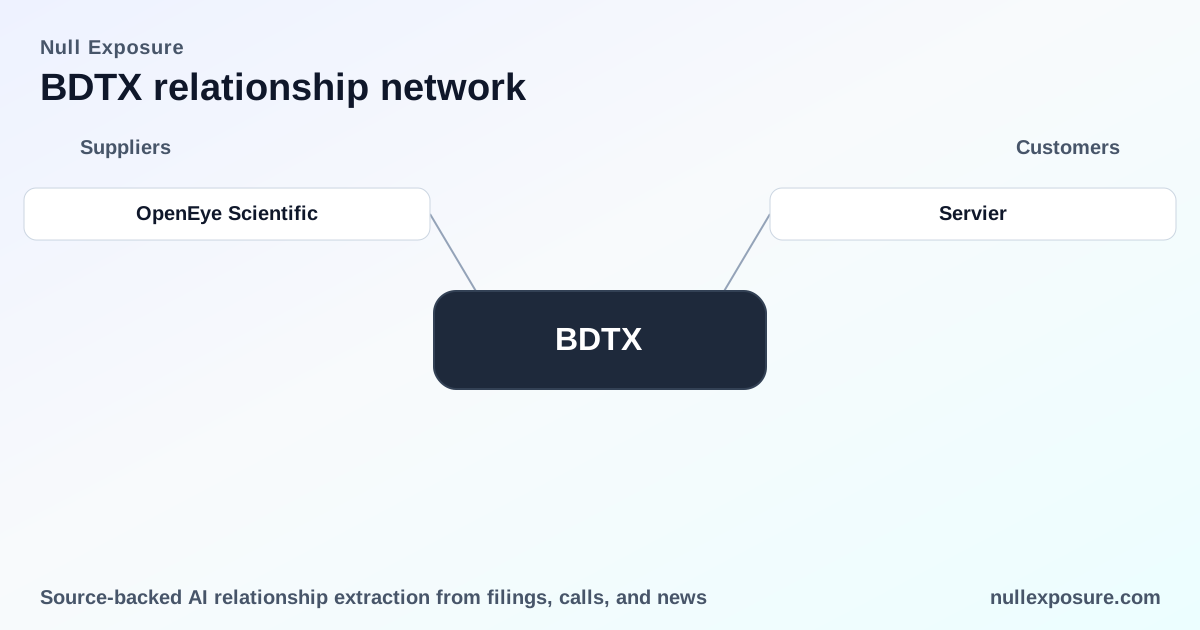
Black Diamond Therapeutics (BDTX) — supplier profile and operational implications for investors
Black Diamond Therapeutics discovers and develops small-molecule, tumor-agnostic therapies and monetizes through a classic biotech progression: partnering and licensing in early discovery, milestone and collaboration revenue during clinical development, and eventual product sales following regulatory approval. The company outsources core discovery compute, preclinical studies, clinical execution, and manufacturing to third parties, delivering operating leverage but concentrating operational risk in a small set of external partners and locations. For investors and operators, the supplier map is a read on execution risk, time-to-market velocity, and cost control. For a full supplier risk profile and ongoing monitoring, visit https://nullexposure.com/.
Quick take: what the supplier relationships tell you about execution capacity
Black Diamond runs a lean, asset-light operating model. Key functions — discovery simulation, preclinical work, clinical trials, and manufacturing — are performed by external providers (SaaS vendors, CROs, CMOs). That structure lowers fixed capital needs and scales development spend with program milestones, but creates critical single points of failure where a third party’s capacity, quality, or geography exposure can directly affect pipeline timelines and costs.
The named supplier: OpenEye Scientific — what the relationship is and why it matters
OpenEye Scientific provides a cloud-enabled molecular simulation platform called Orion that supports protein motion simulation and collaborative analysis. According to a company announcement, Black Diamond partnered with OpenEye to expand its MAP discovery platform, using Orion’s high-performance compute and browser-based tools to accelerate structure-based design and simulation workflows (PR Newswire, March 2026). This relationship is a discovery and computational services collaboration that improves Black Diamond’s in-house R&D throughput without requiring large on-premise compute investments. Source: PR Newswire release announcing the collaboration (https://www.prnewswire.com/news-releases/black-diamond-therapeutics-and-openeye-scientific-announce-collaboration-to-expand-map-drug-discovery-platform-301380841.html).
All relationships in the public record — concise summaries
- OpenEye Scientific — Black Diamond uses OpenEye’s Orion SaaS to perform rapid simulations and collaborative analysis that expand its MAP discovery capabilities; the collaboration was publicly announced via PR Newswire in early 2026 (PR Newswire, 2026).
How the supplier structure shapes Black Diamond’s business model and contracting posture
Black Diamond’s filings and public disclosures describe a contracting posture that blends long-term real estate leases with modular, framework services for R&D and trials:
- The company operates long-term leases for its headquarters (Cambridge, MA) and a New York lab, with expirations in 2028 and 2032 respectively and extension options, which signals fixed occupancy cost commitments and a multi-year physical footprint (company filings referencing leases entered in 2020).
- For clinical execution, Black Diamond uses master services agreements (MSAs) with CROs for specific programs such as BDTX‑1535, reflecting a framework approach that allows rapid tasking and scaling of clinical activity under pre-negotiated terms (company disclosure on MSAs for BDTX‑1535).
- Discovery compute and scientific tooling are procured as cloud/SaaS services (for example, the OpenEye Orion engagement), which outsources capital investment in compute and accelerates iteration cycles.
These contracting choices produce three operational characteristics: flexible development capacity (through MSAs and SaaS), fixed occupancy overhead (long-term leases), and concentrated manufacturing/service reliance (CMOs/CROs for production and trials).
Geography and concentration signals that affect supply continuity
Black Diamond discloses exposure across regions: it engages partners both inside and outside the U.S., and specifically calls out China and APAC exposure for some raw materials and services, which creates geopolitical and operational risk for certain inputs. The company’s research, clinical, and manufacturing contracts are global in scope while its physical operations are anchored in North America (Cambridge, MA and New York, NY). Source: company filings on R&D contracts and supply chain geographic exposure.
Materiality and criticality — why suppliers are not just convenience vendors
Black Diamond’s own disclosures classify third-party testing, CROs, and CMOs as material to its ability to obtain regulatory approval and commercialize product candidates. The company does not own manufacturing capacity and expects future reliance on third-party manufacturers for clinical and commercial supply, making those supplier relationships critical to execution and profitability. Source: company filings describing reliance on third parties for preclinical, clinical, and manufacturing services.
For a detailed supplier risk breakdown and to map concentration across vendors, see https://nullexposure.com/.
Operational risk checklist for investors and procurement teams
- Single points of failure: reliance on a limited number of CMOs/CROs for scale and regulatory-compliant manufacturing. A failure at a CMO can delay regulatory filings and commercialization.
- Geopolitical exposure: components and services sourced from China/Asia introduce supply chain disruption risk and regulatory complexity.
- Contracting maturity: the use of MSAs for trials is a sign of procurement maturity and reduces friction for trial execution; long-term leases increase fixed cost leverage.
- Discovery throughput: partnerships with SaaS vendors like OpenEye reduce capital intensity and accelerate discovery cycles, improving optionality across the pipeline.
What investors and operators should monitor next
- CRO/CMO counterparties and concentration: identify top manufacturing and clinical vendors, and track audit/inspection outcomes and capacity constraints.
- Supply chain origin for critical reagents and intermediates: maps of APAC sourcing and dual-sourcing plans determine resilience.
- Clinical timelines under MSAs: monitor milestone flow and contract amendments that affect cost and schedule.
- Commercial readiness: given the company’s lack of internal manufacturing, watch for strategic manufacturing partnerships or in‑licensing that secure launch supply.
Explore supplier-level intelligence and monitoring solutions at https://nullexposure.com/ to convert these signals into actionable oversight.
Bottom line — decision points for investors and operators
Black Diamond’s operating model is capital-efficient and speed-focused, leveraging external compute, CROs, and CMOs to move programs forward without large fixed investment in facilities. That model delivers scalability and lower burn if third-party partners perform, but it concentrates execution risk in external providers and in geographic supply chains. For investors, the key valuation lever is not only clinical success but the stability and quality of third-party relationships that enable timely development and cost control.
For ongoing supplier tracking and an actionable risk view tailored to institutional investors and operators, visit https://nullexposure.com/.