BDX (Becton, Dickinson): Supplier relationships and financing counterparties investors should price into the risk model
Becton, Dickinson and Company (BD) is a global medical-technology manufacturer that monetizes through product sales of devices, instrument systems and reagents, supplemented by consulting and analytics services in select geographies. The company runs capital-intensive manufacturing and procurement operations while also using capital markets and third-party finance mechanisms to manage working capital. For investors evaluating supplier exposure, the relevant signal set is not just who BD names on a press release but how BD structures short-term supplier finance, sources dealer managers for liability management, and engages service providers for cyber and audit functions. For a practical view of counterparties and operational constraints, read on — and if you want continuous supplier-mapping for portfolio due diligence visit https://nullexposure.com/.
Recent corporate action: why dealer managers and agents matter now
BD announced tender offers in March 2026 and disclosed a compact set of dealers, co-dealers and agents that executed the offer. That roster signals a structured approach to managing debt and liquidity via traditional capital-markets intermediaries rather than bespoke bilateral financing with suppliers.
Who was named in the tender-offer announcement
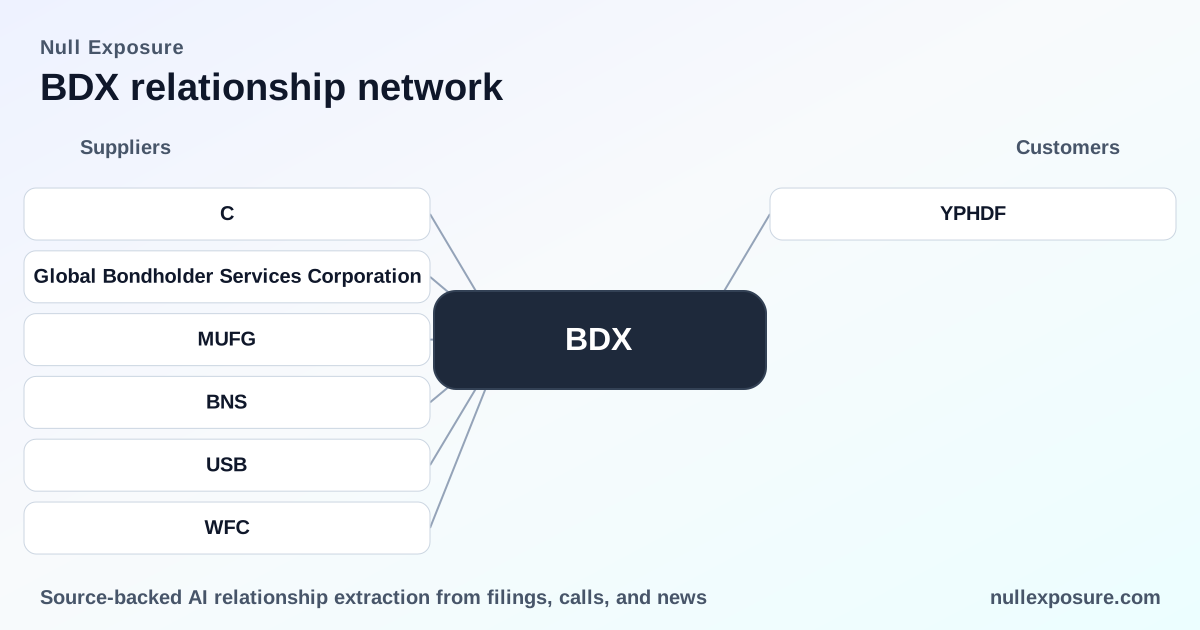
- Citigroup Global Markets Inc. — Citigroup served as a lead dealer manager for the tender offers announced by BD in March 2026, indicating BD's use of major global banks for debt tender execution and distribution. According to BD’s press release (investors.bd.com, March 9, 2026), Citigroup was one of two lead dealer managers for the offers.
- Wells Fargo Securities, LLC — Wells Fargo partnered as a lead dealer manager alongside Citigroup, reflecting BD’s reliance on large U.S. investment banking channels for liability management. This is described in BD’s March 9, 2026 investor release.
- Scotia Capital (USA) Inc. — Scotia Capital was listed as a co-dealer manager for the tender offers, supporting cross-border distribution capabilities for BD’s debt work. The role is recorded in BD’s March 9, 2026 press release.
- MUFG Securities Americas Inc. — MUFG Securities acted as a co-dealer manager, providing additional institutional coverage and syndication capacity for the tender offer process. This was disclosed in the March 9, 2026 investor announcement.
- U.S. Bancorp Investments, Inc. — U.S. Bancorp Investments was named as a co-dealer manager, underscoring a mix of global and regional banks in the syndicate executing the tender. BD’s press release dated March 9, 2026 lists U.S. Bancorp in that role.
- Global Bondholder Services Corporation — Global Bondholder Services served as the tender and information agent, the administrative counterparty responsible for communications and processing related to the offers. BD’s March 9, 2026 investor release identifies Global Bondholder Services as the agent and provides contact details.
These relationships are all drawn from BD’s investor communication on March 9, 2026 and reflect the counterparties used for that discrete financing event.
What the counterparties reveal about BD’s contracting posture
BD’s public disclosures show the company uses third-party supplier finance programs and conventional capital markets intermediaries rather than direct balance-sheet financing of supplier receivables. The company states participating suppliers can get early payment at a nominal discount through programs arranged with financial institutions, while BD itself is not a party to those arrangements and maintains payment terms that generally range from 90 to 150 days. This design establishes a short-term contracting posture: BD preserves its cash-conversion profile while enabling supplier liquidity through intermediaries.
From a maturity and activity perspective, BD reports an active supplier finance program with a rollforward showing a balance of $234 million at September 30, 2025 (versus $112 million the prior year), indicating meaningful usage but not a structural shift in liabilities. Those figures are taken directly from BD’s disclosures around supplier finance as of FY2025/2026.
Operational constraints that shape supplier risk
Several company-level constraints are material to supplier and operator assessment:
- Contract type — short-term: BD’s supplier finance program is structured as an early-pay mechanism executed by third-party banks; BD is not a party to the facility and payment terms remain standard (90–150 days). This signals transactional, short-tenor exposure rather than long-term supplier financing arrangements.
- Relationship role — buyer and service consumer: BD is a large buyer of raw materials and components (plastics, glass, metals, textiles and petrochemical-derived resins) and also a purchaser of professional services (cybersecurity advisors, consultants, auditors). These are company-level partner roles that drive procurement concentration and vendor mix.
- Materiality — commodity hedges immaterial historically: BD discloses that commodity derivative contracts (used for resin price risk) were immaterial to consolidated financials at September 30, 2025 and 2024, so commodity-hedge counterparty exposure has not historically been a major earnings lever.
- Relationship stage — active: The supplier finance program is active, with the balance rollforward and significant additions and settlements during FY2025, indicating an operationalized program rather than a pilot.
These constraints are stated at the company level in BD’s disclosures and provide the operating backdrop investors should layer on top of the tender-offer counterparty list.
Risk implications for operators and investors
- Counterparty concentration is moderate: For the specific tender offer BD used a small, conventional syndicate of global and regional banks plus an established information agent — typical for public corporates and not a signal of unconventional financing partners.
- Operational criticality lies in procurement breadth: BD’s dependency on a broad set of raw materials and third-party services creates a dispersed vendor base; supplier finance programs reduce near-term liquidity stress for suppliers but do not transfer credit risk off BD’s ledger.
- Maturity and liquidity management are active but contained: The $234 million supplier-finance balance and BD’s stated payment terms point to active working-capital management without altering long-term creditor structure.
If you need a continuous feed of supplier and counterparty signals to monitor these dynamics in portfolios, consider tracking the consolidated view at https://nullexposure.com/.
Bottom line and investor action points
BD’s March 2026 tender-offer disclosure confirms the company uses mainstream capital markets intermediaries for liability management and a third-party administered supplier finance program to smooth supplier liquidity. For investors, the practical conclusion is operational flexibility with limited counterparty exoticism: BD relies on major banks and agents, maintains conventional payment terms, and has historically treated commodity derivatives as immaterial to consolidated results.
- Key takeaway: BD is a buyer with active short-term supplier-finance programs and a conventional dealer roster for capital markets work.
- Risk focus: monitor aggregate supplier-finance balances and any shift from third-party-administered programs to on-balance-sheet financing.
For deeper supplier mapping and alerts on these counterparties, visit https://nullexposure.com/. For portfolio-level integration and continuous monitoring, start with the home page at https://nullexposure.com/.