BEAGR: Supplier relationships and what they tell investors about operational risk
Bold Eagle Acquisition Corp. Right (BEAGR) is a SPAC security tied to Bold Eagle Acquisition Corp., which monetizes by sponsoring a public listing vehicle and executing a business combination that transfers private-company equity into the public market. The company funds operations through sponsor support, underwriter arrangements, and nominal administrative service payments to sponsor-affiliates, while listing and registry relationships enable separate trading of Class A shares and right units. For investors evaluating supplier exposure, the picture is one of concentrated, short-term service relationships anchored to sponsor affiliates and capital markets counterparties. Learn more at https://nullexposure.com/.
How Bold Eagle actually runs and gets paid
Bold Eagle’s commercial model is simple and capital-market driven: raise cash via an IPO, hold funds in trust pending a merger, and rely on sponsor and underwriter relationships to cover formation and transaction costs until a business combination closes. Revenue from ongoing operations is effectively zero until a merger consummates; the entity’s value for holders is therefore a function of deal execution and the concentration and durability of its supplier arrangements.
- Operational payments are immaterial today (monthly admin fees of $15,000 to a sponsor-affiliate and $30,000 recorded in late 2024).
- Capital-market counterparty exposure is material at the IPO level (underwriter fees include a deferred component that aggregates into the low millions).
- Sponsor support is central: promissory note capacity and potential working-capital loans give the sponsor control over near-term liquidity.
If you want a consolidated supplier-risk briefing and monitoring, visit https://nullexposure.com/ for additional signals and historical filings.
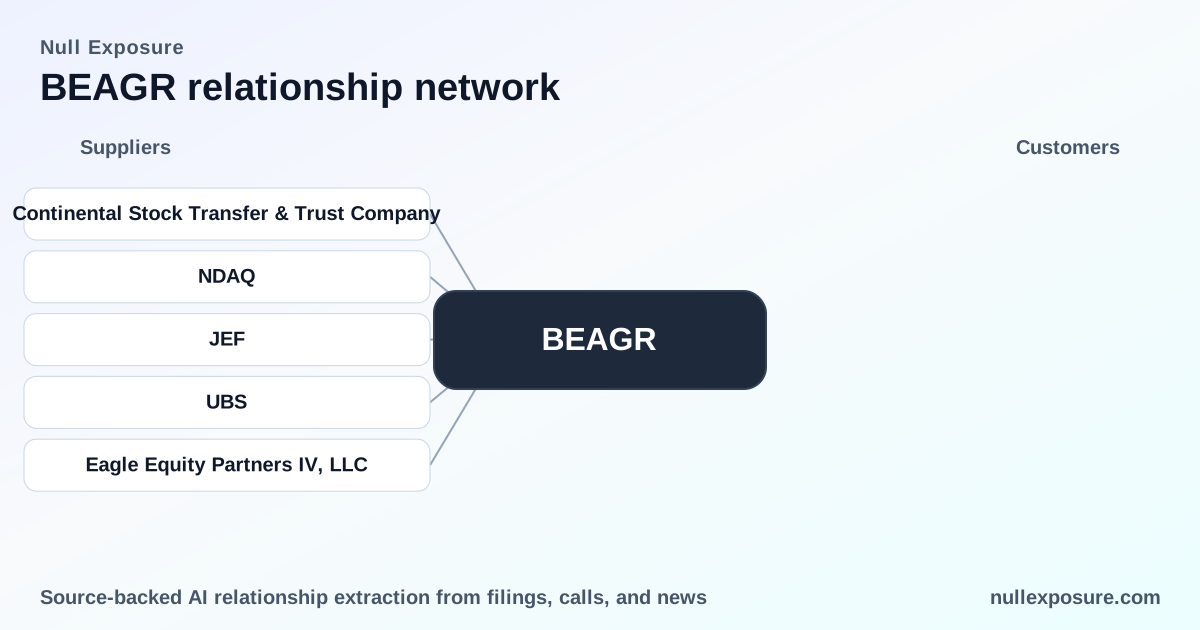
The supplier map — who BEAGR contracts with and what they do
Continental Stock Transfer & Trust Company
Continental acts as a transfer agent to facilitate the mechanics of separating units into Class A ordinary shares and Eagle Share Rights; brokers must coordinate with Continental to complete unit separations. This is a standard nomination for SPAC transactional operations and was disclosed in a GlobeNewswire release republished by The Manila Times on December 13, 2024.
Nasdaq / Nasdaq Global Market
Nasdaq provides listing and trading infrastructure: following the unit separation, Class A ordinary shares and Eagle Share Rights are listed to trade under the tickers BEAG and BEAGR while unsplit units continue under BEAGU. The listing and trading arrangement was confirmed in Nasdaq-focused disclosures in October and December 2024 (GlobeNewswire via The Manila Times, October 24–26, 2024; December 13, 2024).
Jefferies
Jefferies is one of the two lead underwriter representatives for the SPAC offering alongside UBS, responsible for distribution and underwriting stewardship. GlobeNewswire press coverage republished by The Manila Times on October 24–26, 2024 cites Jefferies in the underwriter role.
UBS Investment Bank
UBS Investment Bank served as the co-representative of the underwriters on the $250 million IPO, sharing distribution and underwriting responsibilities and exposure to the deferred fee structure referenced in company filings (GlobeNewswire via The Manila Times, October 24–26, 2024).
Eagle Equity Partners IV, LLC
Eagle Equity Partners IV, LLC is the sponsor and managing member entity connected to Bold Eagle’s management team; the sponsor provides office space and administrative services under an Administrative Services and Indemnification Agreement and is named directly in the registration materials. The sponsor relationship and management identities (Harry Sloan, Jeff Sagansky, Eli Baker) are disclosed in GlobeNewswire materials in October 2024 (GlobeNewswire via The Manila Times, October 26, 2024).
What the contractual and disclosure constraints reveal about operating posture
The filings and press releases produce a consistent set of company-level signals about how Bold Eagle manages supplier relationships:
- Short-term contracting posture. Administrative services and indemnification agreements commence and run only until the earlier of a business combination or liquidation; balance-sheet items like a promissory note to the Sponsor are non-interest bearing and payable on completion or wind-up. This structure signals tactical, event-driven supplier engagements rather than long-term commitments.
- Sponsor-centric service provisioning. The company pays a sponsor-affiliate $15,000 per month for office and administrative services and records modest G&A charges; the sponsor also provides potential working-capital loans (no borrowings recorded to date). Where a constraint excerpt explicitly names Eagle Equity Partners, that confirms the affiliate relationship and sub-lease at 955 Fifth Avenue, New York, NY.
- Mixed spend profile with concentrated capital-market fees. Day-to-day supplier spend is small (recorded administrative expenses of $30,000 in a recent period), while underwriter compensation includes a deferred fee of $0.35 per unit aggregating to approximately $9.03 million—a meaningful lump-sum liability tied to capital markets execution.
- Geographic concentration in North America. Operations, executive offices, and sponsor affiliations are based in New York City, reinforcing a localized operating footprint consistent with sponsor-led SPACs.
These signals collectively describe a SPAC that is operationally lightweight, sponsor-dependent, and exposed to a handful of critical market counterparties for trading, custody, underwriting, and registry services.
For an investor-oriented supplier risk dashboard or ongoing surveillance, see https://nullexposure.com/.
Risk implications for investors and operators
- Concentration risk is high. A few counterparties — sponsor affiliates, the transfer agent, the underwriters, and Nasdaq — control essential functions; disruptions to any of these relationships would impede transactional mechanics or increase costs.
- Liquidity optionality rests with the sponsor. Promissory facilities and working-capital loan frameworks give the sponsor the practical ability to fund near-term needs; liability is short-term and event-tied rather than financed off a diversified vendor base.
- Regulatory and counterparty execution is critical. Transfer-agent coordination and exchange listing rules directly affect tradability of split securities; these are standard but operationally critical dependencies.
Key takeaway: the supplier ecosystem for BEAGR is typical of a newly formed SPAC—operationally minimal but strategically concentrated—so investors should evaluate counterparty stability and the sponsor’s capital commitment as the primary operational risks.
Actionable next steps for market participants
- Review sponsor agreements and underwriter deferred-fee schedules in the registration statement and subsequent filings to quantify contingent liabilities and timing.
- Validate transfer-agent readiness and exchange listing confirmations immediately before any unit separation event to ensure tradability.
- Monitor sponsor liquidity indicators and any drawings on promissory notes to assess the progression from prospect-stage support to active funding.
For ongoing tracking and deeper supplier-risk intelligence on BEAGR and related tickers, visit https://nullexposure.com/.
Investors who require an integrated supplier exposure report and alerts on BEAGR should consult the resources on https://nullexposure.com/ for tailored monitoring and filing summaries.