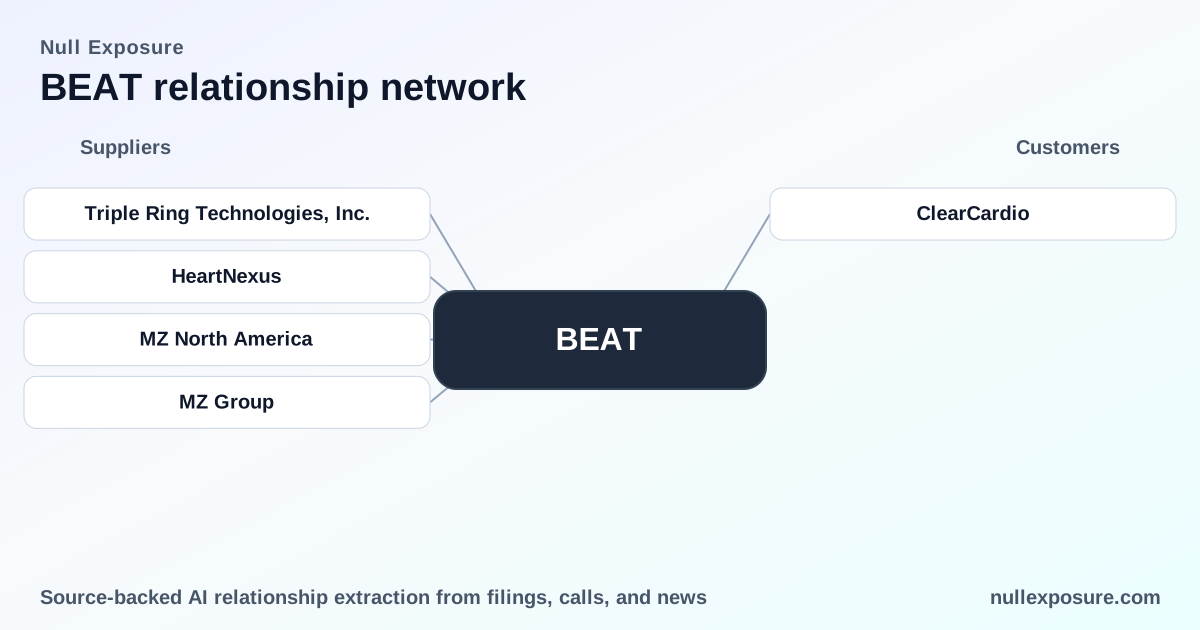
HeartBeam (BEAT): supplier footprint, concentration risks, and operational levers for investors
HeartBeam develops a 3D vector ECG device and related remote cardiac-monitoring services and monetizes through device and service agreements, clinical services and OEM/central-lab contracts. Revenue drivers are a mix of product co-development commitments, outsourced clinical study spend, and third‑party clinical/reading partners that convert device telemetry into clinical decisions. Investors should value the company not only on regulatory and commercial milestones but equally on the durability and concentration of its supplier relationships.
For a concise supplier-risk view and ongoing supplier monitoring, visit https://nullexposure.com/ for the full supplier analytics platform.
What the supplier relationships tell you about how HeartBeam runs its business
HeartBeam runs a tightly outsourced operating model: core product engineering and clinical execution are delegated to third parties rather than built entirely in-house. That posture reduces fixed headcount but concentrates operational risk in a small number of external providers. The firm’s contracting profile shows a combination of single‑source co‑development commitments and recurring clinical operations spend in the low‑ to mid‑single‑million dollar range, indicating an early commercial stage with focused counterparty exposure.
The supplier roster — who is on the critical path
Below are the company relationships surfaced in public filings and press coverage, each summarized in plain English.
-
Triple Ring Technologies, Inc. — HeartBeam contracted TRT as a co‑development partner and single‑source supplier for its initial 3D vector ECG product, with a professional services agreement executed in March 2022 to assist in design and development. According to HeartBeam’s 2024 Form 10‑K, the TRT agreement has been amended over time and included a $1.7 million commitment, with roughly $1.6 million expensed across 2023–2024 and a $0.1 million remaining commitment as of December 31, 2024. (Source: HeartBeam 2024 Form 10‑K filing.)
-
Clinical Research Organization (unnamed CRO) — HeartBeam uses an external CRO to run its clinical trial activities, paying roughly $0.5 million for project setup, trial management and monitoring as part of a broader trial budget expected to be about $0.8 million; HeartBeam expensed $0.7 million in 2024 for CRO and site activities and held $0.1 million in prepaid balances at year‑end 2024. This indicates recurring, near‑term operational spend tied to clinical validation. (Source: HeartBeam 2024 financial disclosures / clinical study agreement disclosures in FY2024.)
-
HeartNexus — In October 2025 HeartBeam announced a partnership with HeartNexus to provide a 24/7 cardiology reader service, where board‑certified cardiologists review synthesized ECGs and deliver feedback to patients or coordinating clinicians, effectively outsourcing interpretive capacity and accelerating time‑to‑market for remote reads. (Source: market coverage reporting on the October 2025 announcement.)
-
MZ North America — MZ North America is listed as an investor relations contact in a HeartBeam press release, indicating retained PR/IR services to support capital‑markets outreach. The press release identifies MZ North America and provides an investor relations contact email for BEAT. (Source: HeartBeam press release published on BioSpace.)
-
MZ Group — HeartBeam used MZ Group for event and investor engagement logistics, including scheduling one‑on‑one meetings for JP Morgan Healthcare Conference participation; this reflects reliance on a retained communications firm for investor engagement at major healthcare investor events. (Source: HeartBeam press release regarding JP Morgan attendance published on BioSpace.)
Business model constraints and what they imply for risk and optionality
HeartBeam’s public disclosures and press excerpts reveal several company‑level constraints that shape supplier risk and operational flexibility.
-
Service‑provider contracting posture. The company conducts a substantial portion of R&D and clinical execution through third parties, including a named co‑developer (Triple Ring) and an unnamed CRO; this reduces fixed costs but creates operational dependency on external execution quality and timeline adherence. (Company‑level signal from FY2024 disclosures.)
-
Concentration risk is real and quantifiable. Triple Ring operates as a single‑source supplier for the initial product — a classic concentration point where a single counterparty holds outsized influence on delivery and timing. The 1.7 million dollar commitment underscores that this is not a nominal relationship. (Constraint excerpt explicitly names Triple Ring.)
-
Spend band and maturity signal. Clinical and development spend sits in the $100k–$10m aggregate band across vendors: CRO trial spend of approximately $0.5 million and a co‑development commitment of $1.7 million indicate a company in late‑development / early‑commercial phase rather than at scale. These financial magnitudes imply limited supplier bargaining leverage but manageable absolute commitments. (Company‑level signal from FY2024 disclosures.)
-
Criticality and contingency needs. Given the reliance on a single co‑developer for the initial device, contingency planning (alternate suppliers, IP ownership clarity, and transition costs) should be a top diligence item for purchasers, partners, and acquirers. (Company‑level signal; constraint implications.)
What investors and operators should do next
HeartBeam’s supplier profile is manageable but concentrated. Operational diligence and contract review should focus on continuity, intellectual property, and cost escalation clauses. Key next steps:
-
Review the TRT contract for IP ownership, delivery milestones, termination rights, and warranty/defect obligations to quantify the risk of supplier failure. The 10‑K confirms a single‑source co‑development posture and an existing $1.7M commitment. (See HeartBeam 2024 Form 10‑K.)
-
Monitor clinical spend cadence against milestone achievement; the company recorded $0.7M of trial‑related expense in 2024 and retained $0.1M prepaid, reflecting near‑term cash flow impact from CRO payments. (See FY2024 disclosures on CRO arrangements.)
For ongoing supplier tracking and alerts that matter to deal teams and operators, visit https://nullexposure.com/.
Practical takeaways — concise
- Concentrated supplier base: One named co‑developer (Triple Ring) is single‑source for the initial product; that creates execution risk if the vendor’s performance slips.
- Measured but material spend: Clinical contracts and co‑development commitments total in the low single millions and are a meaningful use of near‑term capital.
- Operational outsourcing is strategic: Partnerships such as HeartNexus for 24/7 reads reduce staffing needs and speed deployment, improving scalability of the monitoring service.
- Investor communications are outsourced: MZ Group / MZ North America handle investor engagement, suggesting HeartBeam is actively managing market awareness through retained PR/IR channels.
For deeper supplier metrics and to see how HeartBeam’s counterparties stack up across industry benchmarks, explore the platform at https://nullexposure.com/.
Closing note: HeartBeam’s supplier architecture fits a small, clinical‑stage medical device company that is scaling through co‑development and outsourced clinical execution. Supplier concentration is the primary operational risk and also the most actionable item for investors and operators to address through contract-level diligence, contingency planning, and monitoring of spend run‑rate.