BEATW (Heartbeam Inc. Warrant) — Supplier relationships and operational constraints investors should know
Thesis: Heartbeam develops an AI-enabled cardiac diagnostics platform centered on a 3D vector ECG collection device and monetizes through device commercialization, recurring monitoring and reading services, and clinical partnerships that enable clinical adoption. For investors assessing BEATW as a supplier-risk exposure, the company’s path to revenue is tightly coupled to a small set of outsourced development and clinical service relationships and to the selection of a contract manufacturer for scale production. For a deeper look at supplier risk across healthcare technology companies, visit https://nullexposure.com/.
Two partners define near-term operational capability
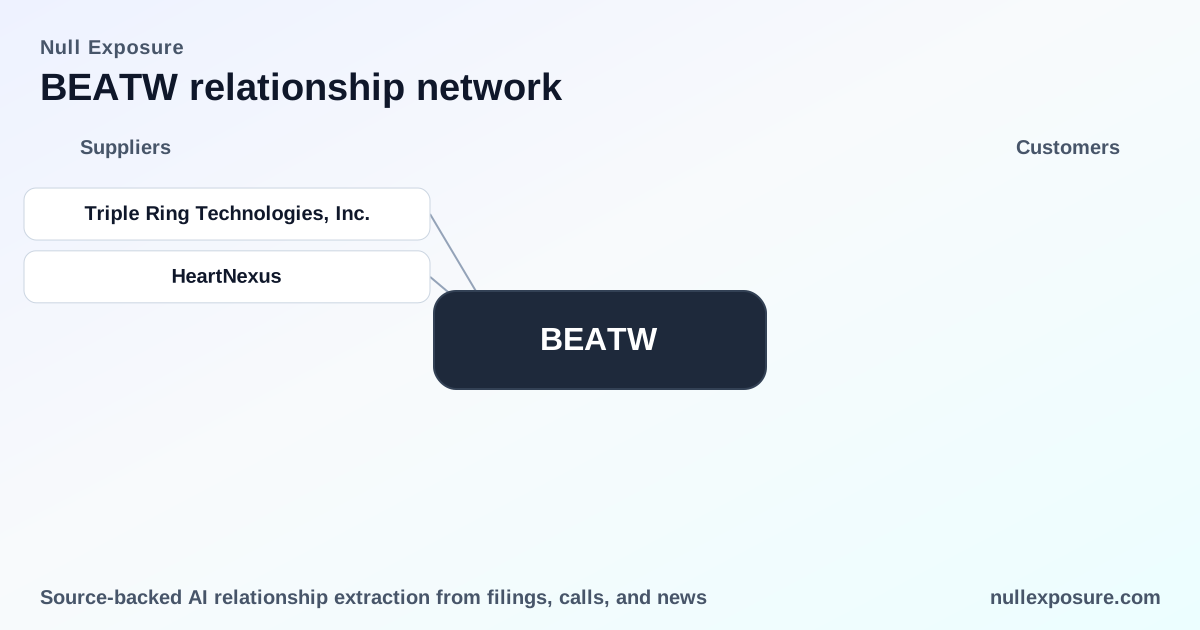
Heartbeam’s public disclosures list two supplier/service relationships that drive product development and clinical reach. Both are active and materially influence the company’s ability to commercialize.
Triple Ring Technologies, Inc.
- Heartbeam has a professional services co‑development agreement with Triple Ring Technologies that serves as the single‑source supplier for its initial product; TRT assisted in designing and developing the company’s 3D vector ECG device. According to Heartbeam’s FY2024 10‑K, the March 2022 agreement designates TRT as a co‑development partner and single source for the initial product. (FY2024 10‑K)
HeartNexus
- Heartbeam announced an agreement with HeartNexus, a U.S. network of board‑certified cardiologists providing nationwide coverage, to support clinical operations and reading services. This partnership was disclosed on the company’s 2025 Q3 earnings call as an arrangement intended to broaden clinical coverage and diagnostic interpretation capacity. (2025 Q3 earnings call)
What the constraints reveal about how Heartbeam operates
Heartbeam’s supplier posture and contract profile present a mixed maturity signal: the company is moving from development to commercialization while relying on concentrated external partners for critical functions.
- Contracting posture — short-term and framework mix. The company uses short‑term service contracts for clinical trial and CRO activities (a March 2024 CRO agreement with roughly $0.5M in fees) while simultaneously maintaining a sales framework (an ATM sales agreement) that supports liquidity. The FY2024 disclosures cite both the CRO agreement and a May 2024 ATM sales agreement with Public Ventures for potential equity issuance up to ~$17M. (FY2024 10‑K)
- Concentration and criticality. Heartbeam explicitly identifies one supplier (Triple Ring) as a single‑source, co‑development partner for its initial device, elevating supplier concentration risk and making that relationship operationally critical to product readiness. The 10‑K specifically calls out TRT as single source for the initial product. (FY2024 10‑K)
- Role mix: manufacturer and service provider. Company statements show dual dependency: external partners provide design/manufacturing support (co‑development and planned CM selection) and clinical/service capabilities (CROs, outsourced 24/7 ECG reading). Heartbeam also reports it has designed and procured production tooling in preparation for selecting a contract manufacturer. (FY2024 10‑K)
- Relationship maturity and status. Relationships are active with documented spend: for 2024 Heartbeam expensed approximately $0.7M for CRO and clinical site services with $0.1M prepaid, and it disclosed remaining CRO commitments as of year‑end. These figures indicate active pilot/clinical operations rather than large‑scale commercialization. (FY2024 10‑K)
For readers comparing suppliers across targets, these are company‑level signals about contracting and concentration unless a constraint explicitly names a party; the Triple Ring criticality is an explicit, relationship‑level constraint.
For additional supplier risk profiles and benchmarking tools, see https://nullexposure.com/ which aggregates supplier intelligence for financial diligence.
Operational implications for investors and operators
- Single‑source development amplifies execution risk. The explicit designation of Triple Ring as a single‑source co‑developer makes the company vulnerable to supplier disruption, quality challenges, or shifting priorities at TRT—risks that directly delay product launch and revenue recognition. (FY2024 10‑K)
- Clinical pathway is outsourced but active. Heartbeam’s use of CROs and a nationwide cardiology reading network (HeartNexus) accelerates clinical validation and service roll‑out while concentrating operational risk into third‑party service providers. The company reported $0.7M of CRO and clinical expenses for the year ended December 31, 2024, and maintains small remaining commitments, indicating near‑term trial activity rather than ongoing large recurring spend. (FY2024 10‑K; 2025 Q3 earnings call)
- Manufacturing readiness is in motion but not finalized. Management has procured production tooling and is actively selecting a contract manufacturer, signaling preparations for scale but an incomplete manufacturing supply chain. This intermediate state requires monitoring of CM selection, validation timelines, and domestic vs. offshore sourcing choices disclosed in future filings. (FY2024 10‑K)
- Liquidity and funding context. The company’s ATM sales agreement with Public Ventures provides an equity financing backbone of up to approximately $17M, with $16.2M available as of the FY2024 filing, indicating accessible near‑term capital to fund development and supply contracts. (FY2024 10‑K)
Practical diligence checklist for investors
- Confirm the terms and exit rights in the Triple Ring co‑development agreement and whether alternative manufacturers have been qualified.
- Validate the scope and duration of HeartNexus coverage and the operating SLA for ECG interpretation and notification workflows.
- Monitor filings for the contract manufacturer selection, tooling validation milestones, and any shifts in sourcing geography that affect cost and regulatory timelines.
- Reconcile reported CRO spend and commitments against the clinical timeline to ascertain burn and milestone risk.
Final assessment and recommended next steps
Heartbeam’s supplier configuration delivers focused development capability and rapid clinical reach, but it also concentrates execution risk in a small number of providers. Triple Ring’s single‑source status is the most consequential supplier risk for commercialization; HeartNexus and CRO arrangements support clinical scale but do not remove manufacturing concentration. Investors should track CM selection, any diversification moves away from single‑source reliance, and subsequent material contract disclosures.
For comparative supplier analytics and to follow supplier change‑events in real time, return to https://nullexposure.com/ and subscribe for updates. A focused due diligence sprint on the Triple Ring agreements, manufacturing milestones, and HeartNexus service level commitments is the highest‑value next step for stakeholders evaluating BEATW exposure.