Bebe Stores, Inc. (BEBE) — Market-facing supplier relationships and capital-market signals investors should know
Bebe Stores, Inc. operates and monetizes as a specialty apparel retailer: the company sells contemporary women's apparel and accessories through a mix of physical stores and a direct-to-consumer online channel, generating revenue from product sales and retail gross margins across those channels. Recent public filings and market notices show Bebe is actively engaging capital-market counterparties to reposition the business and access liquidity, which is the principal mechanism for shareholder value creation in the near term. For investors and operators evaluating supplier counterparties, the relevant relationships recorded are capital-market services and an exchange listing—not traditional manufacturing or logistics vendors—and they signal strategic financing activity rather than product-supply arrangements. Learn more about how this analysis was built at https://nullexposure.com/.
Financial and operational picture in one paragraph Bebe is a micro‑cap specialty retailer with a market capitalization of roughly $7.7 million and a small public float; the most relevant financial signals include negative EBITDA and negatives in reported gross profit alongside a positive operating margin metric in the provided snapshot, which together reflect an atypical reporting profile and stressed profitability. Key investor takeaways: the company is thinly capitalized, displays uneven profitability metrics, and has very low institutional ownership (about 5.6%)—conditions that increase sensitivity to financing counterparties and listing events.
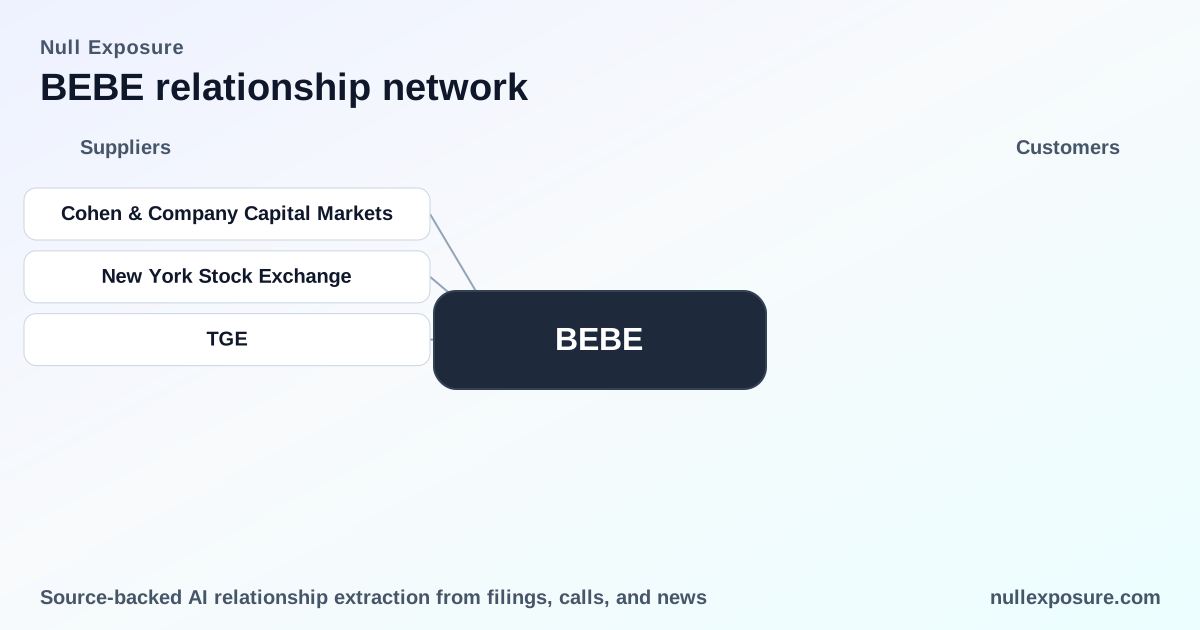
What the reported supplier/counterparty relationships are, in plain English These entries are capital‑markets counterparties and an exchange listing; each relationship is listed below with a concise description and source.
-
Cohen & Company Capital Markets — Cohen & Company acted as the sole underwriter and sole book‑running manager for a recent offering associated with TGE Value Creative Solutions Corp, signaling a boutique underwriter role in the transaction supporting the sponsor’s capital raise activity. According to a Yahoo Finance report dated March 9, 2026, Cohen & Company Capital Markets was named as the sole underwriter and book‑running manager for the offering.
Source: Yahoo Finance, March 9, 2026. -
New York Stock Exchange — Units related to the transaction will be listed and began trading on the New York Stock Exchange under the ticker “BEBE U” starting December 19, 2025, establishing an exchange venue for the newly issued units. The placement of units on the NYSE provides market access and tradability for the transaction’s securities.
Source: Yahoo Finance, March 9, 2026 (listing notice referencing December 19, 2025). -
The Generation Essentials Group (TGE) — The Generation Essentials Group sponsored TGE Value Creative Solutions Corp, which priced an IPO of 15,000,000 units at $10.00 per unit; that sponsorship ties the SPAC sponsor to the capital‑markets activity that affects Bebe’s public securities. The news report identifies TGE as the SPAC sponsor and records the unit pricing and size.
Source: Yahoo Finance, March 9, 2026.
Why these entries matter for operators and investors These relationships are not vendor contracts for goods or store operations; they are capital‑markets counterparties. That distinction is important because capital‑markets counterparties determine Bebe’s access to liquidity, the terms of any equity issuance, and ultimately the company’s runway. A boutique sole underwriter role (Cohen & Company) implies a targeted placement strategy rather than a large syndicate distribution; a NYSE listing for units grants tradability and visibility; and a SPAC sponsor (TGE) indicates the transaction used SPAC mechanics to deliver capital.
Company-level operating constraints and what they signal While there were no explicit constraint excerpts tied to individual counterparties in the material provided, the company profile itself communicates several company-level signals relevant for supplier/counterparty assessment:
- Contracting posture: transactional and financing‑driven. Given the small market cap and active capital-market transactions, the company’s counterparty posture prioritizes immediate liquidity over long-term procurement commitments.
- Concentration risk: high. Small float, low institutional ownership, and micro‑cap status concentrate control and voting, increasing the importance of each counterparty engagement.
- Criticality: capital counterparties are mission‑critical; traditional supply lines are not the subject of the disclosed relationships, so financing partners function as the company’s most critical external suppliers right now.
- Maturity: brand legacy with uneven financial maturity — Bebe’s long brand history contrasts with stressed recent financials, indicating a company that is operationally established but financially immature and reliant on market financing.
How investors should read the combination of signals
- Liquidity and financing are the immediate risk levers. With negative EBITDA and minimal market capitalization, the company’s trajectory depends on execution of these capital‑market transactions and the willingness of counterparties to support future raises.
- Counterparty selection is consequential. A sole underwriter strategy can accelerate a capital event but concentrates distribution risk; an NYSE listing for units improves market mechanics, yet does not itself solve capital adequacy.
- Position sizing must reflect operational and ownership concentration. Small float and low institutional participation mean trading can be volatile and market prices can move on relatively light volumes.
Practical next steps for operators and investors
- If you are an operator negotiating with Bebe, treat capital counterparties as quasi‑suppliers: payment terms, covenants, and execution timing will materially affect operating liquidity.
- If you are an investor, stress‑test scenarios around additional dilution and the success/failure of SPAC‑related transactions before increasing exposure.
- For sponsors or service providers considering engagement, prioritize clarity on use of proceeds and escrow mechanics given the company’s tight capitalization.
Want a deeper, transaction‑level read or a quick screening of counterparties? Visit https://nullexposure.com/ for the full supplier‑relationship toolkit and transaction history.
Final takeaway Bebe’s disclosed relationships in the public record are capital‑market actors—not product suppliers—and they define the company’s near‑term ability to fund operations and reset strategy. Investors should prioritize evaluating underwriting structure, listing mechanics, and sponsor incentives over conventional supply‑chain concerns right now. For a concise view of counterparties and structured relationship intelligence on Bebe and peer retailers, see https://nullexposure.com/.