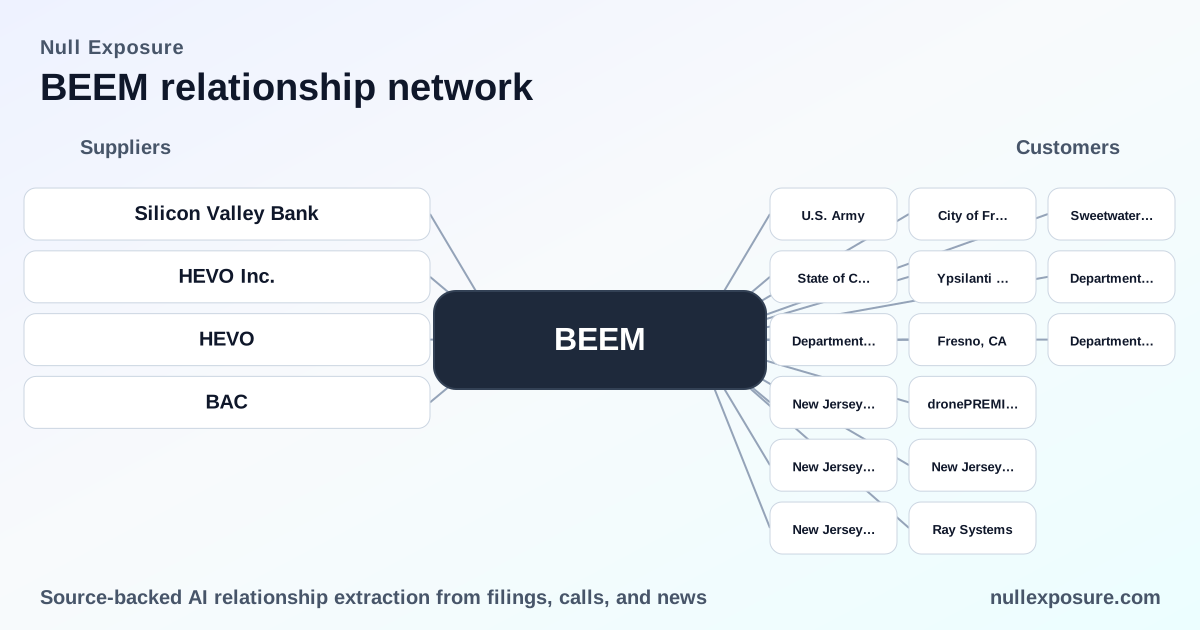
Beam Global (BEEM): Supplier relationships and what they mean for investors
Beam Global designs, manufactures and sells renewable-energy powered products—most notably the off-grid EV ARC™ charger—and monetizes through product sales, project deployments, reseller and strategic partner arrangements, and related services. The business converts intellectual property and patented hardware into deployed infrastructure and licensing opportunities, while maintaining working capital at major U.S. banks and pursuing integration partnerships to expand product capabilities. For investors evaluating supplier and partner risk, the combination of concentrated banking relationships, reseller-style contracting language, and recent strategic integrations defines how revenue scalability and operational resilience will evolve.
Explore supplier and partner intelligence relevant to investment decisions: NullExposure homepage
How Beam makes money and why suppliers matter
Beam’s revenue mix is product sales and project deployments for EV charging, outdoor media/branding, and energy-security solutions. Revenue per share is modest and margins are negative on a trailing basis, reflecting an early-stage cleantech hardware business: Revenue TTM of roughly $27.7 million versus an operating loss and negative EPS in the latest reported period. Beam’s commercialization path depends on two supplier/partner dynamics:
- Banking and treasury counterparties that hold the company’s operating cash and short-term liquidity.
- Technology and reseller partners that extend product functionality, distribution reach, and time-to-deploy.
Both classes of relationships carry operational and strategic consequences for capital efficiency, deployment speed, and product differentiation.
Who Beam works with — the complete list from public records
The following relationships are disclosed across Beam’s filings and recent press coverage. Each entry is summarized in plain English with the cited source.
Silicon Valley Bank — core treasury counterparty
Beam reports holding substantial cash and cash equivalents in accounts with U.S. banks including Silicon Valley Bank. This positions SVB as a treasury counterparty for operating liquidity and short-term cash management. According to Beam Global’s FY2024 Form 10‑K, the company maintains substantially all cash and cash equivalents with U.S. banks including Silicon Valley Bank.
Bank of America — another central banking relationship
Bank of America is explicitly named alongside Silicon Valley Bank as a primary depository for Beam’s cash and cash equivalents, making it a second pillar of the company’s operational banking infrastructure. Beam’s FY2024 10‑K states the company maintains substantially all cash and cash equivalents in accounts with U.S. banks including Bank of America.
HEVO Inc. / HEVO — strategic technology integrator for wireless charging
Beam announced an integration with HEVO’s wireless charging hardware and Journey software to create a combined solution for autonomous and wireless EV charging using Beam’s EV ARC platform. News coverage in FY2026 describes the collaboration as an integration of HEVO’s UL‑certified, SAE‑qualified wireless charging hardware and software with Beam’s deployable EV ARC product to create an autonomous wireless charging solution (see QuiverQuant and ChargedEVs coverage of the March 2026 announcement).
What the constraints tell us about Beam’s operating model
Beam’s public disclosures and extracted constraints reveal a consistent company-level signal: the firm uses reseller, joint development, referral, sales agent, and strategic alliance contracting as regular tools in its commercial model. The FY2024 evidence excerpt from the company’s own materials lists those arrangements and financial-advisory engagements explicitly.
From that signal derive four practical operating-model characteristics:
- Contracting posture — flexible and partnership-driven. Beam pursues reseller agreements, joint development contracts, referral and sales-agent relationships, and strategic alliances. This reduces direct go-to-market cost but increases dependence on external commercialization engines.
- Concentration — treasury exposure to a few banks. The 10‑K names Bank of America and Silicon Valley Bank as repositories for substantially all cash, producing concentrated counterparty risk for short-term liquidity and operational continuity.
- Criticality — partners extend product capability. Integrations like the HEVO collaboration are mission-critical to product differentiation (wireless/autonomous charging for EV ARC), suggesting supplier relationships are not merely transactional but strategically important.
- Maturity — mixed contractual commitment. The documented vendor arrangements include non-binding minimum purchasing provisions and advisory/marketing agreements, signaling early-stage commercial maturity where some supplier commitments are conditional rather than fixed.
Investment implications: risk, optionality, and what to watch
Beam’s supplier landscape creates both upside optionality and concentrated risks. Key takeaways for investors:
- Upside via strategic integrations. Partnerships such as the HEVO integration expand Beam’s addressable market into autonomous and wireless charging, increasing product stickiness and offering potential premium pricing for differentiated solutions (news coverage March 2026).
- Treasury concentration is a short-term operational risk. Holding most cash with a small number of banks creates single-point-of-failure risk for day-to-day operations; investors should monitor bank counterparty health and diversification actions reported in subsequent filings (Beam FY2024 10‑K).
- Commercial scalability hinges on partner execution. The company’s reliance on reseller and alliance models accelerates deployment but trades off margin capture and control; monitor the evolution of contract terms and disclosed revenue recognition from partner channels.
- Early-stage financial profile persists. Trailing revenue and negative margins indicate the business is still investing in commercialization; analyst coverage reflects a small set of buy/hold opinions and a target price that implies upside if integrations and channel scaling succeed.
If you want ongoing supplier and partner risk monitoring for Beam and comparable cleantech suppliers, NullExposure maintains coverage and alerts: NullExposure homepage
Practical due diligence checklist for operators and investors
When evaluating BEEM supplier relationships, prioritize the following diligence items:
- Confirm treasury diversification and counterparty limits in subsequent quarterly filings.
- Review the exact commercial terms of reseller, joint development, and referral agreements for minimum purchase commitments and revenue share mechanics.
- Track integration milestones and field deployments for partnerships like HEVO to validate technical interoperability and time-to-revenue.
- Monitor gross margin trends and backlog disclosures to see whether channel deals are improving or compressing realized margins.
Final assessment and next steps
Beam Global operates a product- and partner-driven commercialization model with strategic integrations that materially affect product differentiation and concentrated treasury relationships that heighten operational risk. For investors, the trade-off is clear: upside from differentiated partnerships versus execution and counterparty concentration risk. Active monitoring of banking counterparties, partner deployment milestones, and the maturation of reseller and alliance contracts will determine whether BEEM transitions from an early-stage hardware company to a scalable market player.
Stay updated on supplier and partner developments for Beam and related cleantech names on NullExposure: NullExposure homepage