Mobile Infrastructure (BEEP): The legal and capital stack behind a $100M asset-backed financing
Mobile Infrastructure Corporation operates and monetizes a portfolio of urban parking assets and related management contracts, collecting parking revenues while increasingly shifting to fee-based management agreements where the company recognizes revenues and pays operators a management fee. The company extracts liquidity through structured financings—most recently a $100 million asset-backed deal—and uses external placement agents and large law firms to execute capital markets transactions. For a deeper supplier-risk view and counterparty mapping, visit https://nullexposure.com/.
Quick take: how BEEP makes money and funds growth
Mobile Infrastructure owns 40 parking facilities across the United States (about 15,100 spaces and roughly 5.2 million square feet as of December 31, 2024) and is transitioning a majority of those assets into management contracts that shift expense and collections responsibility to the company while operators are paid fees. This dual model produces direct operating cashflows from owned assets and recurring fee income from management contracts, then leverages receivables and asset cashflows into securitizations to fund expansion and deleveraging. The March 2026 $100 million asset-backed transaction is a practical example of that monetization route.
Read the full supplier and counterparty map at https://nullexposure.com/
The deal roster — who did what on the $100M ABS
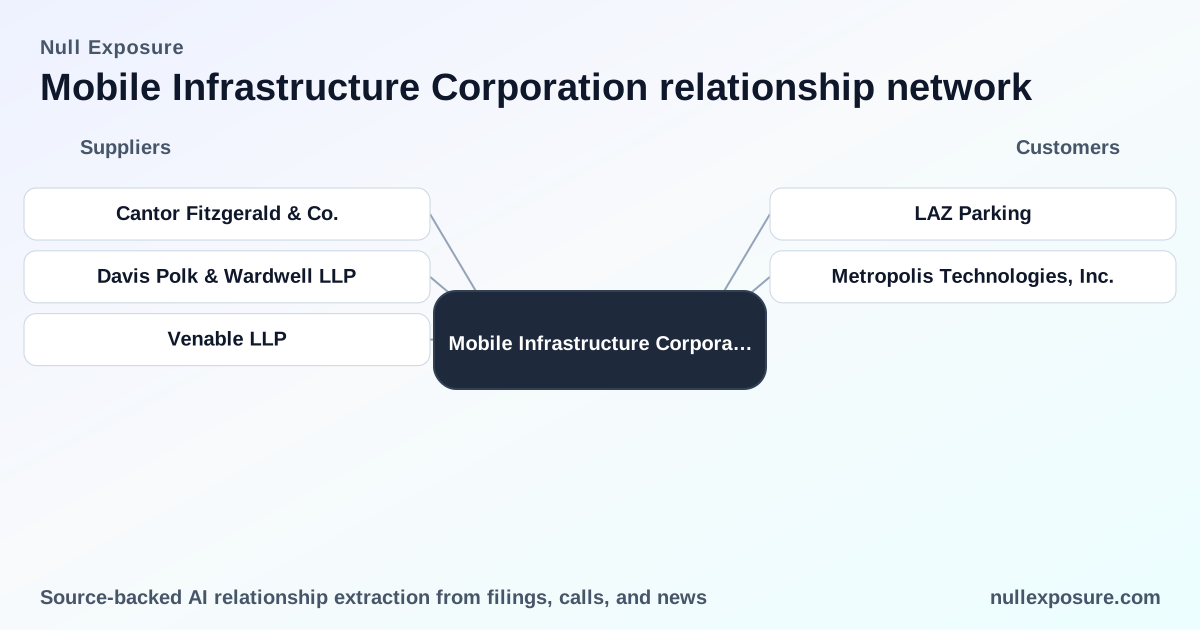
The public notices and transaction press coverage list three external suppliers that executed the financing: Cantor Fitzgerald & Co., Davis Polk & Wardwell LLP, and Venable LLP. Each plays a distinct role that reduces execution and legal risk for investors while signaling the company’s contracting posture.
Cantor Fitzgerald & Co.
Cantor Fitzgerald served as Mobile Infrastructure’s Sole Structuring Advisor and Sole Placement Agent on the $100 million asset-backed financing, taking primary responsibility for marketing and placing the securities with investors. A StockTitan news release covering the closing on March 9, 2026 documents Cantor’s placement role and structuring duties. (StockTitan / news item, March 9, 2026)
Davis Polk & Wardwell LLP
Davis Polk acted as legal counsel for Mobile Infrastructure on the transaction, providing high‑tier capital markets and securitization counsel typically used in institutional-grade financings. The same March 9, 2026 press coverage identifies Davis Polk as counsel to the company. (StockTitan / news item, March 9, 2026)
Venable LLP
Venable LLP also acted as legal counsel for Mobile Infrastructure alongside Davis Polk, supporting transaction documentation and regulatory compliance related to the asset-backed issuance. This engagement is listed in the transaction notice published March 9, 2026. (StockTitan / news item, March 9, 2026)
What the supplier roster implies about BEEP’s operating model
The composition of advisors and counsel on the transaction reveals several structural characteristics of Mobile Infrastructure’s business model and procurement posture:
- Contracting posture (active capital markets orientation): Engaging Cantor as sole structuring advisor and placement agent indicates a deliberate, centralized approach to capital formation and a preference for a single lead arranger to maintain execution control and pricing discipline.
- Maturity and sophistication: Retaining Davis Polk and Venable demonstrates the company’s willingness to pay for top-tier legal support, reducing legal execution risk and making the company’s securities more acceptable to institutional buyers.
- Critical third-party services: The company relies on third-party service providers for operations and IT security—Mobile Infrastructure disclosed a managed service provider for cybersecurity, which is operationally critical to protect transaction data and receivables.
- Geographic concentration of assets: Mobile Infrastructure’s assets are U.S.-based—40 facilities in 20 markets—making its market risk predominantly North American and operational playbooks standardized for U.S. parking markets.
Read supplier risk profiles and contract language examples at https://nullexposure.com/ to benchmark counterparties.
Operational constraints that matter to investors
Mobile Infrastructure’s own disclosures highlight constraints that increase counterparty and operational risk in predictable ways:
- Concentration risk is material. The company states that operations of a large number of properties are concentrated with two tenant operators, creating a potential single-point-of-failure for collections and performance across multiple assets. This is a material operating constraint that affects cashflow volatility.
- Active transition to management contracts. In 2024, 29 of 40 assets converted to management contracts where revenues and expenses are recognized by Mobile Infrastructure and operators are paid fees, indicating the company is consolidating revenue recognition and operational control—this increases direct exposure to day-to-day operational performance but improves visibility into top-line receipts for securitizations.
- Third-party cybersecurity and IT dependency. Mobile Infrastructure uses a managed service provider for cybersecurity functions including threat detection and incident response, making that MSP a critical supplier for operational continuity and data security tied to investor confidence.
- Related-party operator disclosure. The filing names Park Place Parking (PCA, Inc.) as the operator of three assets; Park Place is privately owned by relatives of the CEO and generated small receivable balances ($0.2 million at year-end 2024). That relationship is disclosed and paid on terms of the management agreement, but investors should treat such related-party operations as a governance and reputational risk vector.
These constraints are drawn from company disclosures for the period ending December 31, 2024.
Counterparty and procurement implications for investors
- Execution risk is mitigated by top-tier advisors. Cantor and Davis Polk reduce distribution and legal risk on securitizations, which supports tighter pricing and institutional buyer acceptance.
- Operational concentration remains the largest single risk. Dependency on a small number of operators for multiple assets elevates counterparty risk—credit stress at one operator will transmit quickly across the pool.
- Service provider continuity is material. Cybersecurity and IT continuity are essential to protect collections and investor data flows; the MSP’s capabilities and contract stability are a credit consideration for any lender or ABS investor.
If you are evaluating BEEP as a counterparty or co-investor, the supplier footprint is a mixed signal: high transaction sophistication offset by operational concentration and some related-party exposures.
Relationship-by-relationship detail (comprehensive)
Cantor Fitzgerald & Co. — Cantor served as the transaction’s Sole Structuring Advisor and Sole Placement Agent, handling structuring and investor placement for the $100 million asset-backed financing; this role was reported in transaction coverage on March 9, 2026. (StockTitan / news item, March 9, 2026)
Davis Polk & Wardwell LLP — Davis Polk acted as legal counsel for Mobile Infrastructure on the asset-backed transaction, supplying capital markets and securitization expertise referenced in the March 9, 2026 transaction notice. (StockTitan / news item, March 9, 2026)
Venable LLP — Venable worked alongside Davis Polk as legal counsel for the company on the same financing, providing additional documentation and regulatory support noted in the March 9, 2026 coverage. (StockTitan / news item, March 9, 2026)
Final takeaways and next steps
- Positive: Engagement of Cantor and top-tier law firms supports clean execution and institutional investor access for securitizations.
- Watchlist: Operational concentration with a small number of operators and a related-party operator for a subset of assets create concentration and governance risks that undercut otherwise disciplined capital markets execution.
- Actionable: If your investment thesis depends on stable, diversified cashflows, require covenant-level disclosures on operator concentration, MSP continuity guarantees, and any related-party service agreements.
For a full counterparty risk kit and supplier contract summaries tailored to asset-backed financings, visit https://nullexposure.com/.
For immediate access to benchmarks and comparable supplier engagements across small-cap infrastructure issuers, go to https://nullexposure.com/.