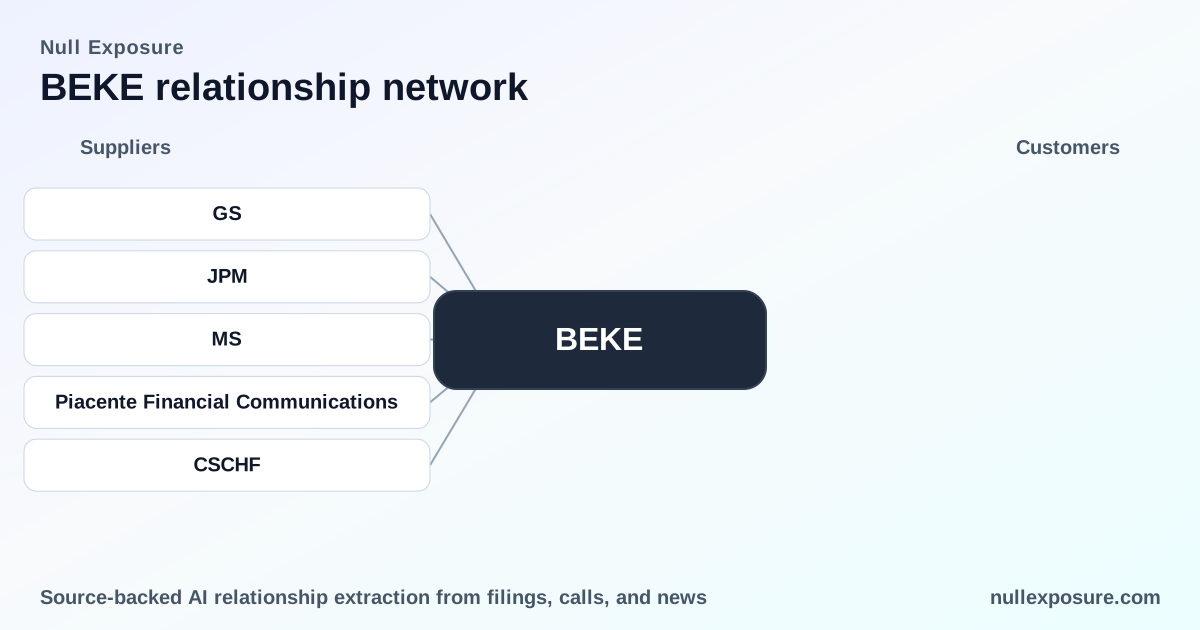
KE Holdings (BEKE): Why the bank syndicate matters more than the headline
KE Holdings runs an integrated online-offline housing platform in China that monetizes through transaction facilitation, value-added services, and financing-related products tied to property transactions. The company funds growth and restructures capital through periodic equity and debt placements, leaning on major financial institutions to execute these offerings and professional communications advisors to manage investor outreach. For investors, the composition and quality of those external partners is a leading signal of capital markets access and execution risk.
Learn more and see how these supplier relationships map to capital access: https://nullexposure.com/
Recent activity in plain language: a high-profile underwriting syndicate
In March 2026 KE Holdings announced an offering that is being managed by a mix of global and China-based lead managers. That syndicate combines the reach of Goldman Sachs, Morgan Stanley, and J.P. Morgan with local advisory strength from China Renaissance, while investor and media contacts for the company are being handled through an international PR/IR firm. These are not routine vendor choices — they are capital markets partners who shape pricing, placement success, and investor targeting.
Who KE Holdings is working with (each relationship)
Goldman Sachs
Goldman Sachs is listed as a lead manager on KE Holdings’ recent offering, positioning Goldman to handle distribution and pricing tasks for the deal. StockTitan’s coverage referenced the syndicate composition on March 9, 2026. (Source: StockTitan news page, 2026-03-09)
J.P. Morgan
J.P. Morgan is also named among the managing banks for the offering, providing additional institutional distribution capacity and bookrunning capabilities for KE’s transaction. (Source: StockTitan news page, 2026-03-09)
Morgan Stanley
Morgan Stanley joins Goldman Sachs and J.P. Morgan as a co-manager on the deal, expanding the global bank representation in the underwriting syndicate. (Source: StockTitan news page, 2026-03-09)
China Renaissance
China Renaissance is included alongside the global banks, supplying local-market placement expertise and advisory access to China-focused investors. Its presence signals deliberate domestic distribution in the syndicate. (Source: StockTitan news page, 2026-03-09)
Piacente Financial Communications (investor / media contact)
KE Holdings named Piacente Financial Communications for investor and media inquiries in its earnings/offerings notices, an expected move to manage U.S. and international shareholder communications. The company’s press release carried by The Manila Times / GlobeNewswire on March 4, 2026 lists Piacente contacts for both China and the United States. (Source: GlobeNewswire press release as published by The Manila Times, 2026-03-04)
What the partner set implies for KE’s operating profile
These supplier engagements create a clear operating posture for KE Holdings:
- Contracting posture — outsourcing to elite capital markets providers. KE leverages top-tier global banks to underwrite and place capital, indicating a strategic decision to outsource execution risk rather than internalize capital markets functions.
- Concentration — a small set of high-skill counterparties. The syndicate is concentrated among a handful of major banks and a specialist China advisor; this reduces the number of critical counterparties while increasing each counterparty’s influence on financing outcomes.
- Criticality — capital markets relationships are mission-critical. For a company with a near-term offering, underwriting performance directly affects liquidity, refinancing costs, and investor perception; these external suppliers are operationally material.
- Maturity — institutionalized capital-market engagement. Working simultaneously with global banks and a professional PR/IR firm signals a mature, repeatable approach to capital access and investor communications consistent with a public company listed on the NYSE.
These are company-level signals about how KE runs funding and communications; they are not isolated tactical choices but reflect a repeatable playbook for market access.
Learn how to map supplier relationships to financing risk on your watchlist: https://nullexposure.com/
Investor implications and risk takeaways
- Execution risk is concentrated. When a handful of banks underwrite a deal, distribution and pricing outcomes hinge on those banks’ syndicate strategy and appetite; monitoring bookbuilding signals and lead-manager behavior provides early read-throughs on demand and pricing.
- Domestic-local balance reduces regulatory friction. Including China Renaissance alongside global banks lowers execution friction with domestic investor bases and regulators, smoothing onshore distribution.
- Communications control is deliberate. Retaining an international IR/PR firm for investor outreach protects message discipline across time zones and regulatory environments — that matters for investor confidence during capital raises.
- Watch timing and disclosure. Underwriting announcements and investor contact points (as published in March 2026) signal an imminent execution window; investors should monitor filings and the lead managers’ syndicate reporting for allocation and stabilization activity.
Key takeaway: the composition of KE’s syndicate increases probability of a successful placement but concentrates counterparty execution risk into a few global banks; active monitoring of syndicate behavior is essential for assessing near-term dilution, funding costs, and secondary-market reaction.
Practical guidance for operators and equity holders
- For investors: prioritize monitoring bookbuilding commentary from the named banks and any syndicate stabilization notices; those signals will be the fastest indicators of demand and pricing pressure.
- For corporate operators and vendor managers: maintain dual tracks — elite global banks for international reach and strong domestic advisers for onshore investor engagement — as demonstrated by KE’s mix.
- For risk teams: track counterparty exposure limits and reputational risk tied to lead-managers’ allocation policies, especially given KE’s reliance on a concentrated underwriting group.
Closing thoughts and next steps
KE Holdings’ choice of global and local underwriters plus a professional investor-relations firm is a deliberate capital markets strategy: maximize placement reach while centralizing execution with trusted partners. That model offers efficient access to liquidity but concentrates operational risk in a small supplier set — a tradeoff investors should price into valuations and covenant expectations.
For a closer look at how supplier and capital-market relationships affect equity outcomes, visit our research hub: https://nullexposure.com/
If you are evaluating counterparty risk or preparing for a capital raise, review the syndicate composition and IR arrangements early — those choices determine both market reception and the cost of capital. Explore more resources at https://nullexposure.com/