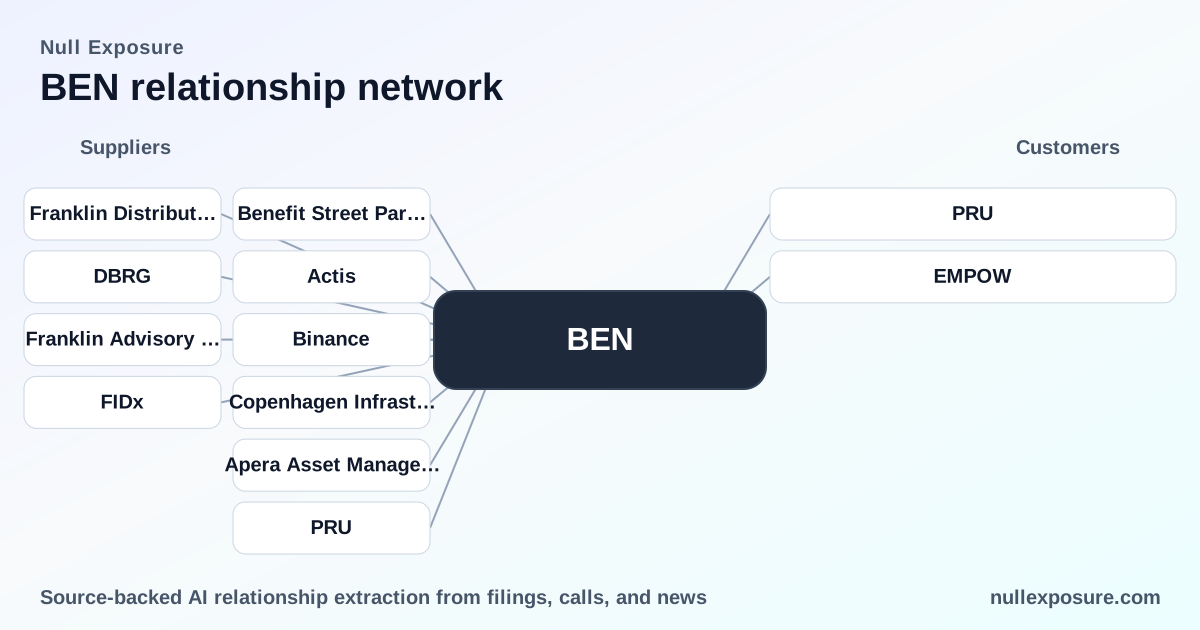
Franklin Resources (BEN) — Supplier Relationships and Strategic Partnerships
Franklin Resources (Franklin Templeton) operates as a global asset manager that monetizes through management and performance fees across public and private strategies, distribution agreements with intermediaries, and product-platform partnerships that extend its retail and institutional reach. Revenue drivers include fee-bearing AUM growth via acquisitions and strategic partnerships, distribution economics through third-party advisors and platforms, and product innovation such as tokenized funds and insurance overlays. For more detail on supplier exposure and partner concentration, visit https://nullexposure.com/.
How Franklin leverages partners to monetize scale and distribution
Franklin uses partnerships and acquisitions to accelerate fee-bearing AUM and expand into private credit, infrastructure, digital asset rails and platform distribution. The firm’s recent activity demonstrates two explicit plays: (1) capability build via acquisitions and strategic private-investing alliances that lift fee yield and recurring income, and (2) distribution and product partnerships that embed Franklin’s products into third-party channels (broker-dealers, platforms, insurers, and crypto wallets) to grow net flows without proportionate fixed-cost increases. These dynamics are reflected in Franklin’s FY2025 disclosures and the 2025 Q4 earnings commentary.
Visit https://nullexposure.com/ for a concise supplier impact brief tailored to investors.
Key supplier and partner relationships you need to track
Below I summarize every supplier/partner relationship referenced in the available results, one by one, with the authoritative source for each mention.
Benefit Street Partners
Franklin described an acquisition that "complements Benefit Street Partners and Alcentra and expands our direct lending capabilities across Europe's growing lower middle market" — signalling a strategic extension of private credit capabilities. This comment came from the 2025 Q4 earnings call (March 2026).
Actis
Franklin announced an infrastructure partnership with Actis alongside two other firms to expand expertise in private infrastructure investing, reflecting a push into large-scale, fee-generating private strategies. The reference is from the 2025 Q4 earnings call (March 2026).
Binance
Franklin reported that it embedded tokenized money market funds into the crypto collateral process and partnered with Binance to develop new products for Binance’s global wallet platform, demonstrating direct engagement with crypto distribution and settlement rails. This disclosure is from the 2025 Q4 earnings call (March 2026).
Copenhagen Infrastructure Partners
Copenhagen Infrastructure Partners is identified as a co-investment partner in a new infrastructure initiative, used to scale Franklin’s private infrastructure capabilities and capture institutional fees. This was described in Franklin’s 2025 Q4 earnings call (March 2026).
Apera Asset Management
Franklin acquired Apera on October 1, which Franklin said increased its private credit AUM to $95 billion and improved European private credit reach — a clear inorganic growth play to lift recurring fee revenue. The acquisition detail is reported in the 2025 Q4 earnings call (March 2026).
Prudential Financial (PRU)
Prudential launched its ActiveIncome insurance overlay on Franklin Templeton’s Canvas platform, indicating distribution and product integration with an insurer to bring protected-income solutions to managed accounts on Franklin’s platform. This was reported in March 2026 press coverage (StockTitan, NJBIZ, MarketScreener).
Franklin Distributors LLC
Franklin Distributors LLC is referenced as a distributor in public reporting, reflecting Franklin’s internal distribution vehicle used to route fund sales through intermediaries and comply with distribution mechanics. The mention appears in FY2026 public news reporting (TradingView feed item, March 2026).
DigitalBridge (DBRG)
DigitalBridge is cited as one of three infrastructure partners in Franklin’s initiative, used to expand capabilities in private infrastructure investing and to access specialized deal flow and operational expertise. This was stated in the 2025 Q4 earnings call (March 2026).
Franklin Advisory Services LLC
Franklin Advisory Services LLC is listed as a primary advisor in public reports, an internal affiliate that provides advisory and management roles across product lines and client relationships. The reference is in FY2026 news coverage (TradingView feed item, March 2026).
FIDx
FIDx appears as the marketplace channel that enables Prudential’s ActiveIncome overlay to be available on Franklin’s Canvas platform, indicating a marketplace/ecosystem relationship that supports third-party product integration on Franklin’s platform. This was reported in March 2026 press releases (StockTitan, MarketScreener).
Constraints and what they imply for supplier management
Franklin’s public disclosures and the available evidence produce several company-level signals that inform supplier posture and counterparty risk:
- Long-term contracting posture: Franklin disclosed a five-year Amended and Restated Revolving Credit Agreement effective April 30, 2025, and contingent earnouts tied to acquisitions with multi-year payment windows. This indicates multi-year financial commitments and suggests counterparties must align to extended timelines and capital planning horizons.
- Distributor and intermediary reliance: Franklin states that it pays most sales and distribution fees to financial advisers, broker-dealers and intermediaries. This is a firm-level signal that distribution economics are outsourced, increasing sensitivity to channel terms and advisor compensation structures.
- Outsourced service model: Franklin outsources administration, transfer agency, technology and other fund services to third-party providers acting as sub-agents or delegates, signaling operational dependency on external service providers for core fund operations.
- Active, ongoing supplier engagement: The company’s stock repurchase program has no expiration date and repurchases continue, a governance posture that signals ongoing capital allocation activity and an active vendor/contract lifecycle.
- Material purchase obligations: Franklin reported $972.8 million of purchase obligations at September 30, 2025, which indicates meaningful contractual spend across suppliers and a procurement footprint that is both material and mature.
These constraints are company-level characteristics — they shape how Franklin structures supplier agreements, the negotiation leverage of counterparties, and the criticality of certain outsourced services.
Visit https://nullexposure.com/ to see a supplier-impact checklist for asset managers.
What investors and operators should watch next
- Concentration risk in private strategies: Acquisitions (like Apera) and partnerships for private infrastructure increase fee potential but concentrate Franklin’s execution risk on a smaller set of specialized third-party managers and integrators.
- Distribution margin pressure: Reliance on external advisors and platform partners creates ongoing fee-sharing dynamics that will determine net margin on retail flows.
- Operational third-party dependency: Outsourced fund administration and technology relationships are critical; any disruption to these service providers would have outsized operational effects.
- Regulatory and reputational exposure from crypto and insurance integrations: Partnerships with Binance and insurance overlays expand addressable markets but also shift Franklin into regulated and reputationally sensitive domains.
Key takeaway: Franklin is executing a dual strategy of capability acquisition and platform distribution to lift fee-bearing AUM, but the model increases dependence on third-party managers, distributors and service providers — all under multi-year contractual commitments.
Practical next steps for relationship monitoring
- Track contractual duration and renewal terms for major outsourcing and distribution partners, and monitor purchase-obligation disclosures each quarter.
- Monitor integration metrics for acquisitions (AUM retention/growth) and distribution outcomes from platform partnerships (Canvas placements, Prudential overlay adoption).
- Keep an eye on regulatory developments and business metrics for crypto and insurance partners that could materially affect distribution or reputation.
For a concise supplier risk brief and alerts tailored to institutional investors, go to https://nullexposure.com/.