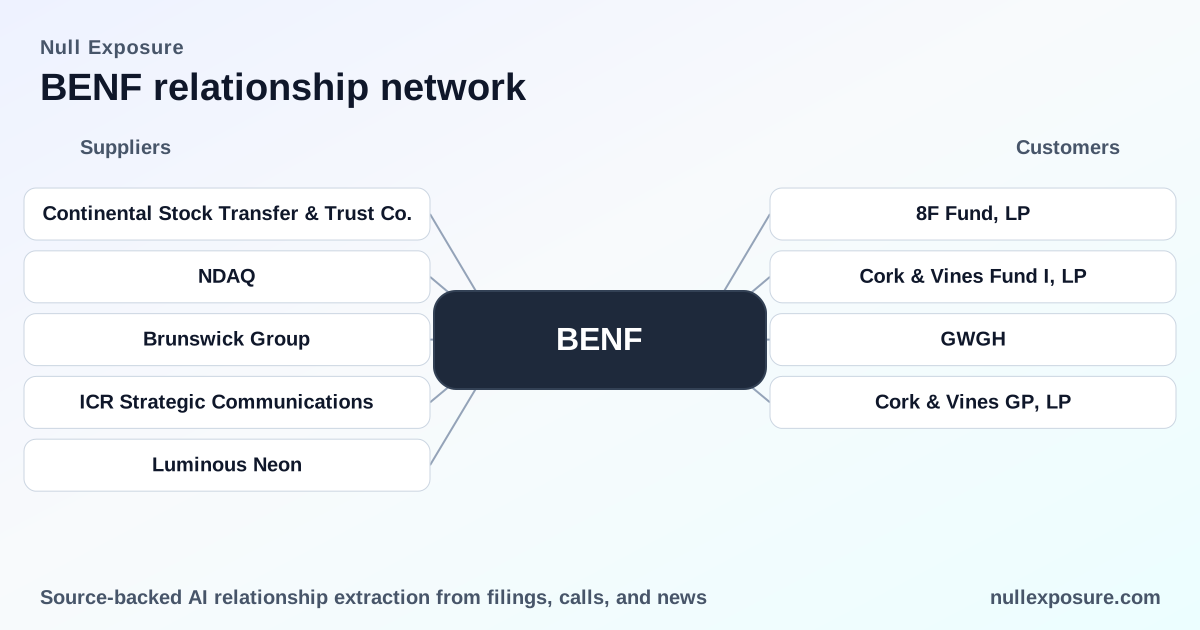
BENF supplier intelligence: what partners reveal about Beneficient’s operating posture
Beneficient is a technology‑enabled financial services firm that provides liquidity and financing solutions to holders of alternative assets. The company monetizes through credit facilities and fee income tied to advisory, servicing and brokerage-related activities, while maintaining a Nasdaq‑listed equity presence; its capital structure and operational footprint make third‑party suppliers (transfer agent, listing venue, PR and specialist vendors) essential to day‑to‑day market access and client delivery.
If you want a concise supplier map and commercial signal set for BENF, start here — or visit https://nullexposure.com/ for a deeper supplier‑risk engagement model.
Why supplier relationships matter to an investor evaluating BENF
Beneficient runs a capital‑intensive, credit‑centric business: that creates two supplier realities. First, financial counterparties and lending arrangements drive cash availability and leverage dynamics. Second, service vendors — transfer agents, investor relations and communications firms, niche signage/branding contractors — control regulatory and market access touchpoints. For operators, supplier terms define product continuity; for investors, they define liquidity and execution risk.
Explore tailored supplier risk analysis at https://nullexposure.com/ to translate these signals into portfolio action.
Supplier roll call: the partners surfaced in public reporting
-
Continental Stock Transfer & Trust Co.
Beneficient uses Continental Stock Transfer & Trust Co. as its transfer agent to maintain book‑entry records for its Class A common stock, a role cited in company press releases announcing corporate actions in FY2024 and FY2025. (Source: GlobeNewswire press releases, Apr 2024 and Dec 2025.) -
Nasdaq / The Nasdaq Stock Market (NDAQ)
Beneficient’s Class A Common Stock trades on The Nasdaq Capital Market under the ticker BENF; the company executed reverse stock splits to regain Nasdaq’s minimum bid‑price compliance and began trading on a split‑adjusted basis on December 15, 2025, per exchange notices and press filings. Recent reporting also traces Beneficient’s public listing back to the GWG Holdings Chapter 11 process that brought it to Nasdaq. (Sources: GlobeNewswire and The Globe and Mail press coverage, Dec 2025; Kansas Reflector reporting on listing history, Jun 2025.) -
Brunswick Group
Brunswick Group is listed as a media contact provider in third‑party postings referencing Beneficient‑related communications (FY2023), signaling the use of an external PR advisor for corporate announcements and investor communications. (Source: stocktitan.net posting referencing FY2023 media contacts.) -
ICR Strategic Communications
ICR Strategic Communications appears as an investor relations contact in FY2023 media material tied to Beneficient, indicating outsourced IR support for investor engagement and public disclosures. (Source: stocktitan.net posting, FY2023.) -
Luminous Neon
Local vendor Luminous Neon is cited in press reporting for physical signage work (painting the Beneficient name on an office building), evidencing a small, operational supplier relationship with on‑site branding and facilities contractors. (Sources: Kansas Reflector reporting, Mar 2023 and Jun 2025.)
What these supplier relationships tell you about the business model and constraints
Beneficient operates with a hybrid model that pairs credit products with outsourced operational infrastructure. From the supplier signals and constraints provided, the following company‑level characteristics are decisive for investors and operators:
-
Contracting posture: mixed tenors. Public filings show both multi‑year credit agreements (notably a three‑year term loan totaling $25.0 million) and shorter, renewable consulting agreements (initial one‑year terms with automatic renewal). This implies a financing backbone with medium‑term maturity risk alongside flexible advisory arrangements that can be scaled down quickly.
-
Spend and capital concentration. The company’s largest single external commitment is the $25.0 million term loan (a spend band of $10m–$100m), while recurring advisory fees sit in the $100k–$1m band (e.g., $150k per year payments cited for individual consultants) and professional services such as audit/accounting total roughly $1.0m annually. These bands indicate credit obligations dominate cash outflow risk, while services are material but non‑systemic.
-
Supplier roles are operationally critical. Transfer agent services and exchange listing are non‑substitutable infrastructure for a publicly traded company: losing Continental or Nasdaq access would directly impair shareholder recordkeeping and market liquidity. PR/IR firms and local vendors are less critical but influence market perception and local operations.
-
Maturity and stability signals. The presence of fixed‑rate amendments and extended lien maturities in filings signals active debt management and covenant negotiation — a creditor‑focused operating posture. At the same time, high insider ownership (over 91% insiders) and low institutional ownership (roughly 3.7%) concentrate control and reduce market liquidity for marginal investors.
Operational and investment takeaways
-
Capital risk is the primary supply‑chain exposure. With a $25m term loan as a dominant external commitment and negative trailing EBITDA, lenders and debt restructuring are first‑order supplier risks that investors must monitor. Keep covenant dates and interest‑rate amendments top of watchlists.
-
Market access depends on a small set of vendors. Continental (transfer agent) and Nasdaq (exchange) are single points of failure for shareholder servicing and tradability; both are straightforward to verify and should be included in any operational due diligence checklist.
-
Outsourced communications and local service providers matter for perception and execution. Use of Brunswick and ICR for media and investor relations implies active external messaging; local vendors like Luminous Neon show localized operational footprint that could be a proxy for cost control and reputation management.
-
Contract maturity laddering is intentional. The mix of three‑year financings with one‑year consulting renewals gives management short runway flexibility while locking key liquidity, a posture that supports tactical resets but concentrates refinancing risk at loan maturities.
For a structured supplier risk scorecard and scenario modeling tailor‑made for BENF, visit https://nullexposure.com/ and see how enterprise‑grade supplier signals convert into actionable investment and operational alerts.
Final recommendation for investors and operating managers
Treat suppliers as strategic assets: prioritize verification of transfer agent and exchange status, map debt maturity windows versus liquidity sources, and monitor PR/IR activity for signaling around refinancing or corporate actions. Focus diligence on counterparty terms for the $25m credit facility, the transfer agent relationship, and any covenant amendment disclosures; these elements drive immediate investor outcomes and operational continuity.
If you want a supplier‑forward diligence package or real‑time alerts tied to BENF counterparties, start the process at https://nullexposure.com/ — our frameworks convert supplier signals into investment actions.