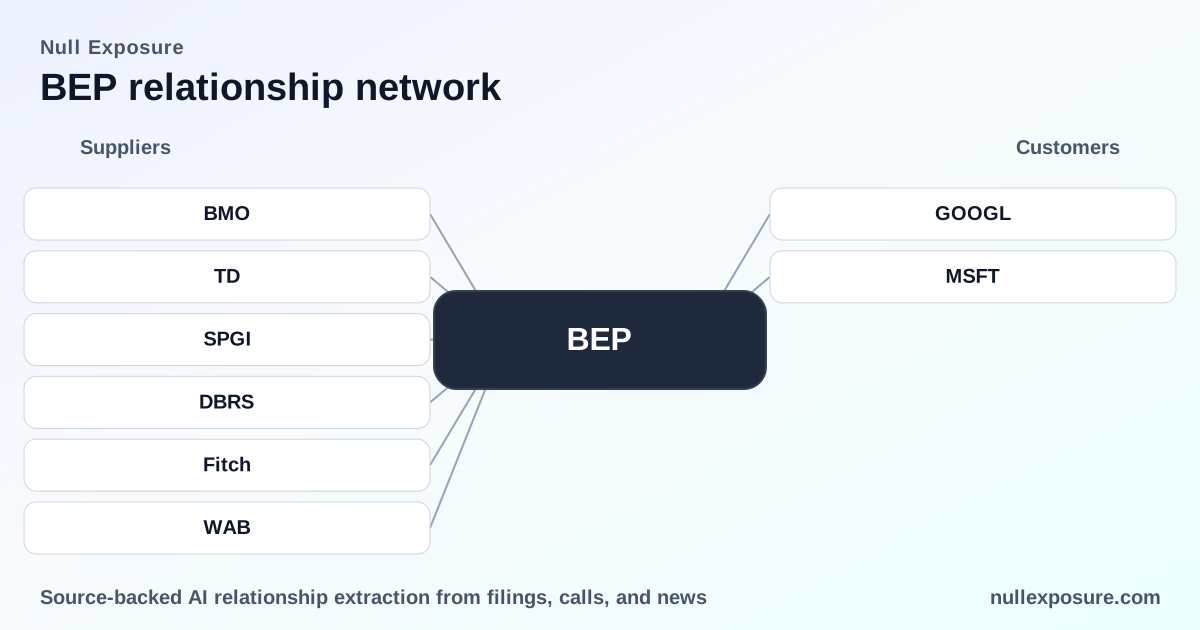
Brookfield Renewable (BEP) — the supplier relationships that underwrite capital and operations
Brookfield Renewable Partners LP owns and operates a diversified global portfolio of renewable generation assets and monetizes through long-term power contracts, merchant sales and active capital markets activity—issuing equity and green debt to finance growth and refinance assets. The company’s supplier footprint for investors is as much about financing partners and ratings agencies as it is about engineering and fuel suppliers, because continued access to capital and long-term service contracts directly affects cash yield and growth optionality. Learn more about supplier risk and connectivity at https://nullexposure.com/.
Why supplier relationships matter for a capital-intensive renewables owner
BEP is a capital-heavy platform. That means two supplier archetypes dominate its risk profile: capital providers (underwriters, distribution agents, and rating agencies) and long-duration operational partners. The former shape cost of capital and liquidity; the latter influence operating availability and lifecycle costs. As a company-level signal, the disclosure set contains no explicit supplier constraints, which indicates there are no announced supplier-specific restrictions or penalties disclosed in the reviewed materials — but the financing relationships disclosed are actively shaping near-term capital strategy.
- Contracting posture: BEP contracts investment banks as distribution agents for equity offers and relies on external rating agencies to support debt issuance. These are predominantly transactional but repeat engagements indicate established market access.
- Concentration: The distribution of capital roles across multiple banks (Canadian and U.S. agents) reduces single-counterparty concentration risk; rating coverage across three agencies disperses rating dependency.
- Criticality: Ratings and distribution agents are critical to financing; long-term service partners (e.g., for reactor projects) would be strategic and operationally critical over decades.
- Maturity: Capital-market relationships are mature and institutionally standard; operational counterparties tied to multi-decade projects imply long-term counterparty exposure.
Explore a deeper mapping of BEP’s supplier landscape at https://nullexposure.com/.
Counterparty-by-counterparty: what each relationship means for investors
BMO Capital Markets Corp.
Brookfield named BMO Capital Markets Corp. as one of the U.S. agents under an equity distribution agreement used to offer BEPC shares, which signals BMO’s role in underwriting and market distribution for Brookfield’s equity issuance. According to a Brookfield announcement reported on Yahoo Finance in March 2026, BMO is part of the syndicate executing the equity distribution agreement.
BMO Nesbitt Burns Inc.
BMO Nesbitt Burns Inc. is listed among the Canadian agents in the same equity distribution agreement, indicating Brookfield’s use of domestic Canadian dealer capacity in parallel with U.S. desks to place BEPC shares in North American markets. This was disclosed in Brookfield’s market-equity announcement carried by Yahoo Finance (Mar 2026).
TD Securities Inc.
TD Securities Inc. is one of the Canadian agents named on the distribution agreement, sharing placement and underwriting duties for the BEPC share offering and providing Brookfield with additional capital-markets distribution bandwidth in Canada. The role is described in the Brookfield announcement reported on Yahoo Finance (Mar 2026).
TD Securities (USA) LLC
TD Securities (USA) LLC functions as a U.S. agent within the same distribution agreement, complementing its Canadian affiliate and enhancing Brookfield’s cross-border execution capacity for equity placements. Brookfield’s press release as reported on Yahoo Finance (Mar 2026) lists the U.S. and Canadian agents together.
S&P (Standard & Poor’s)
S&P is cited among rating agencies that have rated Brookfield’s issuance in the BBB range, which supports BEP’s ability to issue long-dated green bonds at investment-grade-adjacent levels and influences borrowing costs. The rating coverage was noted in reporting on Brookfield’s bond issuance in The Globe and Mail (Mar 2026).
DBRS
DBRS is listed alongside S&P and Fitch as a ratings provider that has assigned a BBB-range rating to Brookfield’s obligations, providing a second independent credit view that underpins the firm’s bond issuance strategy. This was disclosed in press coverage of Brookfield’s green bond (The Globe and Mail, Mar 2026).
Fitch
Fitch joins S&P and DBRS as a rating agency referenced in coverage of Brookfield’s long-dated green bond, collectively giving investors three distinct credit lenses in the BBB range, a meaningful signal for fixed-income investors assessing default and spread risk. The Globe and Mail reported these ratings in March 2026.
Westinghouse
Brookfield referenced a strategic long-term arrangement with Westinghouse in an earnings-call transcript that highlights collaborative development of multiple reactors and ongoing provision of fuel and maintenance services over an eighty-plus year lifespan—this is a long-duration operational partnership that delivers lifecycle value and creates decades-long service commitments. The detail was discussed during Brookfield’s Q4 2025 earnings call transcript published on InsiderMonkey (reported March 2026).
What investors should take away — capital and operational levers
Brookfield’s disclosed supplier relationships demonstrate a dual focus on capital markets execution and long-term operational partnerships:
- Capital access is diversified and institutional. Brookfield uses both Canadian and U.S. dealers for equity distribution and benefits from broad rating coverage (S&P, DBRS, Fitch), supporting institutional demand and manageable funding spreads for green-bond issuance. The Globe and Mail coverage of the bond issue (Mar 2026) and the Yahoo Finance release on equity distribution (Mar 2026) corroborate this funding strategy.
- Operational counterparties are long-tail commitments. The Westinghouse reference (Q4 2025 earnings call) shows BEP engages in multi-decade service arrangements that lock in operational dependency but also secure lifecycle cost predictability and technical expertise.
- Risk profile is financing-driven in the near term. Rating actions or a reduction in distribution capability would materially affect refinancing costs and growth funding; conversely, stable ratings and active dealer support sustain growth optionality.
- No explicit supplier constraints were disclosed in the reviewed materials, which is a company-level signal that there were no announced supplier-imposed restrictions affecting operations or funding during the covered period.
Investment checklist and final judgement
For investors and operators evaluating BEP supplier relationships, focus your diligence on three items: credit-rating trajectory, banking syndicate depth for future equity issuance, and the contractual terms of any long-duration operational partnerships (penalties, replacement clauses, and cost escalators). These levers control cost of capital, access to liquidity, and operational continuity.
- Monitor rating updates from S&P, DBRS and Fitch for shifts that would change borrowing spreads.
- Track equity-distribution agreements and syndicate composition to gauge Brookfield’s access to retail and institutional demand.
- Review the terms and guarantees in long-term service arrangements (the Westinghouse reference underscores the potential scale and duration of such commitments).
If you want a full supplier risk map and actionable monitoring for BEP, visit https://nullexposure.com/ for tailored exposure analysis. For institutional teams assessing counterparty concentration and contract clauses, detailed supplier profiles and monitoring tools are available at https://nullexposure.com/.
Brookfield Renewable’s supplier relationships evidence a mature capital-markets playbook complemented by strategic long-term operational partners; for investors, the financing relationships are the primary lever to watch, while operational contracts provide long-duration stability that supports predictable cash flow — both are decisive inputs into valuation and risk management.