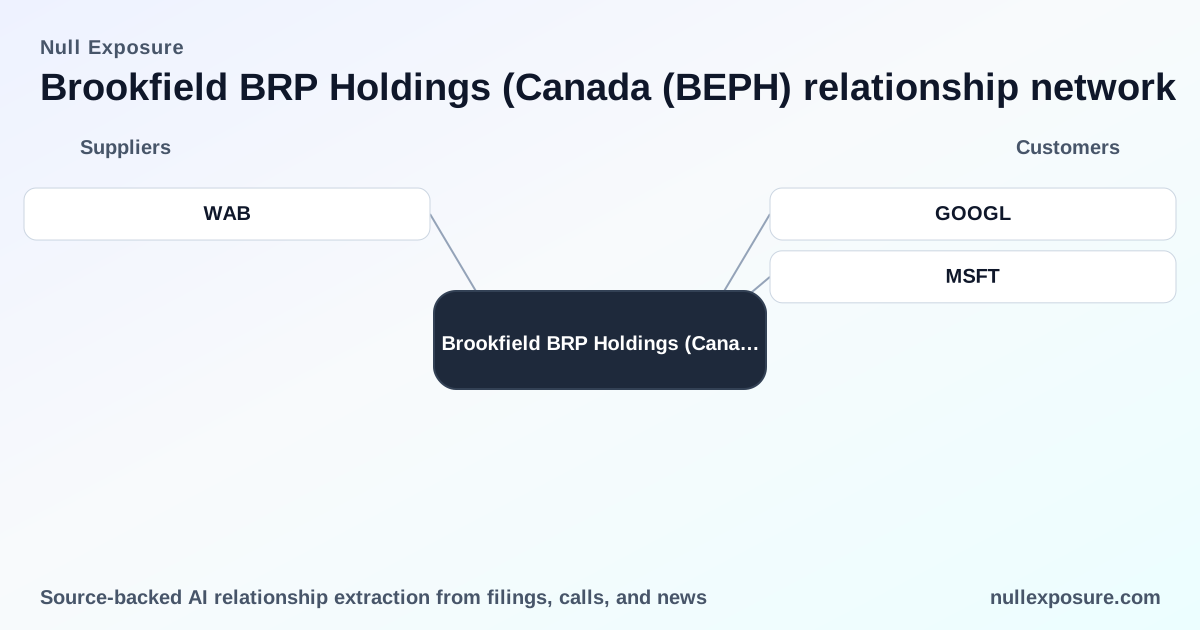
Brookfield BRP Holdings (BEPH): Supplier Relationships and Strategic Implications for Investors
Brookfield BRP Holdings (BEPH) operates as an investment holding/management vehicle focused on renewable energy and infrastructure assets, monetizing through asset ownership, recurring cash distributions, and capital appreciation tied to long‑dated infrastructure cash flows. The company distributes a material yield to investors (reported dividend yield ~7.93% with a dividend date of 2026-01-30) while using strategic equity stakes to secure exposure to technologies and contractors that underpin its asset base. For investors evaluating supplier or partner risk, BEPH’s disclosed supplier interactions provide a direct window into where management is allocating strategic capital and technical dependence.
Explore deeper supplier intelligence at https://nullexposure.com/.
What the Westinghouse tie means for BEPH’s exposure and strategy
BEPH management disclosed a direct investment in Westinghouse, describing it as a strategic exposure to “critical technology for current and future electricity grids given its scale and baseload characteristics.” This is a clear signal that BEPH is positioning for baseload and long-duration power assets as part of its renewable/infrastructure mix, gaining technology and supply-chain exposure through equity rather than purely commercial contracting. According to the 2025 Q4 earnings call transcript (published 2026-03-08), management said: “Only slightly more than two years ago, we invested in Westinghouse…” This places the original investment around early 2024 and frames Westinghouse as a deliberately chosen strategic partner for grid-scale power capability.
Supplier relationships (complete, single-entry list)
- Westinghouse — BEPH invested in Westinghouse to gain exposure to large-scale baseload technology and the broader electricity-grid opportunity; management referenced that investment on the 2025 Q4 earnings call (transcript dated 2026-03-08). (Source: BEPH 2025Q4 earnings call — beph-2025q4-earnings-call.)
How that relationship changes the risk/reward profile
The Westinghouse stake materially alters BEPH’s supplier exposure in three ways: first, it converts a portion of supplier risk into equity upside by investing in a technology vendor; second, it creates direct technological dependence on a single supplier for baseload capability, increasing strategic concentration even as it captures potential upside from the vendor’s growth; third, the position accelerates BEPH’s exposure to nuclear or advanced baseload technologies as part of its energy transition thesis. These characteristics make counterparty performance and regulatory outcomes more central to BEPH’s returns than if the firm maintained only traditional supplier contracts.
Company-level supply/contracting signals and constraints
There are no supplier constraints explicitly recorded in the public supplier-scope data for BEPH. As a company-level signal, that absence itself is informative: BEPH’s approach emphasizes strategic equity investments and forward-looking partnerships rather than publicly disclosed, distributed supplier contracts. Key operating model characteristics implied by the public record:
- Contracting posture — Strategic investor: BEPH secures exposure through equity stakes rather than exclusively transactional supplier agreements, indicating long-term, aligned relationships.
- Concentration — High single-counterparty importance: The public disclosure highlights Westinghouse as a prominent supplier/partner; strategic investments concentrate operational and regulatory risk around few technology providers.
- Criticality — High: The partner cited supplies core baseload capability, which is central to BEPH’s grid-facing asset strategy and revenue durability.
- Maturity — Established but recent: The Westinghouse investment dates to roughly early 2024; the relationship is strategically formed but still maturing into operational integration and revenue contribution.
These are company-level signals derived from disclosed supplier mentions and the absence of recorded constraints, and they should inform diligence on concentration and counterparty governance.
Practical implications for investors and operators
For investors, the Westinghouse tie is both an upside lever and a concentrated risk. Upside derives from ownership exposure to a supplier whose technology could command premium margins if baseload demand reaccelerates; risk arises from regulatory, schedule, or performance disruptions at that single partner. For operators, the relationship signals a need to prioritize integration planning, contract protections, and contingency capacity to protect operating cash flows.
Things to monitor next:
- Regulatory outcomes and certification timelines for Westinghouse technologies in target markets.
- Any disclosure that expands BEPH’s supplier list or shifts exposure from equity positions to long‑term service contracts.
- Operational KPIs tying Westinghouse performance to asset availability and cash distributions.
If you want a tailored supplier-risk briefing for BEPH’s portfolio, visit https://nullexposure.com/ for structured supplier intelligence.
Risk factors that change the investment thesis
- Concentration risk: A strategic equity stake in a single technology provider amplifies idiosyncratic vendor risk.
- Regulatory and policy risk: Baseload technologies are subject to permitting, licensing, and political scrutiny that can materially affect timelines and returns.
- Execution risk: Technology deployment and supply‑chain execution drive near-term cash generation from projects; delays would compress distributions.
- Disclosure risk: The public record is thin on broader supplier relationships, which can mask counterparty exposure not yet disclosed.
Actionable next steps for diligence
- Request direct disclosures on the size and governance terms of the Westinghouse investment and any related offtake or service agreements.
- Validate scenario analyses linking Westinghouse delivery timelines to BEPH cash flow forecasts.
- Assess contingency and replacement strategies for baseload technology if vendor performance lags.
For a concise supplier-map and monitoring plan tied to BEPH’s holdings, see the resources available at https://nullexposure.com/.
BEPH’s public supplier signal—an equity stake in Westinghouse—turns upstream technology performance into a central value driver. Investors should treat that exposure as strategic: a potential alpha source if Westinghouse scales successfully, and a concentrated risk that deserves active governance and scenario planning.