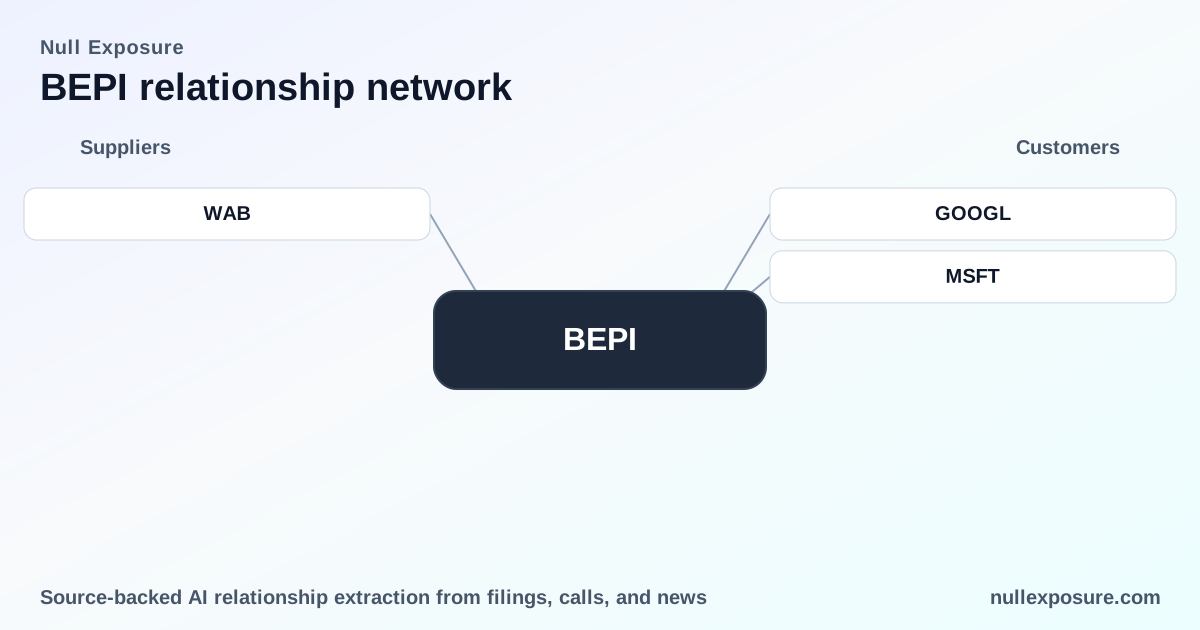
BEPI: Strategic owner, infrastructure operator, and targeted technology investor
Brookfield BRP Holdings (BEPI) operates as a closed-loop infrastructure and real estate owner-operator under the Brookfield umbrella, monetizing through asset ownership, operational cash flow and value creation across long-lived assets. Revenue and returns are generated by owning high-quality infrastructure and real estate, driving cash yields and capital appreciation while leveraging Brookfield’s platform for sourcing and active management. For supplier and partner analysis focused on counterparty criticality and strategic fit, see more at https://nullexposure.com/.
How BEPI makes money and what that means for supplier relationships
BEPI’s operating model is concentrated on ownership and active management rather than transactional service provision. Cash flow derives from rents, utility-like infrastructure fees and project-level returns; management’s role is to extract operational upside through capital allocation and optimization. This structure produces long-term contracting postures, high partner switching costs for critical services, and a premium on counterparty reliability—traits investors and operators must consider when assessing supplier exposures.
BEPI’s parentage under Brookfield Asset Management gives it access to global sourcing and technical capabilities, so supplier relationships typically reflect strategic, long-horizon commitments rather than spot-market purchases. That posture drives two investor-relevant signals: counterparties that service BEPI are likely to be strategic and mission-critical, and concentration risk is a live factor where a small number of specialized suppliers support large, capital-intensive assets. For practical diligence on these supplier dynamics, visit https://nullexposure.com/.
What the Westinghouse relationship reveals
During BEPI’s 2025 Q4 earnings call (released March 2026), management disclosed that the company invested in Westinghouse “slightly more than two years ago,” framing that move as a way to “gain exposure to this critical technology for current and future electricity grids.” This confirms BEPI’s deliberate pivot toward energy infrastructure technologies that underpin grid decarbonization and baseload reliability. According to the earnings call transcript, the Westinghouse stake is a strategic investment intended to secure access to nuclear technology capability as part of BEPI’s infrastructure portfolio.
- Westinghouse — BEPI invested in Westinghouse slightly over two years prior to the 2025 Q4 call to secure exposure to nuclear technology and grid-critical capacity; the disclosure comes from the BEPI 2025 Q4 earnings call (March 2026). (Source: BEPI 2025 Q4 earnings call, March 2026.)
Full list of supplier/partner relationships disclosed in the record
Below is every relationship captured in the available results, summarized in plain language with source attribution.
- Westinghouse: BEPI disclosed during its 2025 Q4 earnings call that it invested in Westinghouse a little over two years earlier to obtain exposure to nuclear technology that is “critical” to present and future electricity grids. This statement was made on the 2025 Q4 earnings call in March 2026. (Source: 2025 Q4 earnings call, BEPI.)
Company-level constraints and operational signals for investors and operators
The supplied record contains no explicit constraints documents or supplier contract excerpts. That absence itself is a company-level signal: there are no publicly provided constraint excerpts in the dataset to indicate supplier-specific terms, exclusivity clauses or short-term supply interruptions. Investors and operators should therefore treat the following operational characteristics as BEPI-level signals derived from its business model and the disclosed relationship activity:
- Contracting posture — long-duration, strategic contracts. BEPI’s ownership model and the investment in a strategic technology provider indicate preference for long-term alignment over spot procurement.
- Concentration risk — targeted relationships matter more. A disclosed strategic investment in Westinghouse implies reliance on a small set of specialized providers for critical capabilities, increasing supplier criticality even if overall supplier count is moderate.
- Criticality — technology and services tied to core revenue streams. Infrastructure and grid technologies are core to BEPI’s ability to generate stable cash flow; partners that enable those technologies are operationally critical.
- Maturity of relationships — strategic investments signal active portfolio integration. Taking an equity stake in a supplier/technology provider suggests BEPI seeks to move beyond arm’s-length contracting toward integrated, aligned partnerships.
Because no contractual constraints are present in the data, diligence should emphasize commercial terms, service-level commitments, and escalation protocols when reviewing any supplier relationship.
Investment implications and operator checklist
For investors and asset operators evaluating BEPI-supplied relationships, the Westinghouse disclosure and company model produce a concise risk/reward framework:
- Opportunity — strategic upside from owning exposure to foundational energy technology. Equity exposure to technology vendors can accelerate BEPI’s ability to capture value from decarbonization trends.
- Risk — single-provider criticality and regulatory sensitivity. Nuclear technology partners operate in regulated, capital-intensive segments; counterparty failure or regulatory setbacks would have outsized operational impact.
- Due diligence priorities: obtain contract term length, exclusivity conditions, liability and indemnity language, service-level metrics, and regulatory compliance history; validate counterparties’ financial strength and backlog.
Operators assessing supplier relationships should prioritize operational redundancy planning and contractual protections that convert strategic dependencies into managed risks.
For a deeper schematic of supplier risk, third-party validation and portfolio-level concentration analysis, check our resources at https://nullexposure.com/.
Bottom line: strategic ownership changes the supplier calculus
BEPI’s reported investment in Westinghouse confirms a deliberate strategy to internalize access to grid-critical technologies and reflects the broader Brookfield approach of combining capital with operational control. That strategy increases the importance of supplier selection, elevates concentration risk where suppliers provide foundational technology, and creates long-dated contracting dynamics that favor integrated partnerships over transactional suppliers.
Investors and operators evaluating BEPI should prioritize contract-level transparency, contingency planning for critical providers, and monitoring of regulatory exposures tied to energy infrastructure. For hands-on supplier risk research and ongoing monitoring tailored to owners and operators, visit https://nullexposure.com/ before finalizing counterparty decisions.