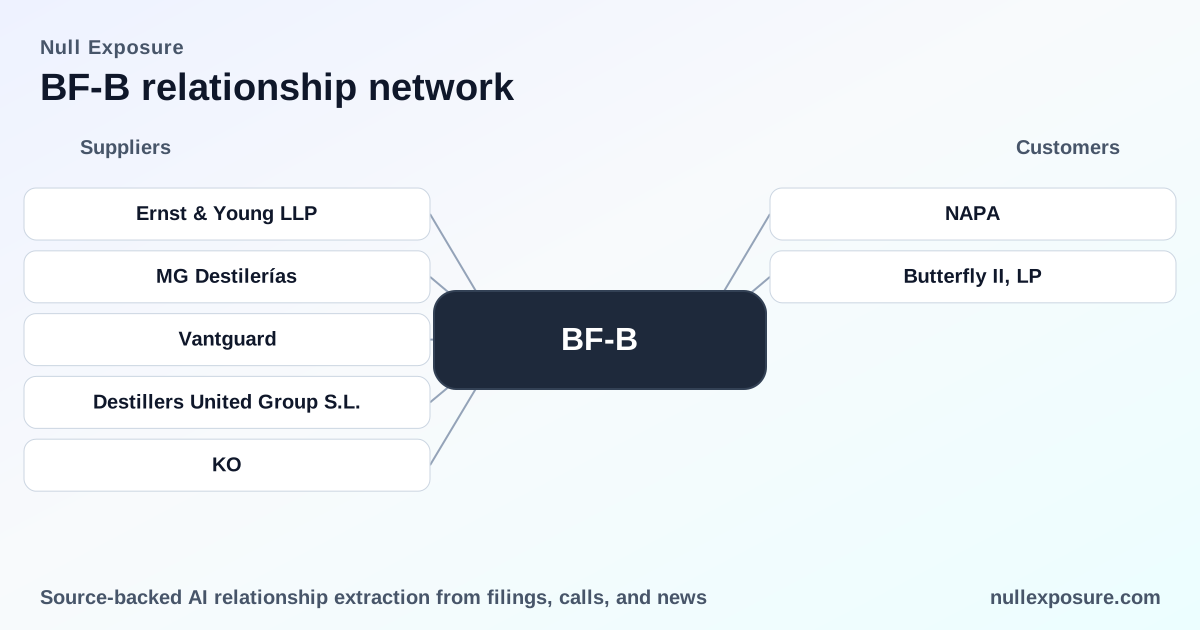
Brown‑Forman (BF‑B): supplier relationships that shape cash flow and operational risk
Brown‑Forman monetizes a global portfolio of premium spirits and wines by owning iconic brands, controlling production and global distribution, and extending reach through selective partnerships and acquisitions. The business model converts brand equity into recurring wholesale and retail sales, while acquisitions and long‑dated supply agreements lock in manufacturing capacity and distribution economics that stabilize margins. For investors, supplier and partner links determine margin durability and execution risk as much as advertising or shelf placement.
Visit the Null Exposure research hub for comparable supplier intelligence: https://nullexposure.com/
How Brown‑Forman structures sourcing and integration — the operating pattern investors should expect
Brown‑Forman runs a vertically focused consumer‑defensive operation: it owns brands, controls much of the production pipeline for flagship products, and supplements capacity through contracted suppliers when it acquires third‑party labels. Acquisitions are followed by binding supply agreements that transfer manufacturing responsibility while protecting the acquirer’s access to product under market terms. That operating posture produces predictable cost structures but increases reliance on third‑party producers where the company does not internalize distillation or aging capacity.
The company’s contracting posture shows maturity: long‑term supply arrangements after brand purchases, explicit ten‑year initial terms for certain acquired brands, and continuity mechanisms that reduce near‑term execution risk while creating medium‑term dependency on a handful of counterparties. Those dynamics are a signal of steady cash flow conversion, but they also concentrate operational exposure into those supplier relationships.
The supplier and partner relationships investors need to track
Ernst & Young LLP
Brown‑Forman’s stockholders ratified Ernst & Young LLP as the company’s independent registered public accounting firm for fiscal year 2025, underscoring a conventional external audit relationship consistent with large, publicly listed consumer companies. According to Brown‑Forman’s shareholder announcement, EY was the ratified auditor in FY2025. (Brown‑Forman press release, FY2024)
MG Destilerías (Gin Mare transaction)
Brown‑Forman completed the purchase of the Gin Mare brands and announced that, at the acquisition date, it entered into a supply agreement for production and supply of Gin Mare products on market terms with an initial 10‑year term (subject to renewal), which channels manufacturing risk to the sellers while securing supply for Brown‑Forman. (Brown‑Forman press release, November 3, 2022)
Vantguard (Gin Mare transaction)
The Gin Mare acquisition announcement lists Vantguard alongside MG Destilerías as sellers; Brown‑Forman completed the purchase and implemented the same multi‑year supply arrangement to ensure continuity of Gin Mare production under the new ownership structure. (Brown‑Forman press release, November 3, 2022)
Destillers United Group S.L. (Diplomático Rum)
Brown‑Forman reached an agreement to purchase the Diplomático Rum brand and related assets from Destillers United Group S.L.; the company disclosed a post‑acquisition supply agreement covering rum production for an initial 10‑year period, locking in source availability while it integrates the brand. (Brown‑Forman press release, October 6, 2022)
Coca‑Cola Co.
Brown‑Forman formed a distribution/partnership with Coca‑Cola to roll out premixed Jack‑and‑Coke cocktails, leveraging Coca‑Cola’s global channel strength to accelerate ready‑to‑drink (RTD) volume expansion and broaden Brown‑Forman’s off‑premise reach. A media report covering the June 2022 announcement highlighted the strategic channel lift from the Coca‑Cola partnership. (Winnipeg Free Press, June 13, 2022)
What the relationships collectively tell investors about risk and return
- Predictable gross margin profile: Long‑term supply agreements for acquired brands convert acquisition upside into predictable COGS and help preserve gross margins during integration periods. The 10‑year initial supply terms for Gin Mare and the acquired rum brand are explicit examples of this approach.
- Execution concentration: Reliance on specific sellers for production creates concentration risk; if a supplier faces capacity or quality issues, Brown‑Forman’s ability to deliver product for fast‑growing SKUs is constrained.
- Distribution optionality via partnerships: The Coca‑Cola collaboration is a distribution multiplier that materially increases GTM velocity for premixed products, shifting the revenue mix toward faster‑growing RTD channels without immediate capital investment in new bottling or logistics.
- Corporate controls and governance: Maintaining an established Big Four auditor (Ernst & Young LLP) signals standard governance and reporting practices appropriate for institutional investors focused on audited financials and internal controls.
Investment implications and what to monitor next
Brown‑Forman’s supplier footprint supports a conservative yet acquisition‑oriented growth profile. For investors evaluating BF‑B supplier relationships, the key monitoring items are:
- Contract renewals and duration: Confirm when the initial 10‑year terms for Gin Mare and the acquired rum assets enter renewal windows and whether renewal economics remain market‑based.
- Integration indicators: Track shelf distribution, promotional cadence, and margin convergence over the first 24 months post‑acquisition for Gin Mare and Diplomático to assess whether the supply handoff preserves brand quality and margin.
- RTD execution: Measure sell‑through and gross‑margin contribution from the Coca‑Cola premixed partnership as a barometer of Brown‑Forman’s ability to scale non‑traditional formats.
- Supplier concentration events: Watch for supplier outages, regulatory headwinds in origin countries, or quality recalls that would immediately affect availability of aged spirits and bottling schedules.
Visit the Null Exposure research hub for an in‑depth supplier map and ongoing alerts: https://nullexposure.com/
Bottom line: where the supplier picture strengthens or weakens the investment case
Brown‑Forman’s model converts brand power into steady cash flows by combining owned production with long‑dated supply contracts and selective distribution partnerships. Those arrangements reduce short‑term execution volatility and stabilize margins, but they transfer concentrated operational exposure to a small set of counterparties and require active monitoring of contract renewals and integration performance. For investors, the company’s supplier set is a feature, not a bug: it is core to how Brown‑Forman scales acquired brands while preserving balance‑sheet discipline.
If you want continuous supplier signals and event alerts tied to Brady‑Forman’s counterparties, explore the analytical tools and relationship monitoring on our site: https://nullexposure.com/