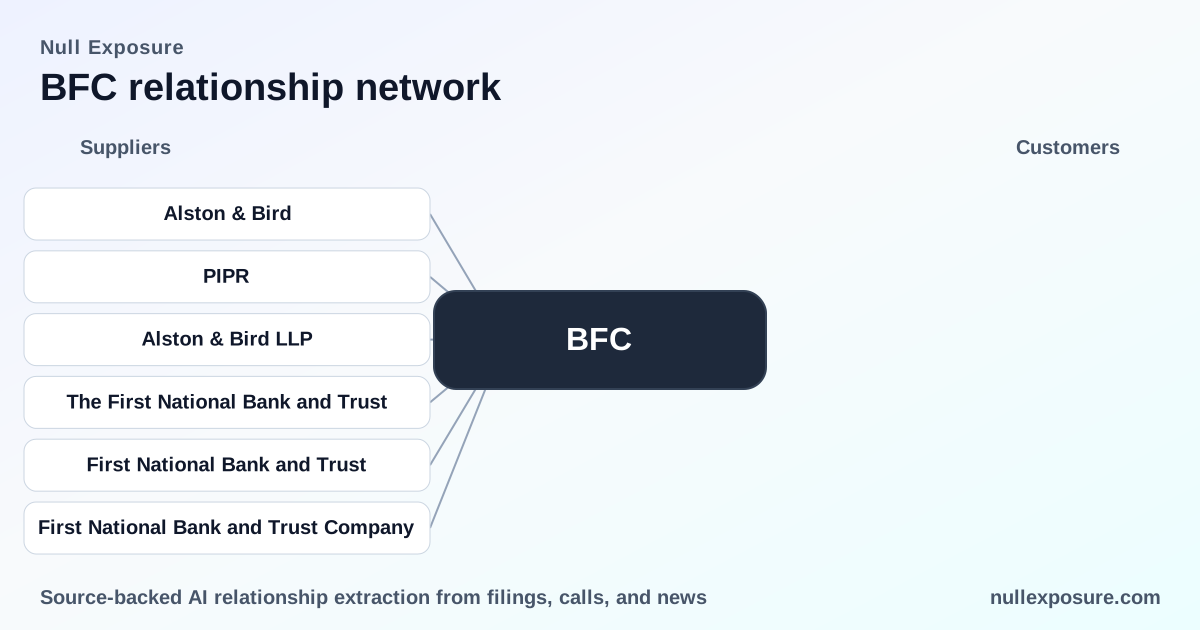
Bank First (BFC) supplier map: advisors, counterparties and the operational constraints that matter
Bank First Corporation is a Wisconsin-based regional bank that monetizes by providing deposit, lending and wealth-management services to local businesses and consumers, and it amplifies scale through acquisitions and strategic partnerships. Recent deal activity shows the company relies on external financial and legal advisors for M&A execution and on peer banks for selected wealth capabilities; operationally it runs long-term real estate leases and outsources key technology and transaction services, which shapes supplier risk and continuity priorities. For a concise view of supplier exposure and contractual posture, see https://nullexposure.com/.
M&A gives a clear window into supplier roles
Bank First’s announced acquisition of Centre 1 Bancorp puts advisors and nearby banks in visible operational roles: Piper Sandler acted as financial advisor and Alston & Bird supplied legal counsel, while customers will gain access to wealth services connected to First National Bank and Trust. These relationships are transaction-focused but carry ongoing integration requirements—legal, advisory and third‑party service providers will be relied upon through closing and post-close integration. A PR Newswire release in March 2026 outlines the transaction and advisors involved.
If you’re mapping counterparty risk in a portfolio or underwriting diligence, this deal is a useful bellwether — review counterparties and their contract tenors at https://nullexposure.com/.
Relationship inventory: the counterparties named in public filings and press
Alston & Bird
Alston & Bird is listed as Bank First’s legal counsel for the Centre 1 Bancorp acquisition, responsible for transaction documentation and regulatory navigation; this role is documented in press coverage of the deal. According to a PR Newswire release (March 2026), Alston & Bird LLP served as legal counsel to Bank First.
Alston & Bird LLP
Alston & Bird LLP is referenced again in multiple outlets as the law firm representing Bank First on the transaction, reinforcing that outside counsel is centralized with a large national firm for regulatory and transactional risk management. Pulse2 and StockTitan both reference Alston & Bird LLP in March 2026 coverage of the deal.
Piper Sandler
Piper Sandler served as Bank First’s financial advisor on the Centre 1 transaction, executing valuation, deal structuring and fairness advisory functions; the firm is referenced by name in news reports covering the acquisition. Multiple sources, including a PR Newswire release and Pulse2 (March 2026), identify Piper Sandler’s advisory role.
Piper Sandler & Co.
Piper Sandler & Co. (ticker: PIPR in public markets) is the formal advisory entity named in press materials as Bank First’s financial advisor for the acquisition; this confirms the engagement was handled through the firm’s corporate advisory practice rather than an in‑house boutique. StockTitan and PR Newswire mention Piper Sandler & Co. in March 2026.
The First National Bank and Trust
The First National Bank and Trust is cited as the wealth-management counterparty whose services Bank First customers will gain access to following the Centre 1 transaction, indicating a product-level partnership rather than an equity acquisition. Industry reporting (Pulse2 and Banking-Gateway, March 2026) notes that Bank First customers will have access to wealth management services from First National Bank and Trust.
First National Bank and Trust Company
First National Bank and Trust Company is referenced in the corporate announcement as the wealth-services provider that enriches Bank First’s post-acquisition customer offering, underlining a contractual relationship with product implications for customers and integration requirements for operations teams. PR Newswire (March 2026) and related news outlets list First National Bank and Trust Company in the transaction release.
What the relationship set says about contracting posture and operational risk
Bank First’s public disclosures and transaction filings reveal several company-level constraints that shape supplier strategy:
-
Long-term contracting posture: The company recognizes operating leases on the balance sheet with a weighted average lease term in the high‑20s to 30 years, indicating long-dated real estate commitments for branches and a tendency to lock in physical footprint for decades. This reduces short‑term flexibility but creates predictable occupancy costs and raises the importance of landlord/lease counterparty diligence.
-
Third-party services are material and critical: Filings state that Bank First oversees third‑party service providers that deliver material services to the business—core technology, cloud operations, data processing and online banking interfaces are explicitly called out. This confirms outsourcing of critical technology and transaction plumbing, raising concentration and continuity risk if a provider underperforms.
-
Licensee and ROU accounting posture: Bank First treats leases where it is the lessee under the right‑of‑use model, reflecting a standard banks’ capitalized lease profile and the governance implications of having long-term license/lease relationships on balance sheet.
-
Active, renewing relationships: The company notes vendors are actively providing these services and that options to extend and renew leases are normally exercised, suggesting mature, long-lived supplier relationships rather than short pilot arrangements.
Taken together, these signals produce a clear supplier-management brief: prioritize continuity plans, validate long-term vendor performance metrics, and treat large advisory and wealth partnerships as strategic integrations rather than one-off engagements.
For tactical supplier scoring and exposure mapping, start a review at https://nullexposure.com/.
Investment and operational implications — what to watch
-
Integration risk is front-and-center: Advisors (Piper Sandler) and counsel (Alston & Bird) reduce execution risk on the transaction, but post-close integration with wealth partners (First National Bank and Trust) and internal systems will be the determinant of realized synergies.
-
Concentration of critical services: The company-level disclosure that core tech, online banking and processing are outsourced means failure or degradation at a major provider would have outsized impact; investors should request vendor concentration metrics and service-level performance history.
-
Capital and balance-sheet effects from leases: The long-weighted lease terms imply sticky occupancy costs; operators should model lease commitments into branch rationalization and cost-savings plans.
-
Counterparty credit and reputational risk: Using large, reputable advisors and counsel is a strength, but wealth-service partnerships introduce counterparty exposure and operational dependencies that need contractual clarity on data handling, client transition, and fee-sharing.
Bottom line: focus remediation on continuity and integration
Bank First’s supplier footprint for the Centre 1 acquisition combines transaction advisors (Piper Sandler), national legal counsel (Alston & Bird) and a product partnership with First National Bank and Trust to broaden wealth offerings. Company-level constraints point to long-term lease commitments and critical outsourced technology, so the practical priorities for investors and operators are vendor concentration analysis, SLA and continuity testing, and rigorous integration planning for wealth and back‑office systems.
If you want a structured supplier risk assessment or to benchmark BFC’s counterparties against peers, explore how we surface these relationships and constraints at https://nullexposure.com/.
Bold counterparties, long-term commitments, and material outsourced services define the operational risk profile here — investors should treat these as central inputs to valuation and operational diligence.