Bread Financial Holdings (BFH): an investor-oriented read on supplier relationships
Bread Financial Holdings operates as a consumer lending and payments technology company, underwriting and servicing credit products while monetizing through interest income, fees and payment-processing services across North America. The company's model is capital-light on payments technology while capital-intensive on credit risk, generating recurring cash flow from a loan portfolio and ancillary merchant/payment revenues. For investors evaluating counterparties and operational risk, the composition of BFH’s supplier base — particularly its cloud and servicing arrangements — is essential to stress-test continuity and scalability. Visit the NullExposure homepage for a full supplier mapping and tailored diligence tools: https://nullexposure.com/
What the public supplier signals show — short version
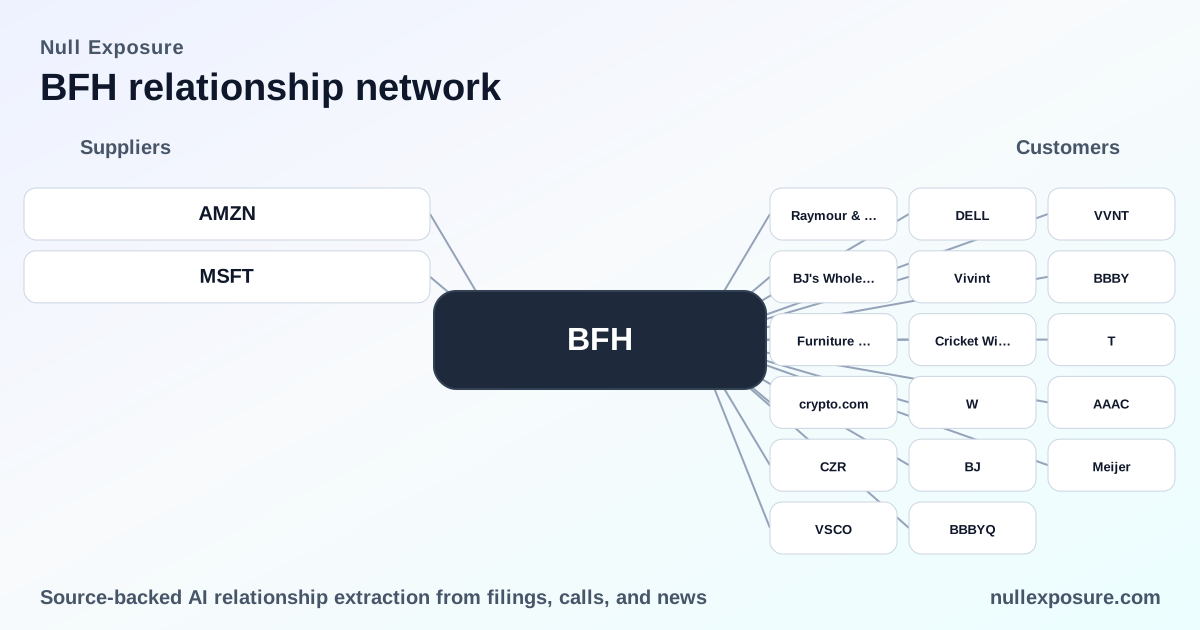
Public records and news coverage tied to BFH's FY2026 disclosure identify major cloud partners that underpin the company’s technology stack. Amazon Web Services and Microsoft are named explicitly as cloud infrastructure partners supporting BFH’s platforms, a fact BFH discloses in its SEC-related commentary for FY2026. This places BFH squarely on the mainstream hyperscaler model for reliability, scalability and third-party risk — with the attendant operational and commercial implications discussed below.
Amazon Web Services (AWS)
BFH lists Amazon Web Services as a partner supporting its cloud infrastructure; this is cited in coverage of BFH’s SEC 10‑K commentary in March 2026. AWS provides the scalable compute and storage backbone that runs critical lending and payments systems, so any prolonged AWS outage or material contractual disruption would directly affect BFH’s operational continuity. (TradingView coverage of BFH’s SEC filing, March 9, 2026: https://www.tradingview.com/news/tradingview:f6f6047c18576:0-bread-financial-holdings-inc-sec-10-k-report/)
Microsoft
Microsoft is named alongside AWS as a cloud infrastructure partner in BFH’s FY2026 disclosures. Microsoft cloud services contribute to BFH’s multi-cloud footprint, likely supporting enterprise tooling and applications complementary to the AWS layer, which spreads vendor risk but creates a multi-party dependency for cross-cloud orchestration. (TradingView coverage of BFH’s SEC filing, March 9, 2026: https://www.tradingview.com/news/tradingview:f6f6047c18576:0-bread-financial-holdings-inc-sec-10-k-report/)
How these supplier relationships fit BFH’s operating model
BFH’s operating model relies on external cloud platforms for core infrastructure while keeping loan servicing functionally internal. The company-level disclosure about its servicer is a clear signal of contracting posture and operational control: BFH reports that “The Servicer is not one of our Bank subsidiaries, but is our wholly‑owned subsidiary that services substantially all of our loans.” That language establishes an in-house servicing posture rather than outsourcing to third-party servicers, and the evidence excerpt supporting that role carries a confidence measure in the source material (reported confidence 0.80).
From that foundation investors should note these characteristics:
- Contracting posture: BFH operates a hybrid model — internal servicing of loans combined with third-party hyperscaler infrastructure for technology. That gives BFH tighter control over credit operations while outsourcing non-core infrastructure to specialized providers.
- Concentration and vendor profile: Use of AWS and Microsoft signals dependence on two dominant hyperscalers. While multi-cloud reduces single-provider lock-in, it creates concentrated exposure to a small set of global vendors for network, compute and identity services.
- Operational criticality: Cloud suppliers are mission-critical for customer-facing lending and payment flows; the internal servicer centralizes credit operational risk and reduces operational fragmentation in collections and portfolio management.
- Maturity: Naming major hyperscalers in an SEC-related disclosure is consistent with an enterprise-grade maturity level in IT sourcing and risk reporting for a public financial services firm.
Explore a complete supplier risk profile and workflow diagrams at NullExposure: https://nullexposure.com/
Risk and exposure considerations investors must weigh
The supplier mix creates three practical investor risk vectors:
- Availability and resilience risk. Hyperscaler outages, regional network failures, or supply-chain constraints in cloud capacity translate directly to service interruptions in lending and payments. BFH’s multi-cloud stance mitigates but does not eliminate this exposure.
- Concentration and commercial leverage. Major cloud vendors hold negotiating leverage on pricing, enterprise support and contractual SLAs. Cost inflation or shifts in commercial terms could compress BFH’s margins if not proactively managed or passed through.
- Operational complexity and governance. Running a hybrid model — internal servicing plus multiple cloud vendors — increases integration and compliance burden. BFH’s choice to retain servicing internally is a control-strength but also concentrates operational risk within a single corporate function that must scale with portfolio and product complexity.
These operational considerations sit alongside BFH’s financial profile: Market capitalization roughly $3.19 billion, Revenue TTM approximately $2.603 billion, EBITDA about $682 million, and a trailing P/E near 6.4, indicating markets already price a strong earnings base into the stock. Operational vendor risks therefore translate directly to downside scenarios for earnings multiple stability and credit performance.
Practical implications for operators and counterparties
Operators should treat BFH as a company with a mature, in-house credit operations engine supported by enterprise cloud vendors. For suppliers and partners negotiating commercial terms, recognize that BFH’s internal servicing capability is a bargaining chip: the firm controls core customer and portfolio flows, reducing the upside for third parties to extract outsized margins on servicing functions.
For investors, diligence actions include:
- Verifying SLA language and contingency arrangements in public filings or vendor disclosures.
- Monitoring regional cloud-exposure maps and resilience investments (multi-region deployments, DR tests).
- Reviewing servicing governance, staffing and change-management controls within BFH’s wholly-owned servicer.
Bottom line: what to do next
BFH balances internal control of loan servicing with the scalability of leading cloud providers. That structure supports operational scale and predictable earnings, while concentrating certain vendor risks that require active management by the company and attention from investors. For targeted due diligence and supplier mapping that goes beyond the headlines, visit NullExposure for platform tools and bespoke reports: https://nullexposure.com/
Key takeaway: investors should treat the AWS and Microsoft relationships as infrastructure essentials that materially impact operational continuity, and view BFH’s wholly-owned servicer as a company-level control that materially reduces outsourcing risk but concentrates operational responsibility internally.