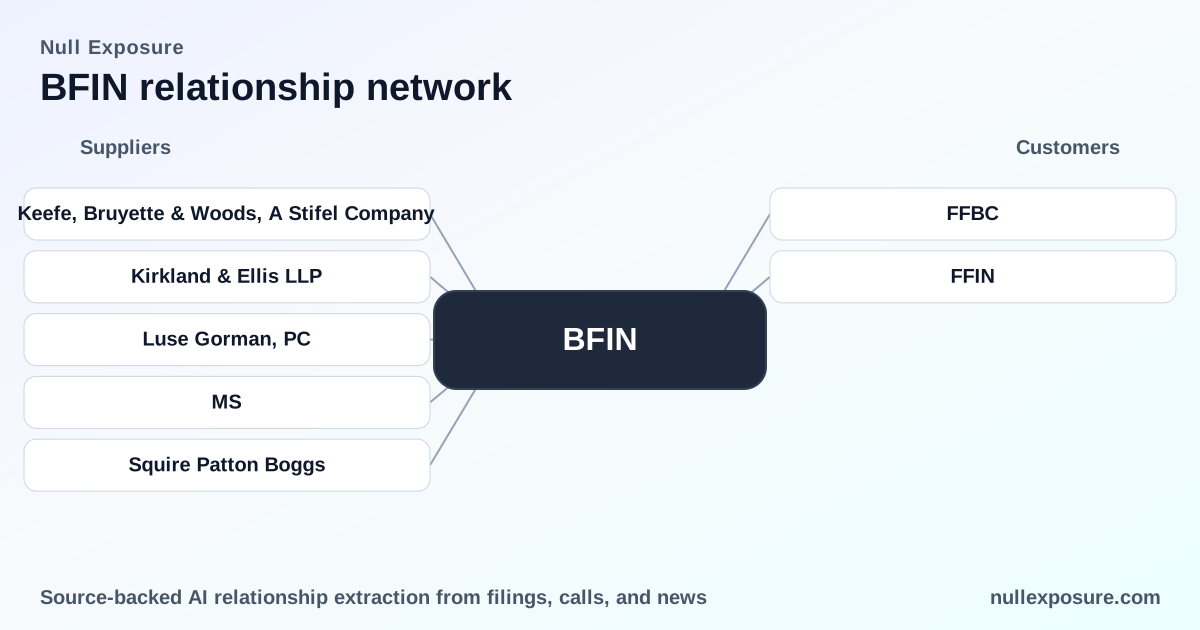
BFIN’s advisor footprint: what the legal and financial lineup reveals to investors
BankFinancial (ticker BFIN) operates as a regional commercial bank and monetizes through traditional banking channels: interest income from lending, margin on deposits, and fee-based services. The recent advisor roster tied to its strategic transaction activity shows a deliberate use of top-tier financial and legal suppliers — a clear signal about the company’s deal posture, governance level, and counterparty selection. For investors and operators evaluating BFIN as a supplier or partner, these relationships are windows into contracting sophistication and corporate priorities.
Explore more on corporate supplier signals at https://nullexposure.com/.
Why the advisor mix matters to investors
BFIN’s choice of counterparties in a strategic process is not cosmetic. Engaging high-caliber advisers and law firms is a deliberate cost that buys execution certainty, regulatory navigation and market credibility. For investors that should translate into:
- A contracting posture that favors established providers over low-cost specialists.
- Low tolerance for execution risk on material transactions, reflected in hiring nationally recognized counsel and banks.
- Evidence of maturity in governance — the company is willing to pay for expertise when market access or regulatory scrutiny is at stake.
These are company-level signals: there are no explicit contract limitations reported in the materials reviewed, and the adviser lineup itself functions as a proxy for how BFIN structures critical supplier relationships.
Who BFIN is working with (and why it matters)
Below are the relationships surfaced in public reporting on the transaction. Each entry is a concise plain-English summary followed by the published source.
-
Keefe, Bruyette & Woods, A Stifel Company — Keefe Bruyette & Woods is serving as financial advisor to BankFinancial on the transaction, implying BFIN selected a specialist bank-sector adviser to manage valuation and market-side execution. Reported by StockTitan (news item, March 9, 2026).
-
Kirkland & Ellis LLP — Kirkland & Ellis is providing legal counsel to BankFinancial, indicating BFIN retained a leading corporate law firm to handle complex deal and regulatory issues. This engagement was noted in StockTitan (news item, March 9, 2026).
-
Luse Gorman, PC — Luse Gorman is also serving as legal counsel to BankFinancial, adding boutique regulatory and banking law capability to the legal team and signaling layered legal coverage for bank-specific regulatory matters. StockTitan reported this role (news item, March 9, 2026).
-
Morgan Stanley (MS) — Morgan Stanley is advising First Financial on the financial aspects of the deal while KBW advises BankFinancial, which frames the transaction as a competitive, cross-advised process rather than a single-adviser negotiation. This was outlined in a Yahoo Finance write-up (March 9, 2026).
-
Squire Patton Boggs — Squire Patton Boggs is acting as legal counsel for First Financial, showing both sides of the transaction leaned on recognized law firms to reduce execution risk and regulatory friction. This was reported on Yahoo Finance (March 9, 2026).
What the relationship map implies for supplier risk and negotiation
The combined picture is unambiguous: BFIN treats material corporate transactions as high-stakes procurements, allocating budget to prominent financial and legal suppliers. Operationally, that produces three practical investor takeaways:
-
Concentration vs. redundancy: BFIN uses multiple, high-end advisors (two law firms plus a specialist bank advisor). That creates redundancy in capability and lowers single-supplier concentration risk on critical legal and financial functions.
-
Criticality of suppliers: The firms involved are core to the transaction outcome — their capabilities are mission-critical during M&A and regulatory reviews. Loss or substitution of those suppliers mid-process would materially affect execution timelines.
-
Maturity and contracting posture: The presence of market-leading advisers signals an institutional approach to contracting: standardized retainer and engagement terms with experienced counsel and bankers, not experimental or bespoke procurement.
Mid-way action: to evaluate how supplier choices affect counterparty risk, review comparative advisor lineups and precedent transactions at https://nullexposure.com/.
Operational constraints and company-level signals
There were no explicit constraint filings or contract excerpts disclosed in the items reviewed. As a company-level signal, the absence of public constraint language combined with the advisor choices suggests:
- Standard public deal mechanics — no reported exclusivity clauses or vendor-specific constraints surfaced in reporting.
- Preference for established, high-trust suppliers rather than low-cost or emergent providers.
- Regulatory sensitivity — the selection of boutique bank-regulatory counsel (Luse Gorman) alongside national firms (Kirkland, Squire Patton Boggs) shows the company anticipates or is responding to regulatory complexity.
These are strategic characteristics of BFIN’s supplier model and are not attributed to any single relationship unless directly referenced in source material.
Near-term monitoring checklist for investors
Investors assessing BFIN as a supplier partner or counterparty should watch for:
- Any amendments to engagement letters or disclosed fee arrangements that would signal negotiation pressure or cost overruns.
- Public filings or press releases that disclose termination provisions, exclusivity, or retention timelines for advisers.
- Regulatory filings or comment letters that could increase legal workload and shift supplier criticality.
For ongoing tracking of supplier relationships and deal counterparties, visit https://nullexposure.com/ for granular coverage and signal extraction.
Bottom line: what to take away
BFIN’s advisor lineup is a positive signal for deal execution and governance — the bank engages recognized financial and legal institutions to manage material transactions, reducing execution risk and demonstrating a mature contracting posture. That approach raises supplier costs but buys predictability and market confidence, which investors should treat as a net positive when assessing BFIN’s strategic risk profile.
To dive deeper into supplier signals and comparable transactions, start at https://nullexposure.com/.