Biofrontera Inc (BFRI): supplier relationships, commercial posture, and what investors should know
Biofrontera Inc commercializes dermatology products in the U.S. by acquiring exclusive licenses, sourcing finished product from related-party manufacturers, and monetizing through direct sales of Ameluz® and RhodoLED® lamps and devices. The company’s revenue base is concentrated on licensed photodynamic therapy products and is monetized via prescription sales and related equipment; recent corporate actions transferred full U.S. asset ownership from the former parent, which reconfigures supplier counterparty risk into ownership and service arrangements. For investors evaluating supplier exposures, the core thesis is simple: BFRI’s commercial upside is tied to maintaining uninterrupted access to Ameluz® supply, regulatory support and lamp availability while managing capital constraints from negative operating margins and modest market capitalization. Read on for relationship specifics and a focused assessment of operational constraints. If you want a consolidated view of suppliers and contractual footprints, visit https://nullexposure.com/ for more supplier intelligence.
Quick company snapshot that matters to counterparties
Biofrontera Inc (NASDAQ: BFRI) is a specialty drug manufacturer and marketer headquartered in Woburn, Massachusetts. The company reported roughly $37.2 million in trailing revenue and negative operating margins, with purchases of licensed products recorded at $8.3 million in 2024 and $23.4 million in 2023 in related-party cost of goods sold, per its FY2024 Form 10‑K. Capitalization and margins constrain its negotiating leverage with large suppliers and financiers; supply continuity for Ameluz® is a mission-critical operational dependency.
What relationships are in the public record — the plain-English rundown
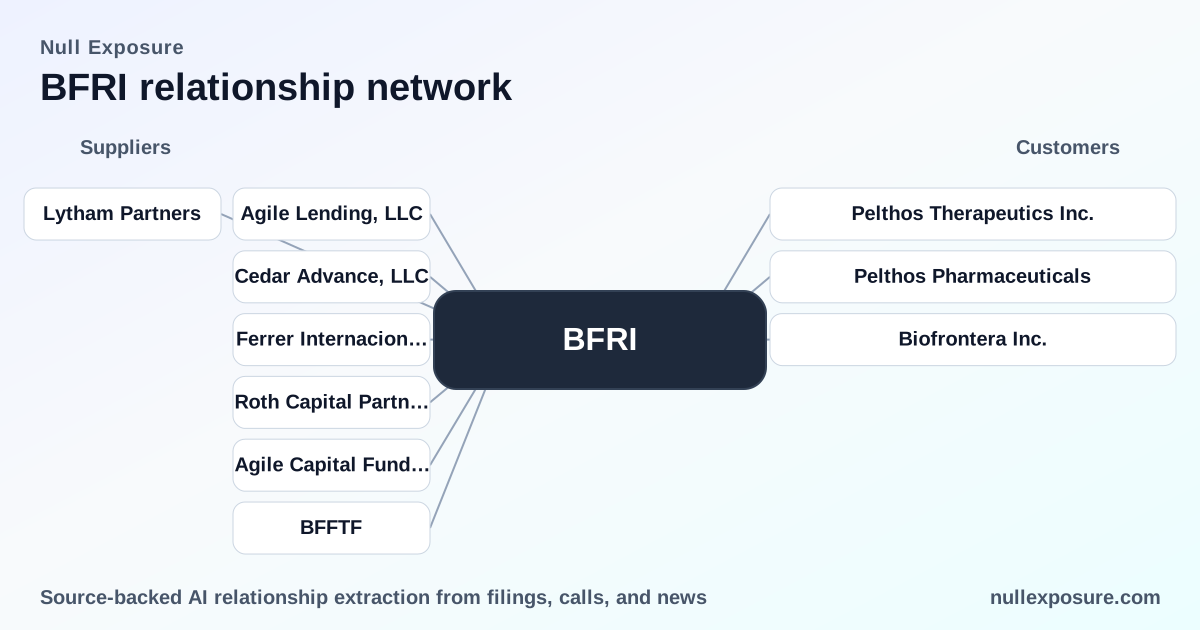
Below I cover every named counterparty disclosed in the public records or news items we reviewed, with a concise take and source reference.
Agile Lending, LLC
Biofrontera amended a Business Loan and Security Agreement with Agile Lending, LLC on December 21, 2023, indicating a financing relationship that supports working capital and operations. This is documented in Biofrontera’s FY2024 Form 10‑K.
Agile Capital Funding, LLC
An Amended and Restated Business Loan and Security Agreement names Agile Capital Funding, LLC alongside Agile Lending, LLC, showing related lending parties to the same credit arrangement executed December 21, 2023 (FY2024 Form 10‑K).
Cedar Advance, LLC
Cedar Advance, LLC is listed as a secured lender under a Business Loan and Security Agreement dated December 21, 2023, making it another finance counterparty for Biofrontera’s capital structure (FY2024 Form 10‑K).
Roth Capital Partner, LLC
Roth Capital served as a placement agent under a Placement Agency Agreement dated October 30, 2023, consistent with equity or debt capital raises executed in 2023 (FY2024 Form 10‑K).
Ferrer Internacional, S.A.
Ferrer Internacional appears in the filings as a counterparty under a Supply Agreement originally executed in March 2018 with Cutanea Life Sciences, Inc.; the reference indicates legacy supply or distribution linkages relevant to product channels (FY2024 Form 10‑K).
Biofrontera AG
In October 2025 Biofrontera Inc announced closing a restructuring and asset purchase with Biofrontera AG, acquiring full U.S. rights and assets for Ameluz® and RhodoLED® including the NDA and associated patents; this was reported in company press releases and multiple news outlets in October–November 2025 (GlobeNewswire and Yahoo Finance reports, Oct–Nov 2025). That transfer converts a licensed supply relationship into owned U.S. assets, materially changing supplier risk and control.
Lytham Partners
Lytham Partners is identified as the investor relations contact on press releases and filings around late 2025, indicating an external communications and investor relations engagement supporting Biofrontera’s capital markets profile (GlobeNewswire releases, Dec 2025).
Operating model constraints and what they mean for counterparties
Biofrontera’s public disclosures and filings lay out several structural characteristics that define its supplier posture, concentration risk, and contract maturity.
- Long-term licensing posture with performance triggers. The Second Amended and Restated License and Supply Agreement for Ameluz® is described as a 15‑year contract that automatically renews for five‑year terms in perpetuity if sales thresholds are met, signaling durable market access conditional on revenue performance (FY2024 Form 10‑K). This confers stability to commercialization but ties renewal to sales attainment.
- Licensing and manufacturer dependency. The company historically operated under an exclusive license and supply agreement to sell Ameluz® in the U.S., with Biofrontera Pharma identified as the responsible manufacturer by the FDA; these excerpts underline a critical dependence on the Biofrontera Group for product supply, manufacturing and regulatory support (FY2024 Form 10‑K).
- Regional concentration with global ties. While the firm sells globally through licensors, the Ameluz® arrangement grants exclusive U.S. rights and mandates exclusive U.S. sourcing from Biofrontera Pharma — a North America-centric supply dependency embedded within a broader global licensor network (FY2024 Form 10‑K).
- Materiality and spend profile. Purchases of licensed products were recorded at $8.3 million in 2024 and $23.4 million in 2023, placing supplier spend in the low‑double‑digit millions and highlighting that supply agreements are financially material to gross margins and inventory flows (FY2024 Form 10‑K).
- Service relationships for regulatory lifecycle. A Master Contract Services Agreement governs regulatory support and pharmacovigilance services from Biofrontera AG and affiliates, indicating that beyond manufacturing the Biofrontera Group supplies ongoing regulatory and safety services that are operationally critical (FY2024 Form 10‑K).
- Supply chain maturity signals. Manufacturing has been concentrated through a single contract manufacturer in Switzerland with qualification underway for a second German manufacturer — a sign that management is addressing supply resilience but remains in a transitional maturity phase (FY2024 Form 10‑K).
These constraints paint a company with durable contractual rights to sell core products but significant operational concentration and near‑term financing dependencies.
If you need a deeper supplier risk scorecard for BFRI or a side‑by‑side comparison with peers, visit https://nullexposure.com/ to request a tailored brief.
Investment implications and risk posture
For investors and operator counterparties, the most salient points are: ownership of U.S. Ameluz® assets reduces licensing counterparty risk but elevates responsibility for manufacturing continuity and regulatory compliance; financing arrangements with multiple nonbank lenders and a placement agent reflect limited capital-market room and the need for external liquidity. Given negative operating margins, any supply disruption or failure to meet the licensing revenue triggers could materially affect cash flows.
Key actions for counterparties and investors:
- Monitor supply-chain qualification progress for the second manufacturer and inventory drawdown trends.
- Track financed covenants in the Agile/Cedar loan documents for potential restrictions on supplier or capex decisions.
- Watch commercial uptake metrics post-asset acquisition to confirm revenue thresholds that underpin long-term licensing economics.
For a consolidated supplier exposure analysis or to commission supplier diligence on BFRI, see https://nullexposure.com/ for engagement options.
Bottom line
Biofrontera’s business model is license-led, manufacturing-dependent and capital-constrained. Recent asset purchase from Biofrontera AG simplifies some counterparty complexity by internalizing U.S. rights but places the onus on BFRI to sustain manufacturing, regulatory and commercial execution. Investors evaluating supplier relationships should prioritize continuity of Ameluz® supply, the health of financing arrangements, and the company’s ability to convert asset ownership into stable revenue growth.