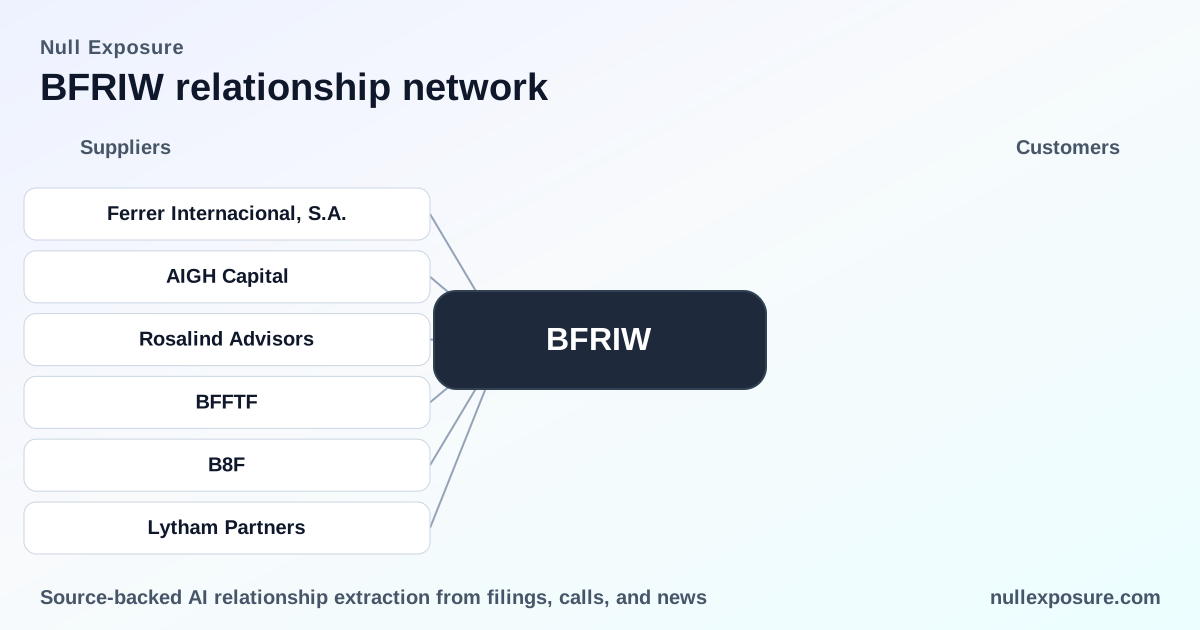
Biofrontera (BFRIW) — supplier relationships and what they mean for investors and operators
Biofrontera monetizes by commercializing dermatology therapeutics in the United States under an exclusive license to sell Ameluz and RhodoLED lamps, purchasing finished product from upstream entities and recognizing revenue from U.S. sales; the company’s economic model is therefore licensed commercialization plus inventory-driven cost of goods sold, with profitability tied to successful scale of Ameluz adoption and control of manufacturing and regulatory interfaces. Visit the research homepage for deeper supplier intelligence: https://nullexposure.com/
How to read Biofrontera’s supplier posture in plain terms
Biofrontera’s operating model is contract-centric and downstream: the firm holds an exclusive U.S. license, relies on third parties for manufacturing and regulatory support, and purchases finished product into inventory. The most consequential signals for procurement and counterparty risk are:
- Long-term, revenue-conditioned licensing — the company describes a license and supply agreement with multi‑year duration and automatic renewals tied to minimum revenue thresholds, creating both stability and dependency on hitting commercial milestones.
- Manufacturing and regulatory reliance — Biofrontera does not internally manufacture its flagship product for the U.S.; the licensor is the FDA‑recognized responsible manufacturer, concentrating regulatory and production risk off‑balance‑sheet.
- Service reliance beyond product — pharmacovigilance, regulatory affairs and medical affairs functions are contracted services the company continues to source from related or third parties.
- Procurement scale consistent with mid‑single to low‑double digit millions — purchases of licensed product were recorded at $8.3M in 2024 and $23.4M in 2023, indicating current spend bands and inventory exposure.
- Mixed relationship lifecycle — portions of the supplier ecosystem are active under new agreements established in 2024, while at least one related‑party service (certain leasing/installation arrangements) was terminated as of December 31, 2024.
These characteristics create concentration and criticality: a single licensor/manufacturer relationship is a potential single point of failure for U.S. commercialization, while long-term license economics offer revenue visibility if Ameluz adoption continues.
Who Biofrontera is interacting with now — relationship snapshots
Below are the supplier/partner and investor‑related relationships surfaced in public filings and statements. Each entry is a concise, plain‑English summary with the source noted.
Biofrontera AG — former parent and asset counterparty
Management described completing a transformational agreement to acquire all U.S. rights, approvals and patents for Ameluz and RhodoLED, giving Biofrontera full control over U.S. production-to-commercialization of its core products (management remarks on the 2025 Q3 earnings call). A subsequent press notice documented the closing of the asset purchase from the former parent as part of restructuring activity in late 2025. (Earnings call 2025Q3; news release October 2025)
Ferrer Internacional, S.A. — referenced supply agreement
The FY2024 10‑K references a Supply Agreement dated March 2018 between Ferrer Internacional and Cutanea Life Sciences, indicating prior supplier network artifacts are captured in the company’s disclosures; the mention suggests legacy or referenced supply arrangements affecting historical sourcing documentation. (FY2024 10‑K filing)
AIGH Capital — investor/advisory engagement
Management publicly thanked AIGH Capital during the 2025 Q3 earnings call, signaling investor engagement or advisory backing from AIGH in recent financing or investor relations activity. (2025 Q3 earnings call)
Rosalind Advisors — investor/advisory engagement
Management also thanked Rosalind Advisors on the same earnings call, indicating Rosalind’s role as an investor or strategic advisor that has provided capital or guidance. (2025 Q3 earnings call)
Lytham Partners — investor relations / communications role
A press release listing an investor relations contact names Lytham Partners and a specific contact, reflecting that Lytham provided IR/communications support for filings and announcements in late 2025. (News release December 2025)
What those relationships imply for procurement, operations and risk
The relationships and constraints together produce a clear operational profile:
- Exclusive licensing raises both stability and dependency. The Second A&R Ameluz LSA establishes exclusive U.S. rights and requires purchase of licensed products exclusively from the licensor; that creates revenue opportunity but centralizes supply risk under the licensor/manufacturer posture described in filings.
- Manufacturing responsibility sits upstream. The licensor is identified as the responsible manufacturer for Ameluz with the FDA, meaning regulatory holds, recalls, or production constraints upstream would directly interrupt U.S. supply. This is a high‑criticality dependency for operations.
- Long-term contract structure with renewal triggers ties commercial outcomes to supplier continuity. The license reportedly includes a 15‑year initial term with automatic renewals conditioned on achieving specified revenue thresholds over rolling five‑year windows; that aligns long-term incentives but also makes future renewal contingent on sustained market performance.
- Spend patterns are measurable but concentrated. Purchases of licensed products totaled $8.3M in 2024 and $23.4M in 2023, placing procurement in the $1M–$10M band in the most recent year but showing variability year-over-year—useful for cash‑flow and inventory planning.
- Service dependencies extend beyond product supply. The company lists ongoing statements of work for pharmacovigilance, regulatory affairs and medical affairs, which means operational continuity depends on both product supply and professional services historically delivered by the Biofrontera group.
Practical due diligence actions for investors and operators
- Verify the contract clauses on exclusivity, purchase obligations, transfer pricing and renewal triggers in the Second A&R Ameluz LSA; these clauses determine supplier leverage and revenue durability.
- Confirm the FDA responsible manufacturer designation and audit trail for Ameluz production to assess regulatory risk and the timeline for any capacity expansion or dual sourcing.
- Model cash‑flow sensitivity to supply interruption scenarios given the procurement figures ($8.3M / $23.4M) and the company’s inventory recognition practice.
- Validate continuity plans for pharmacovigilance and regulatory services if the company plans to replace historical service providers previously supplied by the Biofrontera group.
For a deeper supplier relationship profile and structured risk scoring, visit the research hub: https://nullexposure.com/
Bottom line — investor and operator checklist
Biofrontera’s U.S. business is commercially concentrated and contractually dependent: the exclusive license and upstream manufacturer responsibility provide predictable commercial rights but create a single‑counterparty operational exposure that investors and operators must monitor closely. The company’s recent asset acquisition and active service statements of work reduce some ambiguity about control but do not eliminate manufacturing and regulatory dependence upstream.
If you are evaluating counterparty risk or operational continuity for BFRIW, start with the contract language and FDA manufacturing status, then layer on spend and services continuity checks. For tailored supplier intelligence and ongoing monitoring, return to the research homepage: https://nullexposure.com/