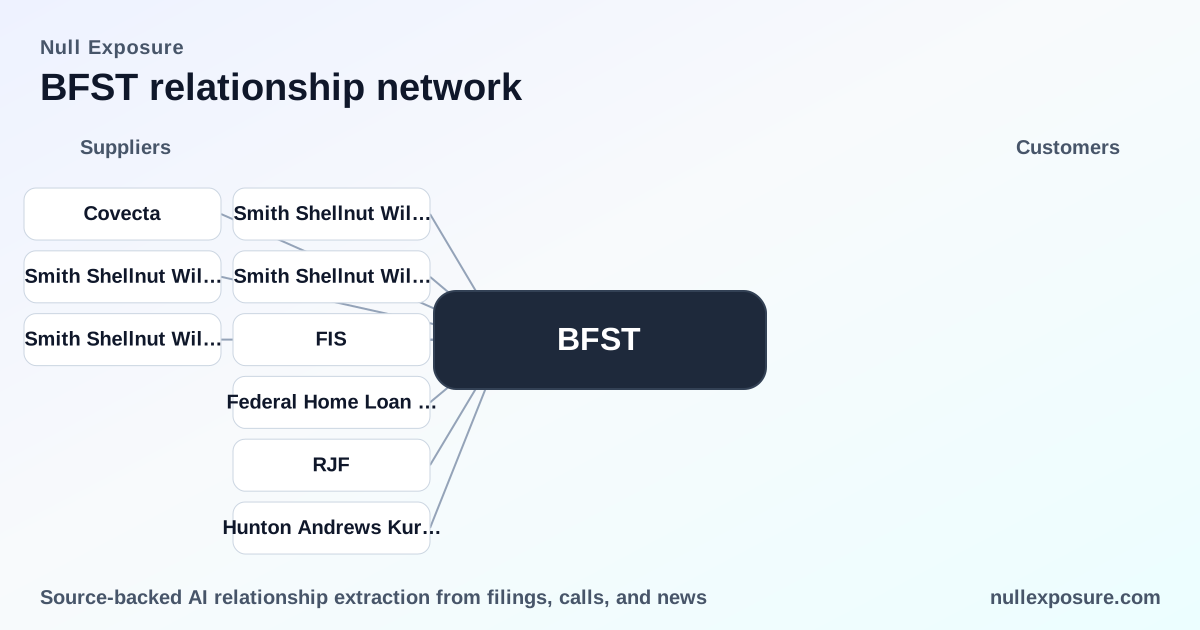
Business First Bancshares (BFST): supplier map and what it means for investors
Business First Bancshares (b1BANK) operates as a regional commercial bank that monetizes through net interest margin on commercial and consumer lending, fee income from asset management and treasury services, and episodic gains from M&A-driven scale. The company combines traditional franchise lending with a growing wealth-management affiliate and deliberate technology investment, creating supplier dependencies that materially affect operating leverage and execution risk.
Learn more about supplier intelligence at https://nullexposure.com/.
Why suppliers matter for BFST's investment case
BFST’s strategy is execution-dependent: scale and margin improvement come from integrating acquired franchises, moving to a modern core platform, and growing fee-bearing assets under management. That logic makes three supplier categories especially consequential to valuation and risk: asset-management partners that drive fee income, core-processing and technology partners that drive efficiency, and financial counterparties that underpin short-term funding. The supplier set documented in public releases confirms that profile and highlights the operational levers investors should model into forecasts.
Supplier relationships investors should track now
Below I cover every supplier relationship surfaced in public reporting. Each entry is a concise, plain-English summary with source context so you can follow up in the filings and releases.
Smith Shellnut Wilson LLC (SSW)
b1BANK’s affiliate relationship with Smith Shellnut Wilson underpins its wealth-management business: the bank reports roughly $5.7 billion in assets under management through SSW, excluding about $0.9 billion of b1BANK assets separately managed by SSW, according to the company’s FY2025–FY2026 releases. This is a recurring revenue driver and a material fee-income source for the franchise. Source: GlobeNewswire financial results release (January 22, 2026) and related shareholder communications.
FIS (core processing vendor)
Business First has invested in a new core processing system (FIS large bank platform) to accelerate efficiency and support higher throughput from recent acquisitions, a move the company links to expected efficiency gains and revenue diversification. This is a strategic technology vendor relationship that will affect operating-margin trajectory as implementation completes. Source: investment commentary and earnings preview from SahmCapital (October 25, 2025).
Federal Home Loan Bank (funding counterparty)
BFST uses short-term advances from the Federal Home Loan Bank as part of its liquidity toolkit; public filings report quarterly swings in FHLB borrowings (for example, a $56.5 million increase from the linked quarter reported in January 2026). That funding relationship is a core component of the bank’s liquidity and interest-rate risk posture. Source: GlobeNewswire FY2025/FY2026 financial statements (January 22, 2026).
Raymond James & Associates, Inc. (financial advisor / institutional connectivity)
Raymond James acted as financial advisor on Business First’s acquisition of Progressive Bancorp and related transactions, reflecting a transactional advisor role that supports M&A execution and capital-markets access. Investors should view this as an episodic but important supplier for deal execution and capital-marketing. Source: QuiverQuant and Globe and Mail coverage of the Progressive Bank acquisition (FY2025–FY2026).
Hunton Andrews Kurth LLP (legal counsel)
Hunton Andrews Kurth served as legal counsel to Business First on the Progressive Bank acquisition, supporting regulatory and transactional legal work that is material to successful integration of acquisitions. Legal advisors like Hunton are key to reducing execution and regulatory risk during roll-ups. Source: GlobeNewswire press releases on the Progressive Bank closing (January 5, 2026).
Covecta (agentic AI / technology partner)
b1BANK announced a multi-year partnership with Covecta to deploy agentic AI across the banking lifecycle, intended to speed work, improve controls, and expand capacity while preserving compliance. This represents a forward-leaning technology dependency that will influence productivity and control frameworks as it is rolled out. Source: GlobeNewswire financial release (January 22, 2026) and industry press coverage (Intellectia/StockTitan, February 2026).
What the supplier map implies for risk and upside
- Execution risk is concentrated in a few high-impact vendors. Core processing (FIS) and the new AI partnership (Covecta) are likely to determine near-term efficiency gains; implementation delays or integration issues would directly pressure operating margins.
- Fee-income resilience rests on SSW AUM. The $5.7 billion AUM figure signals meaningful non‑interest income scale that protects EPS against margin compression.
- Liquidity is actively managed via FHLB advances. Short-term funding swings reported in filings mean funding costs and treasury strategy should be monitored quarter to quarter.
- M&A execution is an explicit growth lever. Raymond James and Hunton Andrews Kurth supported the Progressive Bank deal, underscoring that future acquisitions will continue to rely on external advisors and lawyers for successful closings.
Key risks to model:
- Potential implementation delays or cost overruns in the FIS core migration and Covecta rollout.
- Concentration: a small set of suppliers deliver disproportionate operational value.
- Integration risk from acquisitions that rely on external advisors for deal completion.
Company-level constraints and governance signals
Public constraint excerpts signal three company-level governance characteristics investors must price: the firm disclosed a material weakness in controls, it has outsourced material services to third-party providers, and it has notified at least one provider of contract termination with a transition planned as of May 2025. Treat these as structural governance and contracting signals: outsourcing increases vendor concentration and transition risk; a material weakness raises control and audit risk until remediated; winding-down a provider imposes short-term operational burden. These are company-wide implications and are not assigned to any single supplier unless explicitly named in disclosures.
How to incorporate this into an investment model
- Raise implementation risk assumptions for the next 2–4 quarters tied to FIS and Covecta transition timelines and cost buckets.
- Stress-test fee-income sensitivity to SSW AUM shocks and model a scenario where integration of Progressive Bank delays fee ramp.
- Assume funding volatility related to FHLB advances and build a conservative net interest income band that reflects higher short-term borrowings in stress scenarios.
Explore supplier risk scoring and scenarios in more depth at https://nullexposure.com/.
Bottom line and recommended next steps
Business First’s supplier footprint reveals a clear operating thesis: scale through M&A, efficiency through a modern core and AI, and diversification through wealth-management AUM. Those supplier choices create asymmetric upside if executed cleanly and measurable downside if core and AI implementations or control remediation slip. Investors should prioritize monitoring: (1) FIS migration milestones and metrics, (2) Covecta deployment KPIs, (3) SSW AUM trends and fee margins, and (4) FHLB borrowing patterns. For a structured supplier-risk view that plugs into valuation scenarios, visit https://nullexposure.com/.
Actionable near-term items: review the company’s next quarterly filing for control remediation details, request milestone reporting for the FIS and Covecta programs at investor events, and monitor AUM disclosures from SSW to validate fee-income assumptions.