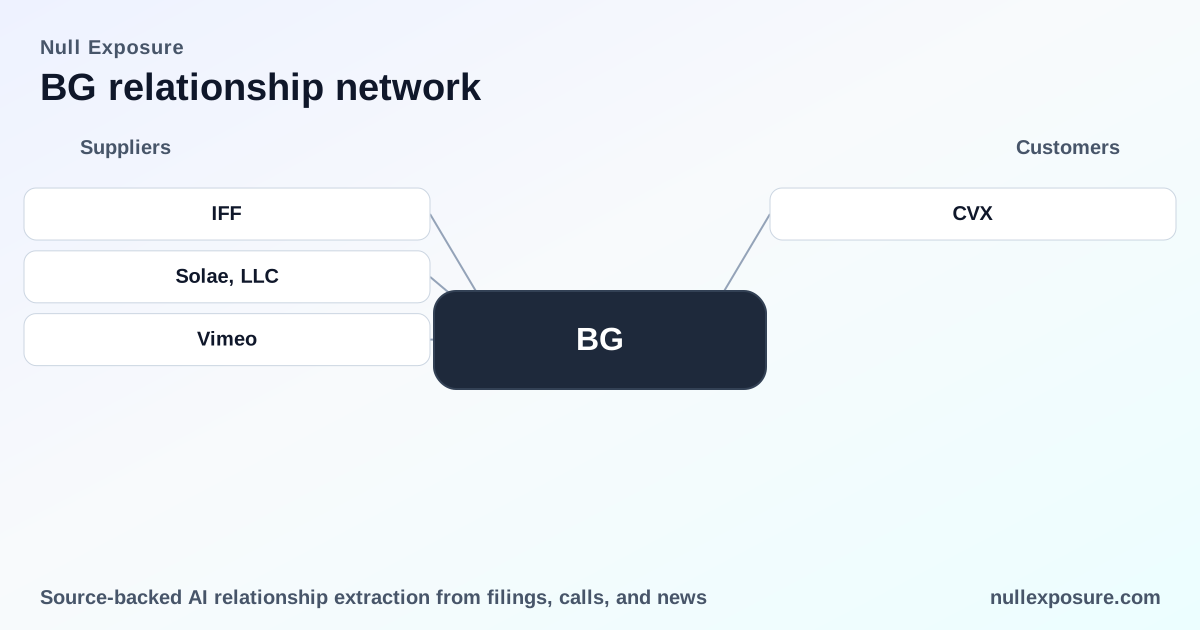
Bunge (BG) supplier relationships: strategic soy assets and operational signals investors should track
Bunge is a global food and agribusiness operator that monetizes through commodity origination, processing and branded/refined product sales—buying crops from farmers, financing and aggregating supply, then capturing margins through crushing, refining, milling and distribution. Recent supplier-relationship activity shows a deliberate tilt toward vertical integration in soy processing and targeted use of third-party services for investor communications. For a concise supplier-risk dashboard and relationship monitoring tools, visit https://nullexposure.com/.
A transformative acquisition: IFF’s soy protein, lecithin and crush businesses
Bunge completed the purchase of International Flavors & Fragrances, Inc.’s soy protein concentrate, lecithin and soy crush businesses, expanding its downstream processing footprint and product set for food ingredients and industrial feedstocks. According to Bunge’s March 2, 2026 announcement and subsequent coverage, the deal brings additional processing capacity and ingredient portfolios that increase Bunge’s ability to capture margin across the soy value chain (reported by Business Wire/FinancialContent and World-Grain in March 2026).
Source: Bunge press release reported March 2, 2026; news coverage at FinancialContent/BizWire and World-Grain.
Consolidating legacy soy assets: Solae, LLC’s businesses join Bunge
Bunge also finalized acquisition of the soy crush, concentrates and lecithin business previously listed under Solae, LLC, folding complementary processing operations into its ingredient platform. MarketScreener reported the Solae asset transfer in March 2026, which reinforces Bunge’s strategy of aggregating soy processing capabilities to improve scale and product breadth.
Source: MarketScreener news report, March 2026.
Ancillary supplier: Vimeo for investor webcast services
Bunge uses third-party streaming services—Vimeo is listed as the platform for an investor-day webcast—showing reliance on established digital vendors for capital markets engagement. A StockTitan notice in March 2026 noted that Bunge’s investor-day webcast would be streamed via Vimeo and required pre-registration.
Source: StockTitan investor-day notice (webcast registration), March 2026.
How these relationships map to Bunge’s operating posture
The recent transactions and supplier choices reveal several company-level operating characteristics that matter to investors evaluating supplier risk, margin durability and execution risk:
- Contracting posture — short-term working relationships with producers but strategic long-term asset ownership for processors. Bunge routinely extends short-term, prepaid commodity purchase contracts and advances to farmers—particularly in Brazil—while acquiring processing businesses outright to secure upstream-to-downstream margins.
- Geographic concentration — material exposure to Latin America, especially Brazil. Bunge explicitly finances and sources soybeans and other agricultural commodities in Brazil, which positions the company to control supply but also concentrates counterparty and geopolitical risk in a single region.
- Relationship roles — dual buyer and seller functions. The company acts as purchaser and processor of commodities (buyer of raw crops; seller of processed oils, concentrates and ingredients), creating interdependent commercial relationships across the value chain.
- Segment focus and maturity — manufacturing and refined oils are strategic and mature cash generators. Bunge’s Refined and Specialty Oils segment and milling operations are central to monetization and now benefit from added soy processing capacity through acquisitions.
- Spend and exposure scale — large short-term receivables and advances. As of December 31, 2024 and 2023, Bunge reported approximately $478 million and $825 million in outstanding prepaid commodity purchase contracts and advances to farmers, indicating substantial working capital exposure to agricultural producers.
These signals combine into a governance profile where Bunge leans on acquisitions to reduce exposure to spot-market volatility while continuing to provide working capital to farmers to secure supply. For a structured supplier-risk heat map tied to Bunge’s public disclosures, explore https://nullexposure.com/.
Why the IFF and Solae moves matter for margins and risk
Acquiring IFF’s and Solae’s soy processing assets is a classic agribusiness consolidation play: increase throughput, capture additional crushing and ingredient margins, and reduce unit costs through scale. For investors, the payoff is clearer margin capture in ingredient markets and potential cross-selling into existing refined-oil and food-ingredient channels. Execution risk centers on integration: combining plants, systems, and customer contracts while maintaining procurement financing programs that anchor raw supply.
At the same time, the company’s prepaid contracts and farmer advances amplify credit and weather risks concentrated in Brazil. The line-item of hundreds of millions of dollars in advances is a direct balance-sheet exposure to harvest outcomes and commodity price movements. Investors should weigh incremental processing earnings against persistent counterparty and regional risks.
Tactical takeaways for portfolio managers and operators
- Integration upside is sizable: Added soy concentrate and lecithin capacity leverages existing distribution and creates higher-margin ingredient sales.
- Balance-sheet trade-off: Bunge’s model combines asset ownership for stability with sizeable short-term financing of farmers to secure throughput; that financing is a clear source of working-capital volatility.
- Operational concentration: Latin American sourcing and financing are strategic advantages that concentrate geopolitical and weather risk.
Actionable next steps
- Review capex and integration guidance in Bunge’s next investor update to quantify expected synergy timelines and margin lift from the IFF/Solae assets.
- Monitor Brazilian crop conditions and farmer credit health to gauge potential draw on the prepaid advances line.
- Track investor-day presentations (streamed via Vimeo for upcoming events) for management’s roadmap on how newly acquired assets fit commercial channels.
For a supplier-risk monitoring toolkit and updated relational intelligence on Bunge, see https://nullexposure.com/.
Final assessment
Bunge’s recent supplier-related moves are strategic and execution-focused: acquiring downstream processing assets that increase margin capture while maintaining a deliberate procurement finance posture to secure throughput. The combination strengthens the company’s integrated agribusiness model but keeps material exposure to Latin American producer credit and crop risk on the balance sheet. Investors should prize management’s ability to integrate assets and control working-capital volatility as the clearest determinants of near-term upside. For ongoing coverage and a supplier-risk dashboard tailored to agribusiness operators and investors, visit https://nullexposure.com/.