BGIN Blockchain Limited (BGIN) — supplier relationships, operational signals, and what investors should act on
BGIN operates as a digital asset technology company headquartered in Singapore with operations in Hong Kong, the United States, and Southeast Asia, generating revenue from products and services tied to digital-asset infrastructure and hardware deployment. The company monetizes through commercial contracts for technology and hardware solutions to participants in the digital-asset ecosystem and supplements cash flow with capital-market activity when needed. For investors, supplier relationships that affect capital raises and financial controls are the most material near-term vectors of risk and opportunity.
Explore further supplier intelligence at https://nullexposure.com/.
Quick read: the supplier relationships that matter right now
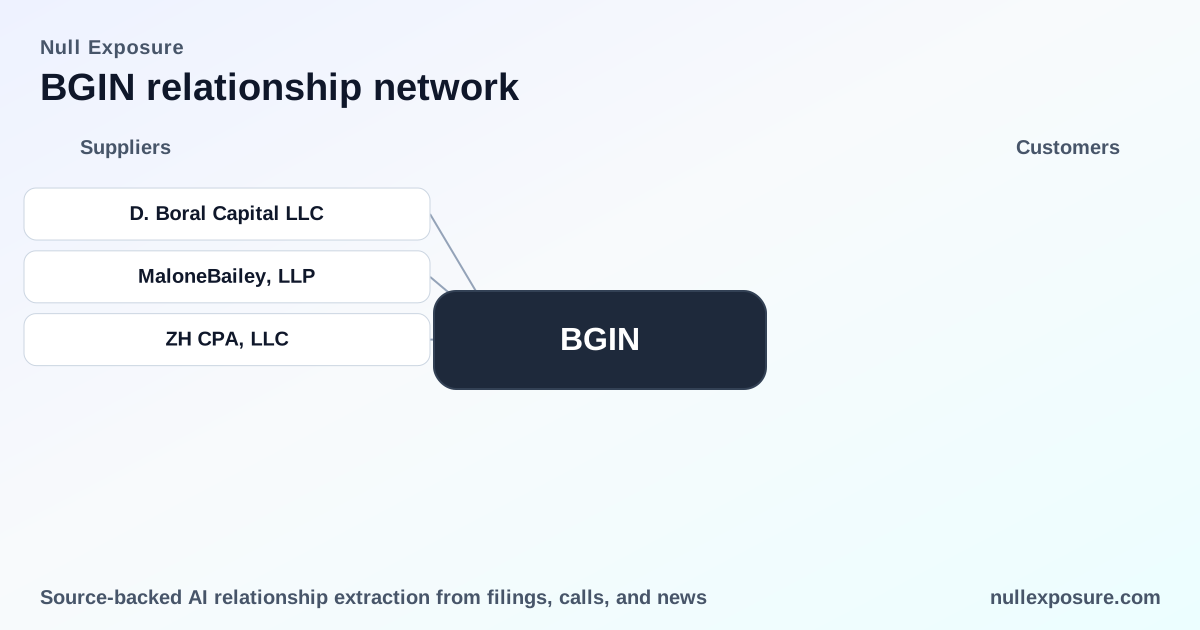
Three supplier relationships show up in public reporting and coverage: a sole book-running manager for a capital offering and a near-term auditor transition. Each relationship has direct implications for financing, reporting quality, and operational continuity.
D. Boral Capital LLC — sole book-running manager for an offering
D. Boral Capital LLC was disclosed as the sole book-running manager for a share offering that priced 5 million shares at $6.00 per share in March 2026. This positions D. Boral as the primary underwriter and execution counterparty for that capital raise. According to a QuiverQuant filing dated March 9, 2026, the firm acted as the book-runner for the offering (QuiverQuant, 2026).
MaloneBailey, LLP — newly engaged independent registered public accounting firm
BGIN’s audit committee approved the engagement of MaloneBailey, LLP as the company’s independent registered public accounting firm for FY2025, replacing the previous auditor. This change signals a material vendor shift for financial statement assurance and SEC reporting processes. The engagement decision is documented in public reporting aggregated by StockTitan in March 2026 (StockTitan, 2026).
ZH CPA, LLC — previous auditor not retained
The audit committee resolved not to renew or negotiate new terms with ZH CPA, LLC, the prior auditor, and therefore transitioned audit responsibilities to MaloneBailey. The decision was disclosed alongside the new engagement in the same March 2026 StockTitan report (StockTitan, 2026).
What these relationships reveal about BGIN’s operating posture and supplier risk
The supplier relationships above reveal several company-level operational characteristics that investors should weigh.
- Contracting posture: BGIN uses external specialists for both capital markets execution and statutory financial assurance rather than maintaining those capabilities in-house. The use of a sole book-runner for the March 2026 offering indicates a concentrated execution strategy for capital raises, which accelerates transaction speed but increases single-counterparty execution risk. The auditor transition demonstrates active governance intervention in professional services procurement.
- Concentration and counterparty criticality: A sole book-runner and a single audit firm are critical counterparty dependencies for near-term financing and reporting; disruptions here would have outsized operational impact. Separately, company-level ownership concentration is high—insiders hold ~52% of shares and institutional ownership is minimal (~0.106%)—which concentrates control and can affect vendor selection and oversight.
- Maturity and financial stability: Financial metrics show negative EPS and operating margin (EPS: -0.51, Operating MarginTTM: -0.886) alongside revenue of $205.5M TTM and a year-over-year revenue contraction signaled in quarterly growth (-67% YOY for the latest quarter). These indicators place BGIN in a growth-to-restructuring phase where external financing and audit credibility are operationally material.
For deeper supplier analytics and monitoring dashboards, visit https://nullexposure.com/.
Risk profile — what to monitor closely
- Capital-raise execution risk: With D. Boral as sole book-runner, investors should monitor offering allocation, pricing trends, underwriting fees, and whether future raises diversify underwriters. Concentrated underwriting increases execution and pricing risk.
- Audit continuity and disclosure quality: A change in auditors during a period of negative profitability and revenue contraction warrants scrutiny of audit scope, any restatements, and the tone of subsequent audit opinions. Audit transitions can precede material adjustments in financial reporting.
- Governance and related-party dynamics: High insider ownership (52%) elevates the significance of board and audit-committee decisions on supplier appointments; investors should evaluate independence and governance protocols.
- Operational and market sensitivity: Negative margins and declining quarterly revenue growth make BGIN more reliant on capital markets and professional services to sustain operations. Vendor reliability and fee structures therefore have direct cash-flow implications.
Actionable steps for investors and operators
- Review the details of the March 2026 offering, including the final underwriting agreement and fee schedule, to quantify dilution and execution cost (see QuiverQuant coverage of the offering).
- Obtain copies of the audit engagement letters and management representation letters from MaloneBailey to understand the agreed scope and any identified limitations; compare to ZH CPA’s prior scope to detect changes in audit coverage (see StockTitan disclosure on the auditor change).
- Monitor subsequent SEC filings and quarterly earnings for audit-report language, related-party disclosures, and any signs of additional financing needs.
- For operators: ensure continuity plans are in place for critical external vendors (audit and capital markets firms) and consider parallel relationships to reduce single-counterparty risk.
Final assessment and next steps
BGIN is operating in a capital- and assurance-sensitive phase: a sole book-runner for a recent offering and a near-term auditor change are two concentrated supplier events that materially affect the company’s financing flexibility and reporting credibility. Given the firm’s negative margins, revenue contraction, and concentrated insider control, these supplier decisions are high-leverage from an investor-risk perspective.
For ongoing supplier monitoring, benchmarking, and deal-level diligence, consider leveraging tailored supplier intelligence at https://nullexposure.com/. Act now to add these vendor-change signals to your tracking set and to receive alerts when counterparties or engagement terms shift materially.