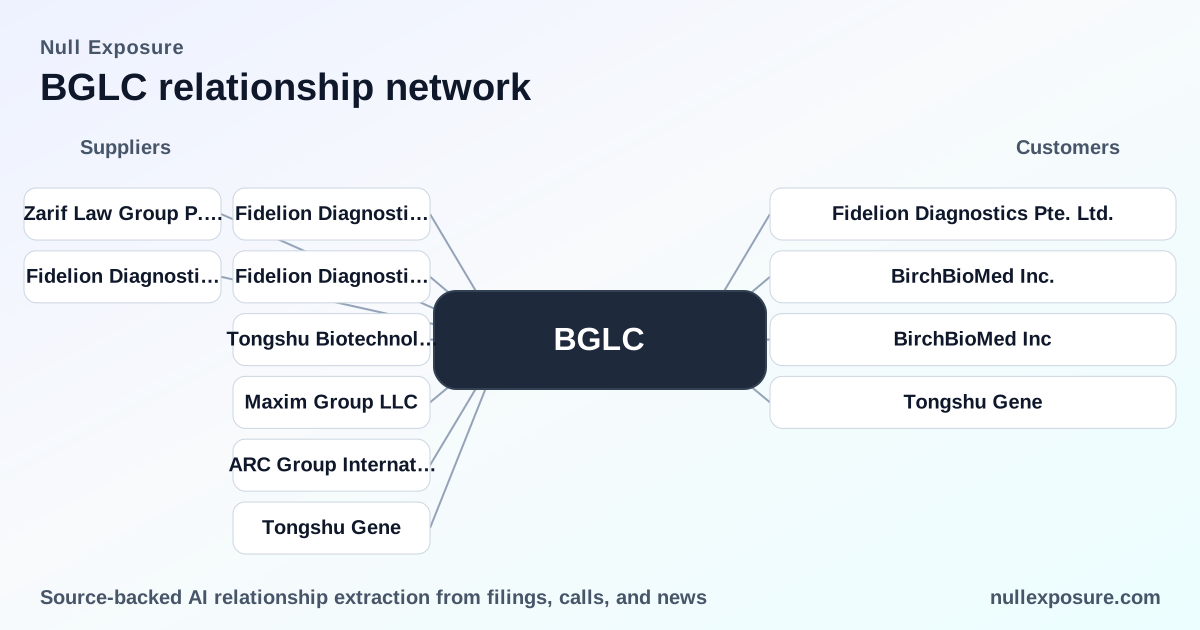
BioNexus Gene Lab Corp (BGLC): Supplier and commercial partner map for investors
BioNexus Gene Lab Corp. operates as a precision-diagnostics and specialty-chemicals supplier with an explicit commercialization play: it purchases and integrates external genomic technology, takes equity stakes in platform owners, licenses commercial rights across Southeast Asia, and sells reagents and services to convert that IP into recurring revenue. Monetization today rests on licensing fees, reagent purchase commitments, strategic equity ownership, and access to capital via at‑the‑market offerings and equity facilities. For a focused view of counterparties, see the partnership map below and the implications for procurement, revenue concentration, and financing. For raw relationship data and ongoing tracking, visit https://nullexposure.com/.
The strategic pivot: VitaGuard commercialization is now core to supplier strategy
BioNexus completed definitive agreements to commercialize the VitaGuard™ tumor‑naïve MRD (minimal residual disease) platform for Southeast Asia, paying a US$2.0 million license fee and committing at least US$500,000 in reagent and system purchases over 24 months while taking an equity stake in the underlying technology company. That combination of license fee, reagent volume commitment, and equity stake converts a supplier relationship into a hybrid commercial-supplier and strategic-investment arrangement that drives both short‑term revenue and longer-term upside through equity appreciation. According to the GlobeNewswire release (Nov 12, 2025) and subsequent press, BGLC is using Fidelion as the primary commercial vehicle for international deployment and regional scale. Learn more at https://nullexposure.com/.
What that arrangement implies in practice
- Revenue mechanics: upfront license revenue (amortizable), recurring reagent/system sales, and upside through equity ownership.
- Supplier posture: BGLC transitions from buyer/provider of lab services to channel owner for VitaGuard in ASEAN — a contractual posture that increases vendor lock but concentrates commercial risk on a small set of partners.
- Financing support: the company has contemporaneous capital tools (ATM program, large equity facility) to fund rollout and inventory; these mechanics affect dilution and working-capital dynamics.
Who BGLC is working with — relationship-by-relationship
Fidelion Diagnostics Pte Ltd
BioNexus acquired a strategic equity stake and secured exclusive commercial rights to Fidelion’s VitaGuard™ MRD platform across Southeast Asia, and executed a US$2.0 million licensing agreement plus reagent purchase commitments for the first 24 months. — GlobeNewswire (Nov 12, 2025); Manilatimes (Dec 3, 2025).
Fidelion Diagnostics Pte. Ltd.
As consideration under definitive agreements, BGLC will pay a US$2 million license fee in 24 equal monthly instalments and commit at least US$500,000 of VitaGuard reagent and system purchases within the first 24 months. — StockTitan press release (Dec 2025).
Fidelion Diagnostics
The company has designated Fidelion as the exclusive commercial vehicle for international IP commercialization and regional expansion of VitaGuard, formalizing a go‑to‑market channel for BGLC’s precision oncology ambitions. — Yahoo Finance summary (Jan 2026).
Tongshu Biotechnology (Hong Kong) Co., Limited
Tongshu is a co‑party to the VitaGuard commercialization agreements and participated in patent support and commercialization arrangements intended to support IP and market deployment across ASEAN. — GlobeNewswire (Nov 12, 2025).
Tongshu Gene
Tongshu Gene joined BGLC and Fidelion in signing a Patent Support Agreement to develop upgraded patents and global IP linked to the VitaGuard platform, indicating a broader IP and development collaboration beyond distribution alone. — Yahoo Finance (Jan 2026).
Tongshu Gene (alternate mention)
BGLC’s public materials reference Tongshu as a patent and development partner alongside Fidelion in the regional deployment communications, reinforcing the multi‑party structure of the VitaGuard rollout. — MarketScreener / Finviz media summaries (Jan 2026).
Maxim Group LLC
Under a filed shelf registration, BGLC entered an Equity Distribution Agreement with Maxim Group LLC to operate an at‑the‑market (ATM) program that can distribute up to US$20 million of common stock, providing immediate access to capital to fund commercialization and working capital. — StockTitan disclosure on the shelf/ATM filing (Dec 2025).
ARC Group International Ltd.
BGLC executed a headline Equity Purchase Agreement with ARC Group International Ltd. for a US$500 million facility described as an equity purchase facility to support expansion of diagnostics, CDMO operations, and therapeutic commercialization. — Markets FinancialContent (Dec 2, 2025).
Zarif Law Group P.C.
Zarif Law Group P.C. served as legal counsel to BioNexus in the shelf/ATM transaction, a classic indicator that the company is structuring its public equity programs with external counsel to support capital markets activity. — StockTitan reporting on the ATM and related legal advisors (Dec 2025).
Fidelion Diagnostics (additional media mention)
Multiple trade and press outlets reiterated that closing of the Fidelion transaction positions BGLC as a strategic shareholder with exclusive ASEAN rights—this is the repeated public narrative underpinning the company’s supplier and commercialization strategy. — Quiver Quant / GlobeNewswire / StockTitan (Nov–Dec 2025).
How these relationships shape BGLC’s operating characteristics
Contracting posture — strategic, exclusive, and hybrid
BGLC’s deals combine exclusive commercial rights, a license fee structure, reagent purchase commitments, and equity stakes. That makes partners both suppliers and strategic assets; contracts lock in distribution economics while also exposing BGLC to execution and conversion risk if regional uptake lags.
Concentration and criticality — high concentration, high criticality
The VitaGuard agreements designate a small set of counterparties (Fidelion and Tongshu) as critical to the company’s growth plan. That concentration increases upside if deployment scales but elevates dependency on a single platform’s commercial success.
Maturity and financial posture — early stage with active financing
Company financials show small market capitalization (~US$5.3 million), negative EBITDA and EPS, and limited institutional ownership; BGLC operates at an early commercial stage and is aggressively managing liquidity through an ATM and a large equity facility. These financing instruments signal both growth intent and potential dilution pressure if equity draws are executed. The company-level signal that BGLC purchases materials from manufacturers and has meaningful supplier spend in the US$1–10 million band indicates established procurement flows, but not yet scale comparable to established diagnostics networks.
Risks and short list of monitoring items for investors
- Revenue recognition and timing: track how the US$2 million license fee is recognized and the cadence of the US$500k reagent purchases. — GlobeNewswire / StockTitan (Nov–Dec 2025).
- Capital execution and dilution: monitor draws under the ARC facility and ATM usage against announced milestones to assess dilution risk. — Markets FinancialContent; StockTitan (Dec 2025).
- Commercial traction: watch initial VitaGuard rollout metrics in ASEAN and any regulatory or payer acceptance developments; product commercialization is the pivot from R&D to recurring revenue. — Yahoo Finance / GlobeNewswire (Jan 2026).
For a continuous feed of relationship-level intelligence and to model counterparty concentration risk, visit https://nullexposure.com/ for our supplier-mapping tools.
Conclusion — position and next steps for investors
BioNexus has converted supplier relationships into a bundled commercialization strategy: exclusive licensing + reagent commitments + equity ownership + capital markets programs. That structure accelerates potential revenue realization but concentrates risk on the VitaGuard platform and a small set of partners. Investors should prioritize three monitoring actions: (1) track license fee recognition and reagent sales, (2) watch ATM and ARC facility usage for dilution and runway implications, and (3) validate early ASEAN commercialization milestones from Fidelion/Tongshu channels. For deeper counterparty analysis and to integrate these supplier signals into portfolio models, go to https://nullexposure.com/.