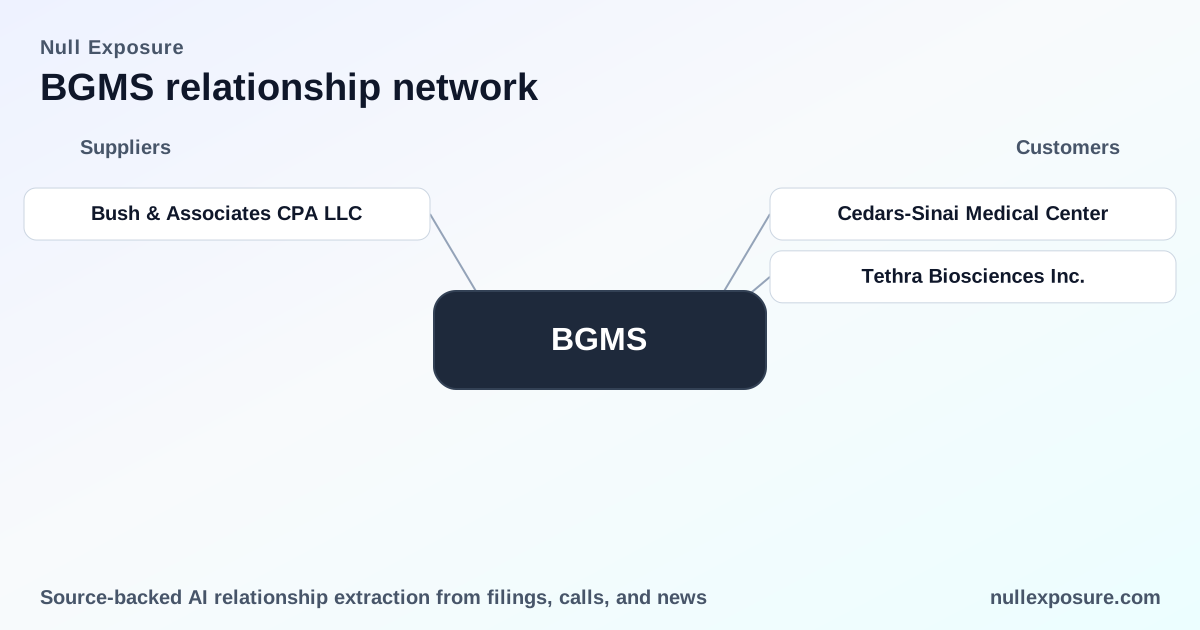
BGMS supplier map: what investors need to know about third‑party relationships and operational constraints
Bio Green Med Solution, Inc. (BGMS) distributes and installs protective and fire‑safety materials while pursuing clinical and product development through licensed technologies and third‑party partners; it monetizes primarily through product sales and asset purchases tied to drug candidates and safety systems, and supplements capital needs via placements and private financing. For investors, the company's economics hinge on an outsized dependency on external manufacturers, contract research organizations and a small set of commercial and professional suppliers, while its capital structure and low revenue base amplify supplier and counterparty risk. For deeper supplier intelligence visit NullExposure.
Overview: lean operations, outsized supplier leverage
- BGMS reports very low trailing revenue (about $81k TTM) against negative EBITDA, a concentrated shareholder base (about 68% insiders) and minimal institutional ownership. These facts underline a business that is operationally light but strategically dependent on partners to execute R&D, manufacturing and commercialization.
- The operating model is service‑and‑contract oriented: BGMS lacks in‑house manufacturing capacity and relies on licensing arrangements, CMOs and CROs to move product candidates through development to market.
How BGMS makes and spends money BGMS’s core monetization today flows from distribution and installation of safety equipment and strategic acquisitions of drug‑related assets (the Cyclacel purchase is illustrative), while ongoing cash needs are met through private placements and placement agent arrangements. Capital efficiency and vendor terms are therefore central to outcomes: if CMOs or CROs lengthen timelines or raise prices, BGMS’s already constrained cash flows will be stressed.
What the supplier landscape looks like right now The supplier posture for BGMS is characterized by short‑term commercial ties (office leases, placement fees), active service relationships for clinical and regulatory work, and critical reliance on third‑party manufacturing. Contracting is predominantly externalized: the company discloses no internal manufacturing operations and purchases licenses from academic and research entities. Geography is global — clinical sites and CRO activity extend outside a single jurisdiction — which raises coordination and regulatory complexity for supplier management.
Key company‑level constraints and what they imply
- Short‑term contracting posture. Company disclosures show operating lease expenses tied to short‑term office leases (Dundee, Scotland), indicating a preference for low‑commitment, flexible real estate and vendor arrangements rather than long‑dated supply contracts. This reduces fixed overhead but increases operational vulnerability if suppliers require longer commitments.
- Global footprint for clinical activity. Management notes dependence on clinics and hospitals internationally for trials and data provision, which elevates logistic and compliance burdens when managing CROs and data vendors.
- Critical external manufacturing. The company explicitly states it has no manufacturing capacity and that failure to secure third‑party manufacturing on commercially reasonable terms would materially impair development and commercialization prospects; this makes CMOs a single point of failure for product timelines.
- Licensing and IP dependencies. BGMS has entered licensing arrangements with academic and research organizations for technology and patents, positioning it as a licensee whose product roadmap depends on third‑party IP terms and milestone obligations.
- Active service relationships and placement agents. The company uses CROs, contracted laboratories and placement agents (H.C. Wainwright was paid placement fees in a 2024 private placement), showing a mixed roster of professional service suppliers that are currently engaged and being paid for capital and program execution.
- Segments focused on manufacturing and services. Public statements highlight reliance on CMOs for product materials and CROs for trial execution, confirming the company competes as a coordinator and purchaser of specialized manufacturing and clinical services rather than as an integrated producer.
A few strategic implications for investors and operators
- Concentration risk is high. Small revenue and limited internal capability mean vendor disruptions or license disputes can stop project progress entirely.
- Contract term management is a core lever. Short‑term leases and service engagements provide flexibility but reduce negotiating power with high‑criticality CMOs; locking favorable terms with critical suppliers should be a priority.
- Regulatory complexity and geography add execution risk. Cross‑border clinical data flows require disciplined vendor oversight and contingency planning.
- Capital dependence increases supplier leverage. Placement fees and evidence of recurring private financing mean suppliers and placement agents can extract higher margins when the company is cash‑constrained.
Relationships in the public record
- Bush & Associates CPA LLC — Auditing firm. BGMS lists Bush & Associates CPA LLC as its auditor in a public market profile, indicating auditing services are outsourced to a professional accounting firm for FY2025 disclosures. According to a Stockopedia company page capture (first observed March 9, 2026), auditors are identified as Bush & Associates. Source: Stockopedia profile referencing FY2025 (document observed 2026‑03‑09).
Operational snapshot with actionable signals
- Active supplier engagements: The firm explicitly relies on CROs, contracted labs and CMOs to run clinical programs and produce materials, and it has paid placement agents to raise capital (engagement with Wainwright in 2024). Company filings and disclosures document these service relationships and related fees.
- High criticality of manufacturing and IP licensing: Filings warn that inability to secure third‑party manufacturing would delay trials and regulatory submissions and could prevent commercial supply — a business‑level constraint rather than a single‑vendor note.
- Short lease commitments indicate a low fixed‑cost model but limit bargaining power with critical suppliers when scale is required.
If you are evaluating BGMS as a supplier partner or counterparty
- Prioritize due diligence on CMOs and CROs tied to key programs; confirm contingency manufacturing capacity and rights under license agreements.
- Validate payment and milestone histories for licensors and placement agents to understand timing risk and supplier leverage.
- Model scenarios where one critical supplier delays production by 3–6 months; this is the most realistic path to material operational disruption given BGMS’s small revenue base and outsized dependency profile.
For institutional or corporate teams mapping BGMS relationships and exposure, more granular supplier signals and contractual intelligence are available — see NullExposure for extended supplier profiles and sourcing analytics.
Bottom line BGMS operates as a capital‑light, partnership‑dependent healthcare company with material exposure to third‑party manufacturing, licensing and clinical services. The company’s small revenue base, high insider ownership and reliance on placement financing amplify the operational importance of supplier terms and contingency planning. For investors and counterparties, the immediate focus should be on CMOs, CROs and license agreements — these are the flow‑control points that determine whether BGMS can move assets from pipeline to market. To explore supplier mapping and risk scoring for BGMS and peers, visit NullExposure.