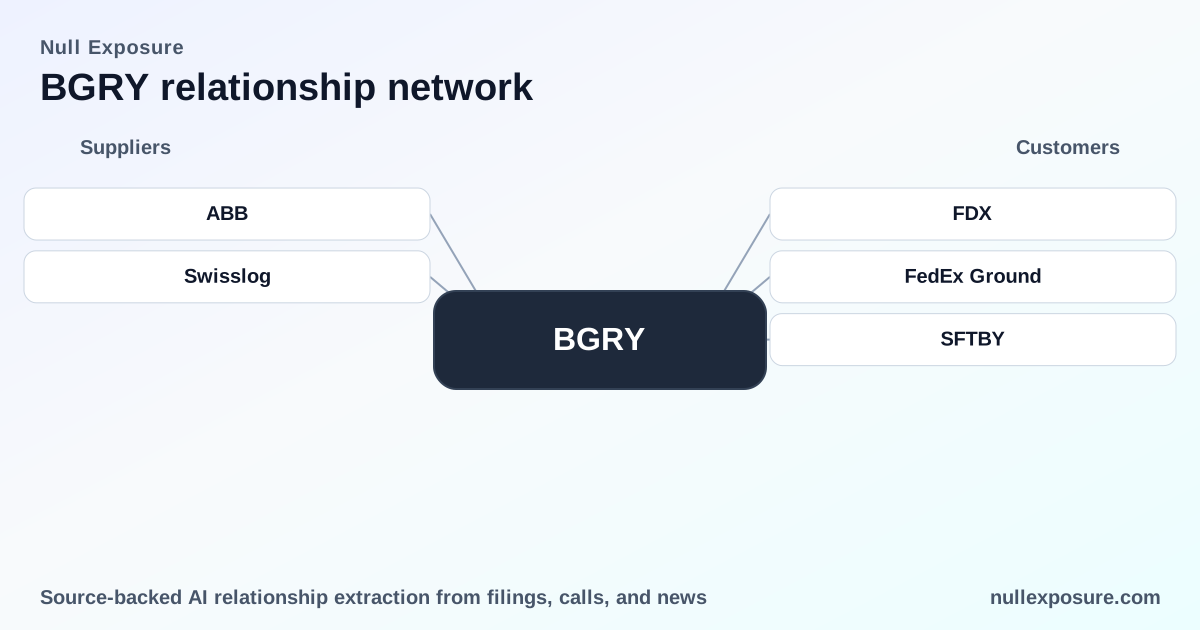
Berkshire Grey (BGRY) — Supplier relationships and what they mean for investors
Berkshire Grey builds and monetizes AI-enabled automation platforms by integrating proprietary software with third-party robotics and systems integration partners to deliver end-to-end warehouse and fulfillment solutions. The company sells software licenses and project services while relying on partner hardware and systems integrators to scale deployments and reduce capital intensity; revenues are therefore a mix of recurring software/value-based fees and project-driven services that are delivered through a partner-led channel. For investors, the key questions are whether this partner model amplifies go-to-market scale and margin leverage or creates concentration and operational risk if partner availability or terms shift. For a deeper view of BGRY partner relationships and supplier signals, visit the NullExposure homepage: https://nullexposure.com/.
Executive takeaway: partner-first commercialization with operational implications
Berkshire Grey’s public supplier references show a deliberate alliance strategy: the company recruits large robotics OEMs and global systems integrators into a partner program to extend reach and speed deployment. That structure reduces Berkshire Grey’s requirement to manufacture heavy hardware, accelerates customer adoption through trusted integrators, and concentrates execution risk in a small set of external vendors. Investors should weigh upside from faster scale and lower fixed capital against downside from partner performance, channel margin splits, and potential supply constraints.
What the disclosed supplier relationships actually are
The sourced results include two named supplier relationships: ABB and Swisslog. Below I summarize each mention in plain English and cite the public notice that documents the relationship.
-
ABB — Berkshire Grey has extensive experience incorporating ABB robotic technology into enterprise-scale automation solutions used in production environments, indicating ABB is a hardware partner for BGRY deployments. This relationship was referenced in a news item reported on AiThority in March 2026. (AiThority, March 9, 2026)
-
Swisslog — Swisslog joined Berkshire Grey’s Partner Alliance program as a strategic Systems Integration Partner tasked with delivering scalable robotic solutions designed to improve fulfillment throughput while lowering operating costs. The announcement was published by PR Newswire in March 2026. (PR Newswire, March 2026)
Why these supplier links matter to investors
Both references are consistent with a partner-alliance commercial model: robotics OEMs like ABB supply hardware platforms and systems integrators like Swisslog embed Berkshire Grey’s software and solutions into customer sites. This approach has three material implications:
-
Scale without heavy manufacturing investment. By depending on established robotics suppliers and integrators, Berkshire Grey can focus R&D and software productization while leveraging partner production capacity. That can speed deployments and preserve capital expenditures.
-
Channel-dependent margin dynamics. A partner-led go-to-market typically shares project margin with integrators and OEMs; investors should expect revenue upside offset by lower realized project margin compared with a pure direct-sales, owned-hardware model.
-
Concentration and execution risk. Publicly cited partners are large players; however, a small list of named partners in available disclosures signals potential dependency concentration that could impact delivery cadence if partner priorities change.
If you want continuous investigator-grade monitoring of supplier relationships and contract signals, check the NullExposure homepage for the latest supplier mapping: https://nullexposure.com/.
Operating-model signals and corporate constraints (company-level view)
The supplied constraints data contains no explicit contractual caveats or exclusive supply constraints. That absence is itself a signal: there are no documented supplier constraints in the provided feed, which suggests limited public disclosure of restrictive supplier terms or that most partnering occurs under flexible, non-exclusive alliance agreements. From the partner evidence we can derive several company-level operating characteristics:
-
Contracting posture: channel-first and alliance-oriented, favoring strategic partnership agreements with robotics OEMs and systems integrators rather than vertically integrated hardware contracts.
-
Concentration: The named partners are large, global firms, implying reliance on a small number of strategic partners for critical hardware and systems-integration capacity.
-
Criticality: Robotics and systems integration are operationally critical to delivering Berkshire Grey’s value proposition; failures or slowdowns at that layer would materially impede deployments.
-
Maturity: The existence of a formal “Partner Alliance” program and named global integrators suggests a transition from early-stage direct deals toward structured partner distribution, consistent with scaling commercialization.
These are company-level signals, not relationship-specific constraints, because the constraint metadata provided did not name or attach limits to individual partners.
Risks investors should watch
-
Partner concentration risk: A small group of hardware and integrator partners increases the impact of supplier service interruptions, pricing pressure, or strategic re-prioritization by those partners.
-
Margin compression via channel economics: Reliance on integrators to deliver projects will lower direct project margin and make gross-margin improvements dependent on software-recurring revenue scale.
-
Commercial dependency on partner go-to-market: Customer adoption speed is tied to partners’ sales channels and implementation workflows; misalignment here slows revenue recognition.
-
Disclosure opacity: The lack of explicit supplier constraints in the sourced feed highlights a transparency gap — investors are operating with limited public detail about contract length, exclusivity, or SLAs.
Relationship-by-relationship recap (concise)
ABB — Berkshire Grey is documented to have extensive experience integrating ABB robotics into enterprise production environments, signaling ABB is a practical hardware supplier for deployments (AiThority, March 9, 2026).
Swisslog — Swisslog became part of Berkshire Grey’s Partner Alliance program as a strategic Systems Integration Partner, positioned to deliver scalable robotic solutions to improve throughput and reduce costs (PR Newswire, March 2026).
Investment implications and recommended next steps
Berkshire Grey’s partner strategy is a credible pathway to scale: it leverages global OEMs and integrators to accelerate deployments while minimizing capital intensity, but it also imports third-party execution risk and compresses per-project margins. For investors and operators evaluating BGRY exposure, prioritize obtaining the following:
- Contractual detail on partner terms (exclusivity, pricing, service-level commitments).
- Partner concentration metrics (percentage of projects or procurement spend tied to top 3 partners).
- Evidence of co-sell and joint pipeline metrics that demonstrate partner-led revenue growth.
For ongoing supplier relationship monitoring and deeper signals, visit NullExposure and subscribe for updates: https://nullexposure.com/.
Final verdict
Berkshire Grey’s supplier footprint — publicly documented links to ABB and Swisslog — confirms a strategic partner-alliance model that accelerates scale while concentrating operational dependency. Investors should value the capital-efficient growth thesis but underwrite partner concentration and margin-sharing as key risk factors. For a systematic view of how these supplier relationships evolve and affect valuation assumptions, see the NullExposure homepage: https://nullexposure.com/.