Biglari Holdings (BH-A) — supplier relationships and capital posture investors should price in
Biglari Holdings operates and franchises restaurants in the United States and monetizes through restaurant operations and franchising revenues, supported by centralized purchasing and periodic capital market activity. The company generates roughly $395 million in trailing revenue and maintains a market capitalization near $1.00 billion, while using external financing channels — including an at‑the‑market equity program — to fund strategic flexibility and liquidity. For investors evaluating supplier risk and capital strategy, the interaction between centralized distributor contracting, third‑party advisory relationships, and new equity shelf capacity is the critical lens. Learn more on the platform for structured supplier intelligence: https://nullexposure.com/
How the commercial model actually runs — procurement, services and financing in one view
Biglari is a consumer‑cyclical operator in restaurants with a mix of company‑run and franchised locations. Procurement is centralized: restaurant operations obtain food products and supplies from independent national distributors and purchases are centrally negotiated to ensure uniform quality. This structure lowers unit procurement variability but increases dependency on national distributors’ pricing and service continuity, making distributor relationships operationally critical. The company also retains specialist advisers for non‑operational functions — controls and reserve estimation — reflecting a reliance on third‑party expertise for compliance and asset valuation.
- Scale context: Revenue TTM is $395.3M and EBITDA is $62.6M, with a market cap of approximately $1.00B. That scale positions the firm as a mid‑market restaurant operator that combines operating cash flow with episodic capital markets access to adjust the balance sheet and fund opportunities.
- Ownership profile: Institutional holders account for over 92% of shares outstanding, signaling concentrated professional ownership and active capital‑market scrutiny.
Recorded supplier and capital relationships you must know
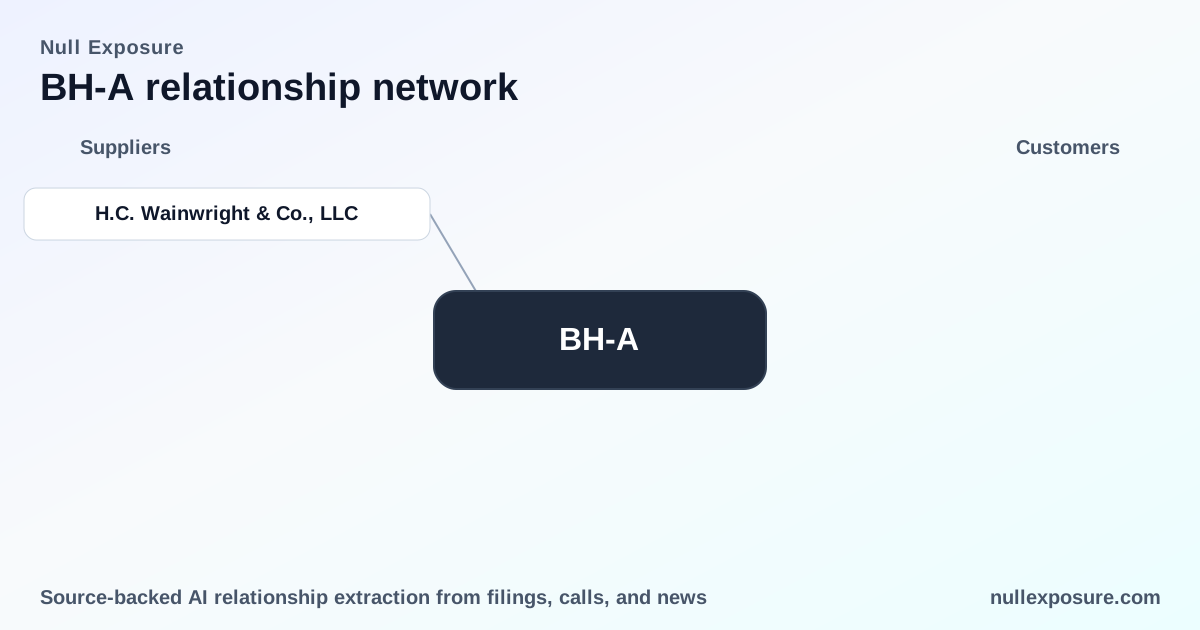
H.C. Wainwright & Co., LLC — equity distribution partner (ATM capacity)
Biglari filed an effective S‑3 shelf on 2026‑01‑16 that permits the offering of up to $500 million of Class A and Class B common stock, including through an at‑the‑market program administered with H.C. Wainwright & Co., LLC. This establishes H.C. Wainwright as the securities distribution partner for opportunistic equity issuance. (News report on StockTitan, first seen 2026‑03‑09: https://www.stocktitan.net/news/BH/biglari-holdings-inc-news-na8nwhpoo5mc.html)
What these relationships imply for contracting posture and business model risks
The constraint and disclosure signals combine into a clear operating profile:
- Contracting posture — centralized, standardized, and transactional. Company disclosures state that restaurant operations obtain food products from independent national distributors and that purchases are centrally negotiated to ensure uniformity in product quality. That centralized posture streamlines procurement negotiation but concentrates counterparty dependency at the national distributor level.
- Concentration and criticality — suppliers are operationally critical but structurally replaceable. Centralized purchasing reduces the number of counterparties handling core goods, making each distributor relationship operationally critical for day‑to‑day service; however, reliance on national distributors implies redundant supply channels exist across the national network, limiting single‑counterparty lock‑in.
- Service relationships reveal maturity and governance gaps being addressed. The company engaged a third‑party provider for internal control services to design and implement controls addressing material weaknesses, and engaged Netherland, Sewell & Associates, Inc. to prepare reserve estimates for proved reserves as of December 31, 2024. These appointments are indicative of a company transitioning toward stronger governance and specialist validation for non‑core technical tasks.
These are company‑level signals drawn from disclosures and do not attribute constraints to any single external partner beyond the named advisers.
Mid‑article note: for investors and operators wanting structured due diligence on supplier exposure and capital programs, visit https://nullexposure.com/ to see how supplier mapping integrates with financing events.
Financial and strategic implications investors must price
- Dilution and capitalization flexibility. The $500 million S‑3 shelf represents roughly half of current market capitalization (~$1.00B), giving management significant optionality to raise equity opportunistically via the ATM facility with H.C. Wainwright. That capacity materially changes the capital structure levers available to management.
- Valuation nuance. EV/EBITDA sits at a high reported figure (145.91) driven by modest EBITDA on the reported enterprise value; investors should reconcile that multiple with cyclicality in restaurant margins and episodic corporate actions such as equity raises.
- Operational margin dynamics. Operating margin TTM is positive at 3.58% while net profit margin is negative (‑9.48%), indicating operating performance is being diluted by non‑operating charges or unusual items; third‑party control engagements suggest management is actively addressing governance and accounting issues that influence bottom‑line volatility.
Practical takeaways for commercial counterparties and risk teams
- If you are a national distributor or a category supplier, expect centralized contracting and standardized specifications; negotiating through centralized channels yields scale but also emphasizes on‑time performance and price competitiveness.
- If you are a financial or advisory provider, the company will engage specialists for reserve and control work; opportunities exist for credible, transparent third‑party validation and remediation.
- If you are an investor, the ATM capacity is a live financing option that can be executed quickly; value and dilution should be modeled against potential capital needs and strategic initiatives.
Final judgment and actions
Biglari runs a centralized procurement model backed by specialist service relationships and a meaningful equity distribution pact with H.C. Wainwright for ATM issuance. The $500 million shelf changes how investors should model capital availability and dilution risk, while distributor concentration and third‑party control engagements shape operational resilience and governance outlook.
For a deeper supplier‑level intelligence package and decision support for underwriting or counterparty negotiation, explore curated profiles and alerts at https://nullexposure.com/
Key sources: company disclosures on procurement and third‑party engagements (reserve estimates and control services) and a StockTitan news item reporting the effective S‑3 shelf and ATM arrangement with H.C. Wainwright (reported 2026‑03‑09).