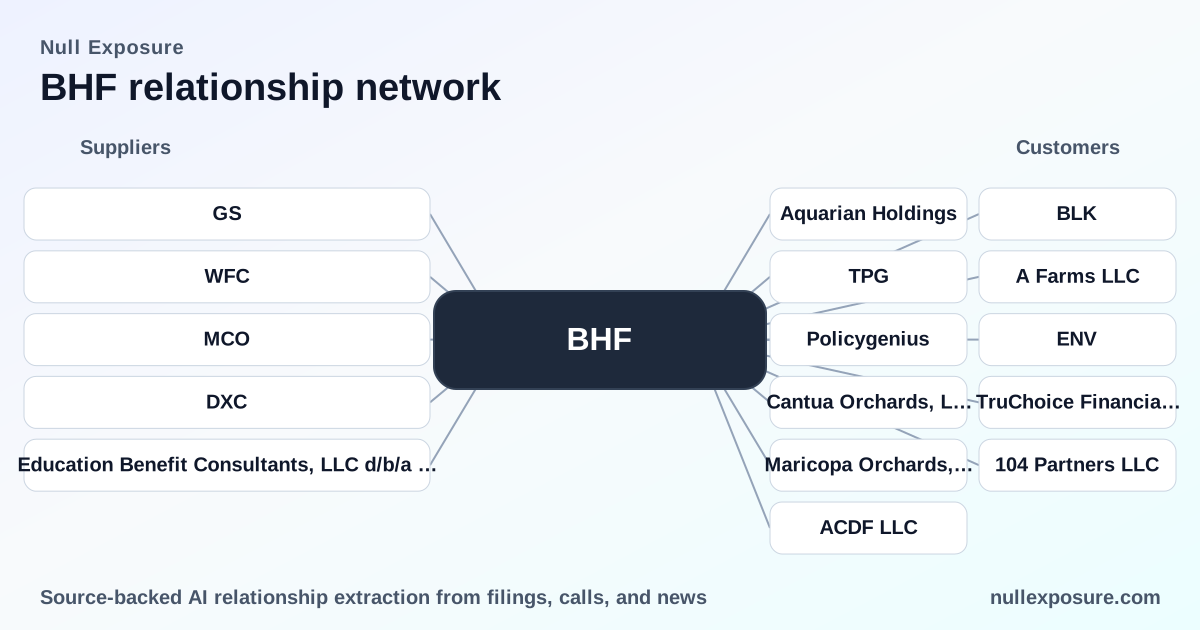
Brighthouse Financial (BHF): supplier map and what it means for investors
Brighthouse Financial underwrites U.S. retail life insurance and annuity products and monetizes through net interest spread on invested reserves, policy fees and portfolio management, plus capital and liability management transactions. The business is fundamentally a spread-driven insurer that leverages reinsurance, secured funding facilities and third‑party services to scale operations while keeping capital efficient. Investors should value BHF for earnings stability from annuity cash flows, offset by operational concentration and periodic balance-sheet maneuvers that reprice enterprise value.
Explore more supplier intelligence at https://nullexposure.com/.
Why supplier relationships matter to a life/annuity operator
Brighthouse operates with a hybrid contracting posture: long-term funding and reinsurance backstops coexist with short-term liquidity facilities and numerous outsourced service providers. That combination lowers capital requirements and supports product margins, but it increases sensitivity to funding markets and vendor risk.
- Contracting posture: The company maintains long-dated credit-linked reinsurance financing and multi-year credit lines while also running repurchase facilities that rotate on short maturities; this mix reduces funding cost volatility but requires active capital management.
- Concentration and criticality: Brighthouse relies on external administrators and technology vendors for core operations and on rating agencies and investment banks for funding and strategic options, making a small set of relationships operationally critical.
- Maturity and stability: Established financing structures and a historical credit rating provide runway for strategy execution, but upcoming facility maturities and any sale process will re-price optionality for equity holders.
These are company-level signals drawn from public notices and disclosures tied to BHF’s funding, reinsurance and vendor programs.
Supplier relationships, in plain English
Goldman Sachs — strategic adviser on potential sale (investment banking)
Brighthouse engaged Goldman Sachs as one of the investment bankers working on a potential sale process, a development reported via InsuranceNewsNet citing the Financial Times in March 2026. (InsuranceNewsNet / Financial Times, March 2026)
Wells Fargo — co-adviser in potential transaction activity
Wells Fargo is named alongside Goldman Sachs as an advisor in the same reported sale exploration, positioning it as a counterparty for M&A advisory and capital markets execution. (InsuranceNewsNet / Financial Times, March 2026)
Moody’s Investors Service — ratings oversight and credit signal
Moody’s affirmed BHF’s Baa3 senior debt and A3 insurance financial strength ratings for Brighthouse’s operating companies in a January 2022 notice; the rating framework remains a live input to funding costs and counterparty acceptance. (Moody’s press release cited on Yahoo Finance, January 2022)
DXC Technology — administration provider implicated in information exposure
Brighthouse disclosed that an administrator used by the company, DXC Technology, disclosed certain information to an unauthorized party, a vendor security incident that surfaced in 2024 legal notices. (JD Supra, 2024)
Education Benefit Consultants, LLC d/b/a Aviben — third‑party breach vector
Brighthouse filed a notice after confidential information provided to it was leaked through a third‑party breach at Education Benefit Consultants (Aviben) on October 22, 2024, highlighting downstream vendor data risk. (Brighthouse notice summarized on JD Supra, October 2024)
What the supplier map implies for valuation and risk
Brighthouse’s supplier footprint drives four investment-relevant conclusions:
- Liquidity and capital execution are structurally important. Long-term reinsurance financing alongside a $1.0 billion revolver and repurchase facilities show the company proactively manages balance-sheet funding; market access and rating stability directly influence enterprise value.
- Operational risk is a visible and current cost. Recent vendor disclosures (DXC) and a downstream breach (Aviben) translate into remediation costs, regulatory attention, and potential reputational friction with distribution partners and customers.
- Strategic optionality exists via M&A processes. Engagement of major investment banks signals either a potential sale or strategic review that could crystallize value for shareholders or reconfigure counterparty relationships.
- Ratings are a lever on funding economics. Moody’s A3/Baa3 posture supports access to lower-cost capital relative to lower-rated peers and constrains downside in stressed scenarios.
Constraints and contracting characteristics to monitor
Public disclosures describe a mix of long-dated and short-term contractual arrangements that shape operational flexibility:
- Long-term arrangements include credit‑linked reinsurance with maturities to 2039 and multi-year funding programs with Farmer Mac and other partners, indicating structural reliance on long-dated counterparty financing as part of liability management.
- Short-term liquidity is provided by repurchase facilities with up to three‑month tenors and a revolving credit facility (maturing 2027) that provide rotational liquidity but require ongoing market access.
- The company explicitly uses third parties for administrative, technology and actuarial services; Brighthouse conducts vendor security assessments, but vendor access to customer and employee data makes cybersecurity and vendor oversight a persistent operational constraint.
Key investor takeaway: monitor facility maturities, rating commentary, and vendor incident disclosures as immediate catalysts for credit spreads and equity valuation.
Explore supplier risk profiles and deeper analytics at https://nullexposure.com/.
A short checklist for active investors and operators
- Track any formal sale timeline or banker updates from Goldman Sachs and Wells Fargo for valuation inflection.
- Watch Moody’s publications for changes to the A3/Baa3 ratings that would affect funding costs.
- Verify remediation steps and contractual changes with DXC and Aviben to assess operational continuity and regulatory exposure.
- Review maturity schedules for the revolver, repurchase facilities and reinsurance financing to assess rollover risk.
Bottom line and action items
Brighthouse is a spread-focused annuity and life insurer that leverages a small set of strategic banking, ratings and vendor relationships to manage capital and operations. The company’s valuation is sensitive to funding-market access, rating stability and vendor execution — all of which are currently observable in public supplier signals. For investors, the immediate action is to monitor the sale process headlines, Moody’s commentary, and vendor breach remediation; for operators, tighten vendor oversight and funding contingency planning.
For ongoing supplier intelligence and breach-tracking for financial counterparties, visit https://nullexposure.com/.