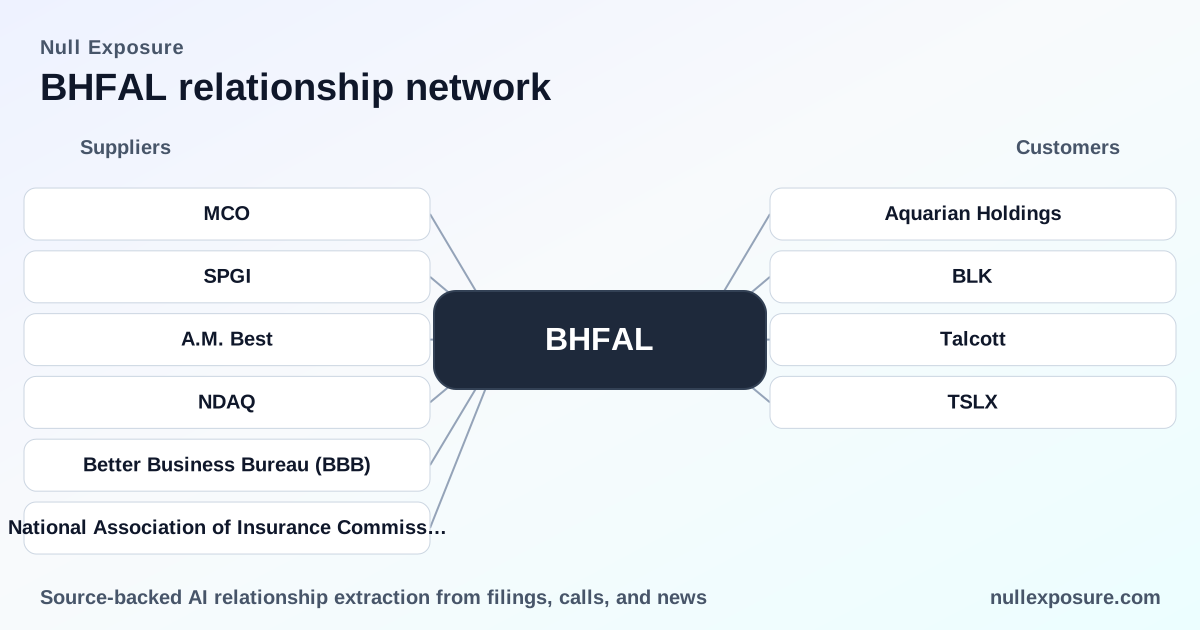
Brighthouse Financial (BHFAL): supplier relationships that shape risk, capital and distribution
Brighthouse Financial operates as a U.S. life insurance and annuities platform that monetizes through underwriting margins, investment income on reserves and fee income tied to annuity products and policy servicing. The company deliberately structures its economics around capital-light distribution and risk-transfer tools — notably reinsurance, debt and short-term financing facilities — while relying on third-party vendors for administration, technology and actuarial services. For investors and operators, the supplier map around Brighthouse is therefore a direct conduit to funding costs, regulatory posture, and customer reputation. Learn more about how we track these supplier linkages at Null Exposure.
Why supplier relationships move the P&L and balance sheet
Brighthouse’s operating model is defined by a mix of long-dated liabilities and active balance-sheet management. The company uses long-term instruments (senior notes, subordinated debentures) alongside short-term facilities (repurchase agreements and derivative ladders) to manage liquidity and hedge exposures. It also cedes risk to unaffiliated reinsurers and outsources key non-core functions to third parties — administrative, actuarial, investment and cybersecurity services — to reduce fixed-cost leverage and keep capital deployed against profitable blocks.
- Contracting posture: Both long-term and short-term contracts are core to the model, creating rollover and counterparty considerations at different horizons.
- Concentration and criticality: Reinsurance, ratings agencies and market access providers are critical counterparties; disruptions here translate directly to capital costs or distribution friction.
- Maturity and predictability: Long-dated debt and fixed-price reinsurance for existing blocks enhance predictability, while short-term repo lines and derivatives introduce a periodic need for liquidity management.
These are company-level structural signals drawn from public filings describing long-term notes, repurchase facilities and routine reinsurance arrangements.
The relationships you need to know — direct and cited
Moody’s — independent credit opinion used for capital signaling
Moody’s holds an A3 rating on Brighthouse, a key input into how investors and counterparties price the company’s debt and hedging costs. According to a SmartAsset guide on Brighthouse’s long‑term care coverage (first seen March 2026), Moody’s has assigned an A3 rating which supports the company’s access to capital markets (https://smartasset.com/insurance/brighthouse-long-term-care).
Standard & Poor’s (S&P) — market-facing rating that affects investor confidence
S&P has assigned an A+ rating to Brighthouse, which materially improves market reception of the company’s securities and products. That rating is cited in the same SmartAsset coverage of Brighthouse’s long‑term care position (https://smartasset.com/insurance/brighthouse-long-term-care).
A.M. Best — industry-rated view important for distribution partners
A.M. Best rates Brighthouse at an A grade, a rating frequently referenced by brokers and distribution partners when placing life and annuity business. SmartAsset’s review of Brighthouse references the A rating from A.M. Best as part of the company’s public ratings profile (https://smartasset.com/insurance/brighthouse-long-term-care).
NASDAQ — listing venue that governs market access and reporting
Brighthouse is a publicly traded company listed on the NASDAQ, which dictates disclosure cadence and investor access to liquidity for equity holders. The NASDAQ listing is noted in SmartAsset’s summary of the company’s public status (https://smartasset.com/insurance/brighthouse-long-term-care).
Better Business Bureau (BBB) — consumer-facing reputation signal
The company is not accredited by the BBB but receives an A+ score from the organization, a reputational datapoint that impacts distribution and consumer trust. SmartAsset’s consumer guide states the BBB rating and accreditation status for Brighthouse (https://smartasset.com/insurance/brighthouse-long-term-care).
National Association of Insurance Commissioners (NAIC) — regulator-facing complaints metric
The NAIC reports a decline in complaints against Brighthouse for long‑term care products, an operational indicator of claims handling and customer service quality that regulators and partners monitor. SmartAsset’s coverage cites NAIC data showing falling complaint trends (https://smartasset.com/insurance/brighthouse-long-term-care).
Mid-article note: if you want consolidated visibility across counterparty exposures and supplier-criticality for BHFAL, visit Null Exposure for an integrated view of these relationships.
What these relationships imply for risk and capital
The ratings from Moody’s, S&P and A.M. Best are not just labels; they feed directly into borrowing costs, collateral requirements in derivative and repo transactions, and counterparties’ willingness to transact. The NASDAQ listing preserves public market liquidity but also enforces transparency that can amplify reputational shocks. The BBB and NAIC signals are softer but operationally meaningful: complaint trends and consumer ratings translate into distribution leverage and regulatory focus.
Company-level constraints reinforce these implications:
- The firm documents long-term debt obligations and junior subordinated debentures, indicating structural long-duration funding needs that require stable access to capital markets.
- Short-term liquidity tools — repurchase facilities and laddered derivatives — are used to manage roll-over risk and market disruption exposure.
- The business explicitly leverages third-party providers for administration, actuarial and cybersecurity services, signaling operational dependency on external suppliers for core processes.
Together these characteristics create a dual exposure: sensitivity to capital markets and counterparty credit on one axis, and operational/service continuity on the other. Investors should treat supplier stress (rating actions, repo line withdrawals, or key vendor failures) as direct drivers of solvency economics and product competitiveness.
What investors and operators should do next
- Prioritize monitoring of rating agency actions and commentary because downgrades or negative outlooks change funding costs immediately.
- Include repo and derivative counterparty status in liquidity stress tests to reflect the company’s documented short-term facilities.
- Audit vendor concentration for administration, actuarial and cybersecurity services; outsourcing reduces fixed costs but increases single‑point-of-failure risk.
For a practical gateway to supplier-level intelligence and counterparty scoring on Brighthouse, review the platform resources at Null Exposure.
Brighthouse’s supplier map is a concise window into its capital and operational architecture: ratings and reinsurance determine cost of capital and risk transfer capacity; exchanges and consumer/regulatory signals shape liquidity and distribution. Investors who integrate these supplier relationships into valuation and stress-testing will have a clearer view of downside pathways and where management control can materially change outcomes.