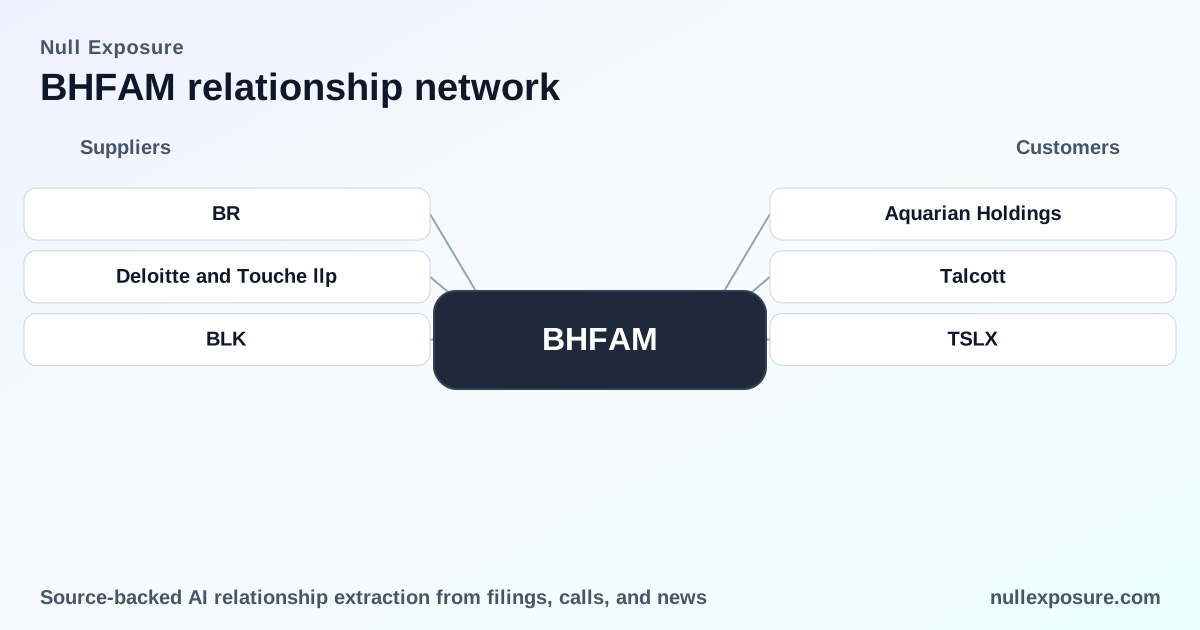
BHFAM’s supplier map: relationships, constraints and what investors should price in
Brighthouse Financial (BHFAM) operates as a capital-intensive life and retirement insurer that monetizes through premiums, asset-management spread and retained investment income, while outsourcing critical administration, accounting and asset-management functions to third parties. The company leverages reinsurance and external asset managers to manage risk and capital, runs secured short-term funding facilities for liquidity, and maintains long-dated financing to underwrite term-matched obligations — a model that amplifies the importance of supplier reliability and counterparty strength. For investors evaluating BHFAM supplier exposure, the key questions are service criticality, contract tenor, counterparty credit, and how concentrated those functions are. For a concise vendor-risk snapshot and ongoing monitoring, visit https://nullexposure.com/.
Supplier snapshot: three named partners and what they do for Brighthouse
BHFAM’s public disclosures and recent transcripts identify a small set of visible, high-profile suppliers that handle governance, audit and product distribution or asset management. Below I cover each relationship mentioned in the public record and provide the precise sourcing.
Broadridge Financial Solutions — corporate meeting and proxy services
Broadridge acted as the inspector of election and provided an affidavit confirming the mailing of meeting notices on April 29, 2025, indicating Broadridge is supplying proxy and shareholder-meeting services for Brighthouse. Source: AlphaStreet earnings/meeting transcript (first seen Mar 9, 2026).
Deloitte & Touche LLP — independent external auditor
Deloitte attended the company meeting as Brighthouse’s independent accounting firm, confirming Deloitte’s role as external auditor and control examiner for statutory and financial reporting. Source: AlphaStreet earnings/meeting transcript (first seen Mar 9, 2026).
BlackRock — distribution and asset-management partnership
Brighthouse announced a partnership with BlackRock to offer the LifePath Paycheck retirement solution into defined contribution plans, and the company reported receiving its first deposits from that solution in 2024 — signaling a commercial distribution and product-integration relationship that opens workplace channels. Source: AlphaStreet earnings/meeting transcript (first seen Mar 9, 2026) and Simply Wall St coverage (FY2025 commentary, Mar 9, 2026).
What the supplier relationships imply about operating posture
BHFAM’s operational model is outsourced, relationship-driven and reliant on large institutional partners for governance, audit, and distribution. The relationship set is small but strategically broad: governance services (Broadridge), assurance (Deloitte), and distribution/asset management partnerships (BlackRock). That pattern aligns with an insurer that seeks scale via platform partners rather than vertical integration.
- The Broadridge relationship is low-volume operationally but high on governance criticality — failure or delays in proxy services would affect shareholder voting and regulatory timelines.
- The Deloitte engagement is fundamental to financial transparency; auditor continuity or quality issues would materially affect investor confidence.
- The BlackRock connection is commercially material to distribution and product innovation, with direct implications for premium inflows and asset gathering.
For active evaluation and monitoring of these supply-side exposures, see https://nullexposure.com/.
Company-level constraints that shape supplier risk (contracting posture, maturity, criticality)
BHFAM’s publicly disclosed constraints give a clear picture of how it funds and structures counterparty relationships:
- Contract tenor is mixed but includes material long-dated arrangements. The company reported a $15.0 billion financing arrangement at Brighthouse Reinsurance Company of Delaware (BRCD) structured as credit-linked notes maturing in 2039, with the facility reported as available and undrawn as of December 31, 2024. This reflects long-term capital backstops that support reinsurance and risk-transfer strategies (company filings, Dec 31, 2024).
- Short-term, committed liquidity lines are prominent and actively used for asset-liability management. Brighthouse Life Insurance Company maintains secured repurchase facilities (up to $2.5 billion, with repo terms up to three months) and a $1.0 billion senior unsecured revolving credit facility maturing in 2027, both serving day-to-day liquidity and margining needs (company filings, Dec 31, 2024).
- Supplier relationships are explicitly service-provider focused and operationally integral. Management states that it leverages third parties for administrative, technology, investment management and actuarial services, and conducts vendor security assessments where vendors have access to systems or data — a recognition that vendor risk is a core operational control vector (company disclosures).
- Segment focus is services-heavy. The company frames third parties as critical to delivering administrative and technology services, not merely fringe contractors, which implies ongoing vendor management costs and operational dependency.
These constraints position BHFAM as a company that balances long-term financing with short-term liquidity tools while intentionally outsourcing material functions — a structure that reduces fixed-cost investment but increases dependency on counterparty quality and contract execution.
Investment implications: risk hotspots and what to watch
- Concentration risk: The visible supplier roster is compact and dominated by large incumbents; while that lowers counterparty risk per partner, it increases systemic exposure if a major vendor relationship were disrupted. Monitor contract renewal terms for key providers and the presence of fallback arrangements in filings and proxy materials.
- Operational criticality over transaction volume: Vendors like Broadridge perform low-frequency but high-impact functions (proxy services); Deloitte provides continuous assurance; BlackRock drives distribution and flows. Investors should weight service criticality as heavily as counterparty credit.
- Liquidity and funding mix matter for vendor resilience: The coexistence of a long-dated $15.0 billion financing facility and shorter-term repo and revolving lines demonstrates a layered funding approach that supports reinsurance cedings and short-term margining, but also requires active liquidity management under stress (company filings, Dec 31, 2024).
Final takeaways and next steps for investors
- BHFAM runs a vendor-centric operating model where large, well-known firms provide governance, audit and distribution — this reduces day-to-day execution risk but concentrates impact if a prime vendor fails.
- Capital structure choices — long-term credit-linked finance plus short-term repo and revolver capacity — support the outsourced model but require active liquidity oversight.
- For a deeper supplier-risk profile and ongoing monitoring of vendor changes, governance filings and counterparty updates, visit https://nullexposure.com/ for tools and reports tailored to institutional investors.
If you want a prioritized watchlist for vendor-related triggers (contract renewals, auditor rotation, distribution deposits), review our structured supplier dashboards at https://nullexposure.com/ and subscribe for alerts tied to filing dates and earnings transcripts.