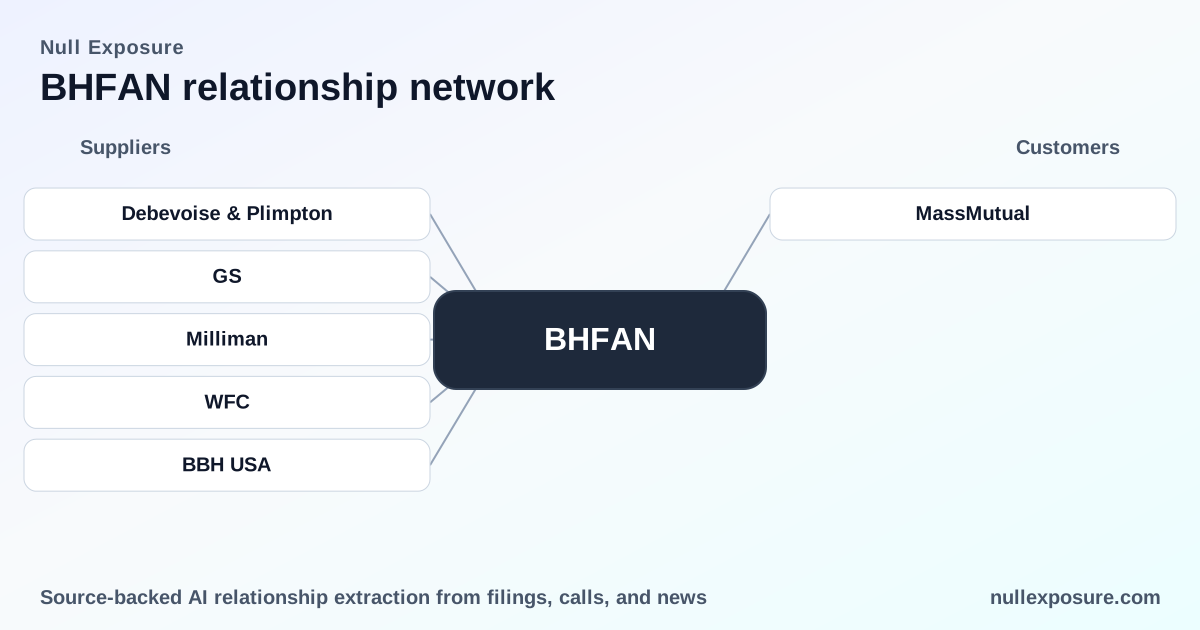
Brighthouse Financial (BHFAN): Supplier map, deal advisers, and what it means for counterparties
Brighthouse Financial underwrites and services U.S. life insurance and annuity contracts and monetizes through premium income, investment spreads on its general account, and fees tied to variable products; the company supplements balance-sheet management with reinsurance and secured financing to scale capital efficiency. The recent strategic sale process and financing arrangements make supplier relationships—banks, actuarial houses, legal firms and creative agencies—critical operational inputs and risk levers for investors and counterparties assessing exposure to BHFAN. For a full supplier-risk view and searchable partner profiles, visit https://nullexposure.com/.
The transaction advisers: who did Brighthouse hire and why it matters
Business North Carolina reported that Brighthouse engaged a classic sell-side roster for its strategic transaction: Wells Fargo and Goldman Sachs acted as financial advisers, Debevoise & Plimpton provided legal counsel, and Milliman served as actuarial adviser in connection with the Aquarian Capital acquisition announced in early March 2026. These advisers indicate a market-standard mix of investment banking, legal, and actuarial support for large insurance dispositions; the sourcing and structuring of the deal relied on established global banks and specialist actuarial input (Business North Carolina, March 9, 2026: https://businessnc.com/aquarian-capital-acquires-charlotte-based-brighthouse-financial-in-4-1-billion-cash-deal/).
Goldman Sachs — strategic financial adviser
Goldman Sachs was the lead financial adviser to Brighthouse during the transaction process, supplying valuation, buyer outreach and process management services. This engagement signals a full-service investment banking approach to maximize sale proceeds and structure financing options (Business North Carolina, March 9, 2026).
Wells Fargo — co-adviser on the deal
Wells Fargo acted alongside Goldman Sachs as a financial adviser, contributing distribution and debt-placement capabilities that are important when selling insurance portfolios with financing components. Wells Fargo’s role underscores the need for large-bank balance-sheet support on both advisory and execution tasks (Business North Carolina, March 9, 2026).
Debevoise & Plimpton — legal counsel on the sale
Debevoise & Plimpton provided legal advice to Brighthouse for the transaction, handling structuring, regulatory review and purchase agreements—an indication that the company deployed top-tier transactional legal resources for regulatory and contractual complexity (Business North Carolina, March 9, 2026).
Milliman — actuarial advisory and deal analytics
Milliman acted as actuarial adviser to Brighthouse, supplying the mortality, reserve and pricing workstreams necessary for acquirers and lenders to underwrite long-dated liabilities. Actuarial endorsement from a major consulting firm materially reduces execution risk in insurance portfolio transfers (Business North Carolina, March 9, 2026).
BBH USA — creative and marketing relationship
Earlier filings and media coverage note that BBH USA handles creative strategy and execution for Brighthouse Financial as part of broader advertising mandates, linking brand and distribution support to product sales and customer retention efforts (Adweek AgencySpy, FY2022: https://www.adweek.com/agencyspy/bbh-usa-names-erica-roberts-chief-creative-officer/).
What the supplier map reveals about Brighthouse’s operating posture
Collectively, the supplier roster and company disclosures show a mixed contracting posture: long-dated capital structures coexist with short-term liquidity facilities and external service providers running material functions.
- Long-term funding: Brighthouse Reinsurance Company of Delaware maintains a $15.0 billion financing arrangement supported by credit-linked notes maturing in 2039, which anchors long-duration liability financing and reduces short-term refinancing pressure.
- Short-term facilities: The company uses secured committed repurchase facilities (up to $2.5 billion, terms to three years) and a $1.0 billion unsecured revolving credit facility (maturing April 15, 2027) for working capital and liquidity management.
- Service provider model: Brighthouse outsources key functions—asset management of the general account and separate account assets, actuarial advisory, and creative/marketing services—while retaining select capabilities in-house (notably derivatives trading and its registered investment adviser function).
These are company-level signals drawn from public excerpts and filings; they collectively point to high vendor spend and concentrated counterparty exposures. The scale of committed facilities and reinsurance lines places Brighthouse in a spend band consistent with >$100 million strategic counterparties, and the mix of long-term reinsurance financing plus revolvers/repurchase lines indicates a deliberate laddering of maturity and counterparty types.
For enterprise clients and suppliers evaluating engagement, the full supplier profile on NullExposure helps quantify counterparties and contract scope—see https://nullexposure.com/ for supplier intelligence.
Practical implications for investors and counterparties
- Counterparty concentration and criticality: Large, multi-year financing arrangements and concentrated use of select asset managers make counterparty performance a material credit and operations risk. Credit stress or a sudden withdrawal from a principal counterparty would have immediate balance-sheet consequences.
- Liquidity profile: The coexistence of long-term reinsurance financing with short-term repo and revolver facilities creates a two-tier liquidity picture: long-dated structural funding paired with tactical liquidity that must be managed through market cycles.
- Operational reliance on third parties: Outsourcing investment management, actuarial validation and creative/marketing functions reduces fixed costs but increases vendor risk vectors—especially around data, governance and service continuity.
Midway through diligence, investors should validate counterparty ratings, review facility covenants and confirm continuity plans with third-party vendors. For a deeper supplier-risk view and to benchmark counterparties, visit https://nullexposure.com/.
Due diligence checklist for counterparties
- Confirm maturity profile and covenant triggers for the $15.0 billion reinsurance financing and the $1.0 billion revolver.
- Request counterparty lists and concentration metrics for asset managers running general account and separate account assets.
- Review vendor cyber and data-access controls for third-party service providers with customer or employee data access.
- Validate actuarial assumptions and Milliman’s role in transaction-related liability transfers.
Bottom line: focused exposure, material dependencies
Brighthouse’s supplier map is consistent with a mid-market life insurer that leverages both long-term structural financing and short-term liquidity tools while outsourcing specialist functions to top-tier advisers and vendors. For investors, the central questions are not whether advisers are reputable—they are—but how concentrated and enforceable those financial and operational relationships are under stress. The mix of a $15.0 billion long-term reinsurance facility alongside sizeable repurchase and revolving facilities signals scale and complexity that require active counterparty monitoring.
To assess counterparties rapidly and see the underlying documents referenced here, use the supplier intelligence hub at https://nullexposure.com/ for a searchable, evidence-backed supplier view.