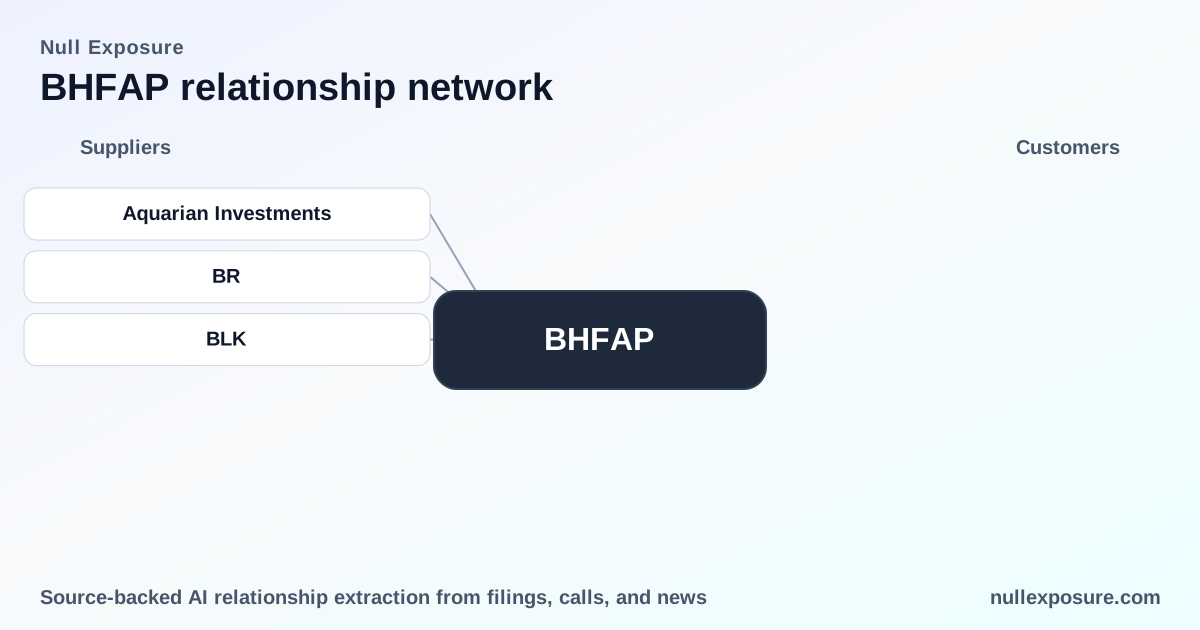
Brighthouse Financial (BHFAP): Supplier relationships under an active strategic reset
Brighthouse Financial sells U.S. life insurance and annuity products and generates returns from premium flows, investment spreads and fee income on structured retirement solutions. The company’s commercial model is capital-intensive and distribution-driven, with supplier relationships concentrated around investment management, transaction services and large secured financing facilities that support product liabilities. Recent strategic moves — notably a takeover by Aquarian Capital and visible engagement with major asset managers — reframe supplier risk and opportunity for counterparties and acquirers evaluating ongoing relationships.
For a focused supplier-risk scorecard and relationship mapping, visit NullExposure: https://nullexposure.com/
How Brighthouse runs its supplier footprint — what matters to investors and operators
Brighthouse’s operating posture blends multi-year financing commitments and tactical short-dated liquidity facilities. Company disclosures through December 31, 2024 show both long-dated financing (credit-linked reinsurance notes maturing in 2039) and medium-term bank facilities (a $1.0 billion revolving credit facility maturing in 2027), alongside repurchase facilities with terms up to three years that support asset-liability management. These contract structures create a dual dynamic: strategic, long-duration counterparties are critical for capital continuity, while shorter-term counterparties support day-to-day funding flexibility.
Company-level constraints that shape supplier selection and contracting behavior:
- Contracting posture: A mix of long-term financing (reinsurance credit-linked notes) and multi-year bank facilities, alongside shorter repurchase facilities used for liquidity. These are company-level signals drawn from the 2024 disclosures.
- Concentration and spend: The balance-sheet programs and committed facilities imply counterparty spend and exposure in the $100m+ band, making counterparties materially important rather than peripheral.
- Criticality and maturity: Facilities maturing in 2027 and reinsurance arrangements maturing in 2039 impose specific continuity and covenant considerations for suppliers.
- Service role and operational maturity: Brighthouse engages third-party consultants and security vendors to assess controls and cybersecurity posture, indicating formal vendor governance with security due diligence baked into contracting.
These signals imply that suppliers to Brighthouse operate under robust vendor governance and face high operational criticality when they support funding, investment management or distribution functions.
Material supplier and strategic relationships you must evaluate
Aquarian Investments — strategic acquirer and investment-management partner
Brighthouse accepted a $4.1 billion takeover offer from Aquarian Capital, and Aquarian plans to expand Brighthouse’s investment management capabilities through Aquarian Investments as part of the transaction. This is a transformational relationship: private-equity ownership will reorient vendor decision-making toward integration with Aquarian’s investment platform. (InsuranceNewsNet, March 9, 2026 — https://insurancenewsnet.com/innarticle/brighthouse-financial-accepts-4-1b-takeover-offer-from-aquarian)
Broadridge Financial Solutions, Inc. — proxy and meeting services provider
Broadridge provided an affidavit confirming mailing of the notice and proxy materials for Brighthouse’s special shareholder meeting that approved the merger, indicating Broadridge’s role as a transaction and shareholder-services provider during the corporate event. Operationally, this is a standard but mission-critical service during M&A and governance workflows. (MarketBeat, February 12, 2026 — https://www.marketbeat.com/instant-alerts/brighthouse-financial-stockholders-approve-aquarian-merger-deal-at-special-meeting-2026-02-12/)
BlackRock — asset-manager partner on product initiatives
Brighthouse highlighted ongoing work with BlackRock on the LifePath Paycheck annuity product, reflecting a distribution and asset-management coordination with one of the industry’s largest managers — a relationship that supports product innovation and scale distribution. This kind of partnership links Brighthouse’s liability book to external asset management capabilities. (InsuranceNewsNet, March 9, 2026 — https://insurancenewsnet.com/innarticle/brighthouse-financial-accepts-4-1b-takeover-offer-from-aquarian)
What the relationships mean for supplier risk, revenue and integration
Aquarian’s acquisition creates an immediate reset of incentives across the supplier roster. Investment-management alignment with Aquarian Investments will be prioritized, which can shift assets away from incumbent managers or expand mandates for partners willing to integrate. BlackRock’s existing product-level collaboration demonstrates that Brighthouse remains open to third-party asset-manager partnerships where scale and product fit deliver distribution value.
Operational vendors like Broadridge are transaction-critical during governance events; their relationships are less discretionary and more about execution continuity. For suppliers delivering funding or liquidity (repurchase facilities, revolving credit), the presence of large committed facilities and reinsurance-linked financing indicates that these counterparties occupy a strategic tier in Brighthouse’s vendor hierarchy.
A mid-cycle diligence imperative: review covenant sensitivity and counterparty replacement lead times. According to company disclosures as of December 31, 2024, the firm was in compliance with financial covenants, but the combination of long-dated reinsurance structures and near-term facility maturities concentrates operational risk around covenant monitoring and replacement financing scenarios. For immediate supplier impact assessment, consult the NullExposure model for counterparty criticality and replacement horizon: https://nullexposure.com/
Practical implications for investors and operators
- Priority one: integration playbook. Suppliers that can propose rapid integration with Aquarian’s investment platform will be favored for mandates and could capture larger AUM or discrete product responsibilities.
- Priority two: continuity for financing partners. Counterparties supporting Repurchase Facilities and the revolving credit line are pivotal to Brighthouse’s liquidity management; they warrant close covenant tracking and scenario planning.
- Priority three: cyber and security vendors are contractually material. The company’s explicit statements about third‑party security assessments indicate formalized vendor risk management — vendors should expect ritualized controls reviews and evidence requirements.
- Governance services matter during M&A. Corporate actions lean on providers like Broadridge for proxy and mailing execution; these vendors are de facto mission-critical for shareholder-facing events.
For deeper supplier-level analytics and to map exposure across counterparties, follow up at NullExposure: https://nullexposure.com/
Final takeaways — what to watch next
Brighthouse’s supplier landscape is transitioning from a public-company vendor set to a configuration shaped by private-equity ownership and integration objectives. Key risks for suppliers are displacement through strategic reallocation of mandates and heightened covenant scrutiny, while opportunities center on scaled asset-management mandates and transactional services tied to ongoing product innovation. Monitor three vectors closely: Aquarian’s integration decisions, asset-manager reassignments tied to product programs like LifePath Paycheck, and covenant/renewal timelines for the firm’s financing facilities.
If you are evaluating counterparty risk or positioning to bid for Brighthouse mandates, start with a targeted review of financing continuity plans and integration-ready service offerings — and see how NullExposure models the supplier landscape for actionable diligence: https://nullexposure.com/
Concluding note: Brighthouse is a capital-intense insurer whose supplier relationships are pivotal to both liquidity and product distribution; recent ownership change amplifies the premium on strategic alignment and operational resilience.