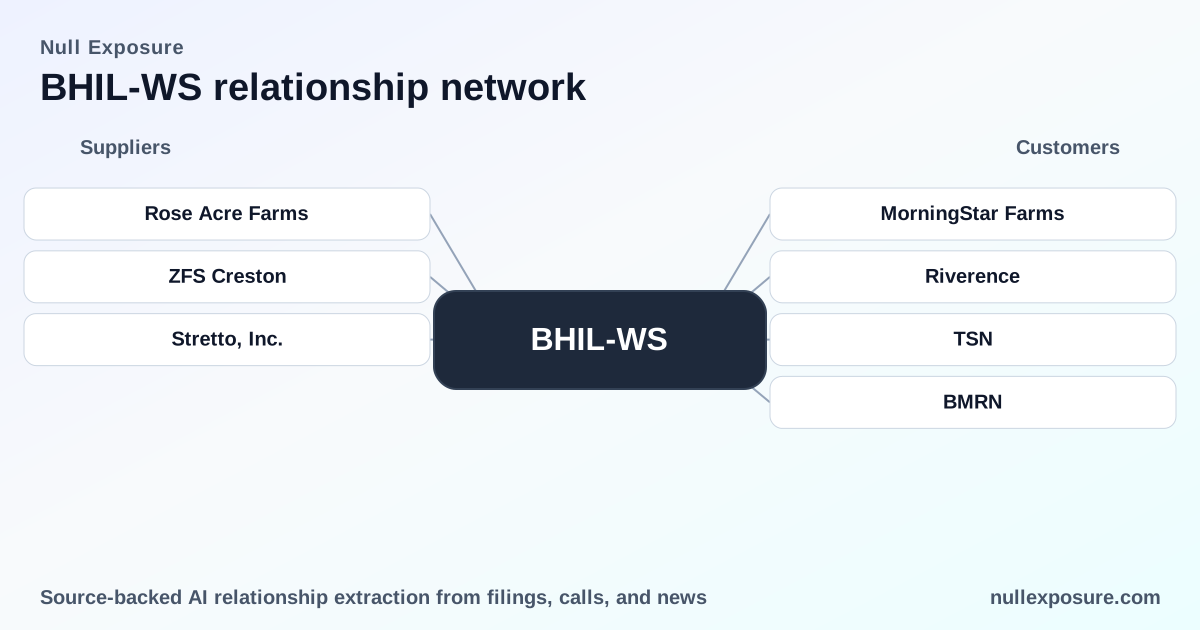
Benson Hill (BHIL-WS): supplier relationships that matter for investors and operators
Benson Hill operates as a plant-protein ingredients and food-production company that is scaling by acquiring midstream processing assets and securing commercial partnerships with food manufacturers. The firm monetizes through ingredient sales to CPG and foodservice customers, strategic supply deals with brand partners, and by controlling processing capacity to capture margin uplift on raw soy inputs. Recent asset purchases and a court-directed restructuring materially reshape supplier risk and operational leverage for prospective counterparties and investors. For a focused view of supplier exposures, visit https://nullexposure.com/.
What the corporate moves tell an investor up front
Benson Hill’s playbook is clear: verticalize processing to reduce input cost exposure and accelerate volume-based sales to large food customers. The company is moving from pure R&D and ingredient formulation toward owning the physical processing nodes that convert soybeans into ingredients. That shifts its contracting posture from buyer-dependent to owner-operator, increases capital intensity and brings concentrated operational risk tied to a small number of physical sites. For a full supplier intelligence view, see https://nullexposure.com/.
The three direct supplier/partner touchpoints every analyst should know
Below I cover each relationship found in the supplier-scope results set. Each entry is a plain-English operational summary with the source called out.
Rose Acre Farms — physical asset sold to Benson Hill
Benson Hill acquired a soybean crushing facility that had been owned by Seymour, Indiana–based Rose Acre Farms, a move used to scale ingredient production capacity. According to AgFunder News coverage of the Kellogg’s–Benson Hill arrangement in FY2022, that facility purchase was executed to increase processing throughput for plant-protein products. (AgFunder News, FY2022)
ZFS Creston — regional soybean processing added to capacity
Benson Hill purchased Iowan soy processing firm ZFS Creston in January to expand regional crushing capability and secure a second processing node for soy inputs. AgFunder News reported the ZFS Creston acquisition as a deliberate step to scale product manufacturing for ingredient supply contracts. (AgFunder News, FY2022)
Stretto, Inc. — claims agent during Chapter 11 process
During the company’s FY2025 Chapter 11 process, Benson Hill directed stakeholders to a case website managed by Stretto, Inc., who was appointed as the claims agent to administer filings and creditor communications. A Yahoo Finance release in FY2025 referenced Stretto’s claims portal as the central point for additional restructuring information. (Yahoo Finance, FY2025)
Why each relationship matters for counterparties and investors
The Rose Acre and ZFS Creston transactions are not minor procurement deals; they are core operational moves that materially change how Benson Hill sources, processes and prices its ingredients. Owning crushing plants converts supply risk from third-party vendor reliability into capital-asset and operational uptime risk. That matters to buyers because a plant outage now directly constrains Benson Hill’s ability to meet volume commitments.
The Stretto relationship is procedural but consequential: the appointment of a claims agent during Chapter 11 signals a formal restructuring with attendant counterparty uncertainty around contract performance, cure rights and post-emergence supplier choices. Investors must price both operational concentration and restructuring-related legal risk into valuations.
Operating model characteristics and company-level constraints
There are no explicit contractual constraints reported in the supplier-scope records. As a company-level signal, the following characteristics are observable and relevant to risk assessment:
- Contracting posture: Transitioning from buyer-of-capacity to owner-operator, Benson Hill’s bargaining dynamics change in favor of capturing processing margin but increase fixed-cost commitments and exposure to maintenance, regulatory and labor risks associated with physical plants.
- Concentration: The company’s reliance on a small number of crushing facilities creates concentration risk — a single-site disruption now has outsized impact on throughput and revenue recognition.
- Criticality: For major CPG partners seeking predictable ingredient flow, Benson Hill’s owned assets are critical infrastructure; partners will require clarity on redundancy, service-level commitments and contingency sourcing plans.
- Maturity and financial posture: The FY2025 Chapter 11 process and the use of a claims agent indicate material capital structure stress and a period of elevated counterparty and covenant risk during restructuring and post-emergence execution.
All of the above are company-level signals; no explicit supplier-side constraints were listed in the records.
Practical implications for investors and operational partners
- For investors: price in operational concentration and restructuring uncertainty. Ownership of processing assets boosts long-term margin potential but converts variable supply risk into fixed-capex and operational execution risk. Monitor uptime, capex-to-maintenance mix, and post-Chapter 11 covenant terms closely.
- For counterparties: demand explicit continuity clauses and contingency sourcing commitments where ingredient supply is mission-critical. Evaluate the ability and willingness of Benson Hill to prioritize contracted volumes during any post-restructuring ramp.
- For lenders and service providers: asset-backed exposure to single-site plants requires tighter monitoring regimes, insurance reviews and stress tests for outage scenarios.
Final takeaways and next steps
Benson Hill’s strategy to own midstream processing assets is a deliberate commercial pivot that increases both potential margin capture and operational concentration. Rose Acre Farms and ZFS Creston are tangible examples of that pivot, while the engagement of Stretto, Inc. during Chapter 11 demonstrates the near-term legal and counterparty uncertainty that accompanies a capital restructuring. Investors and operators should prioritize operational diligence on plant performance and legal review of restructuring outcomes.
If you want a vendor-level intelligence package or monitoring feed tuned to supplier events and restructuring signals, visit https://nullexposure.com/ to get started. For hands-on, analyst-grade supplier tracking and risk alerts, go to https://nullexposure.com/ and request a briefing.