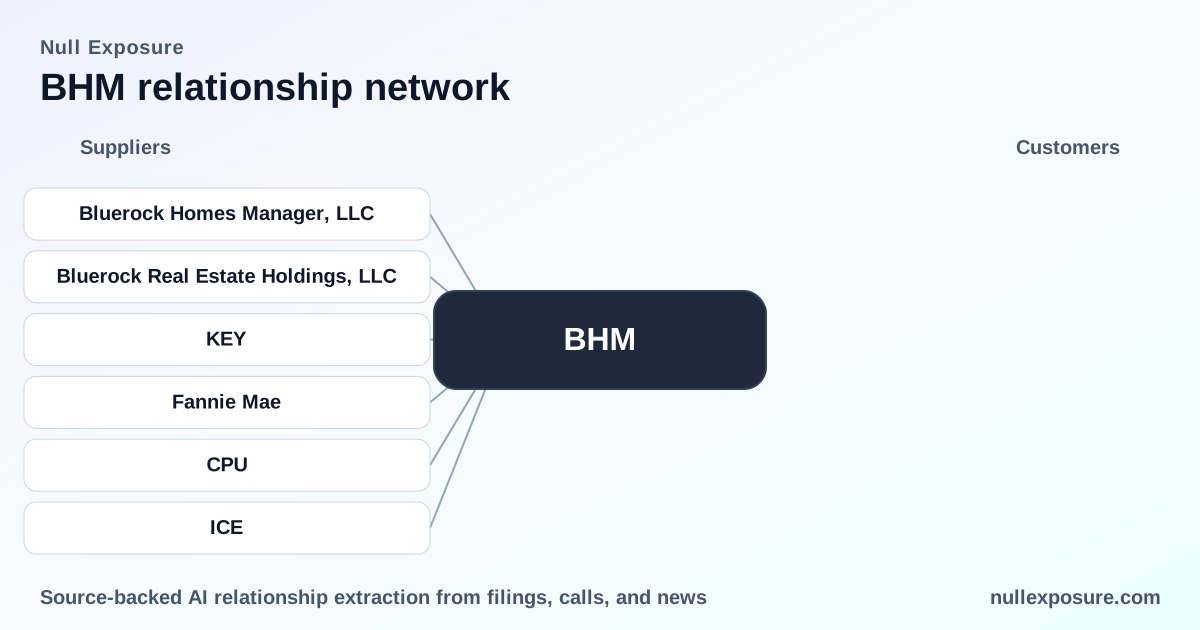
Bluerock Homes Trust (BHM): supplier relationships that shape operating leverage and risk
Bluerock Homes Trust (BHM) acquires, develops and manages single‑family rental assets and monetizes through rental revenue and structured fee arrangements with affiliated managers and capital providers. The company is externally managed—the manager collects base management fees, earns incentive compensation and can be paid in equity-like LTIP units—while BHM finances growth through a mix of unsecured facilities, agency loans and preferred‑stock offerings. For investors evaluating supplier exposure, the interaction between related‑party management, financing counterparties and transfer agents drives both operating leverage and governance risk. Learn more at https://nullexposure.com/.
What the supplier model is—and why it matters to returns
BHM does not employ its own operating workforce; it is externally managed under a Management Agreement that delegates day‑to‑day operations to an affiliated manager. That arrangement concentrates operational dependency and creates a recurring fee stream paid to the manager. The manager’s compensation structure includes a base management fee that can be paid in cash or in long‑term incentive units, and the company records material lease and financing obligations on its balance sheet that amplify counterparty importance.
Key operating characteristics: long‑term contracting with auto‑renewal features; concentrated counterparty reliance on an external manager; material operational criticality if management services are interrupted; and mixed spend bands that range from modest recurring fees (hundreds of thousands) to large capital facilities (hundreds of millions). For background on BHM’s governance and financials, see the company overview and filings at https://nullexposure.com/.
Supplier relationships, one by one
Bluerock Homes Manager, LLC
Bluerock Homes Manager, LLC is the external manager that administers BHM’s business activities and day‑to‑day operations under a Management Agreement that provides for a quarterly base management fee and discretionary LTIP unit payments; the agreement contains automatic one‑year renewals and termination provisions (8‑K disclosure) (see https://www.stocktitan.net/sec-filings/BHM/8-k-bluerock-homes-trust-inc-reports-material-event-d94fa9c81949.html).
According to Form 4 filings, the manager accepted LTIP units in partial satisfaction of the base management fee for Q4 2025 (see Form 4 disclosure at https://www.stocktitan.net/sec-filings/BHM/form-4-bluerock-homes-trust-inc-insider-trading-activity-1c0f27a042a2.html).
Bluerock Real Estate Holdings, LLC
Bluerock Real Estate Holdings, LLC is an affiliate tied to manager reimbursement obligations; filing excerpts show the manager reimbursed BREH for salary costs of executive services, with LTIP unit issuance tied to those reimbursements (Form 4, FY2026) (https://www.stocktitan.net/sec-filings/BHM/form-4-bluerock-homes-trust-inc-insider-trading-activity-d14b4f6c2bc7.html).
KeyBank (KEY)
KeyBank is a lender and a counterparty to BHM’s credit facility; press coverage of BHM’s Skytop Apartments acquisition notes financing via a senior loan from Fannie Mae and borrowings under an existing KeyBank credit facility, indicating continued reliance on bank liquidity for acquisitions (Globe and Mail press release, FY2025) (https://www.theglobeandmail.com/investing/markets/stocks/BHM-A/pressreleases/35239292/bluerock-homes-trust-completes-acquisition-of-skytop-apartments/).
Fannie Mae
Fannie Mae provided a senior loan for a stated acquisition, demonstrating access to agency financing channels for stabilized assets — a structural source of lower‑cost, long‑dated debt for residential portfolios (Globe and Mail press release, FY2025) (https://www.theglobeandmail.com/investing/markets/stocks/BHM-A/pressreleases/35239292/bluerock-homes-trust-completes-acquisition-of-skytop-apartments/).
Computershare (CPU)
Computershare acts as the distribution agent, transfer agent and registrar for BHM common stock, a standard market‑infrastructure role that supports shareholder liquidity and corporate actions (PR Newswire and CityBiz coverage, FY2022) (https://www.prnewswire.com/news-releases/board-of-directors-of-bluerock-residential-growth-reit-inc-approves-the-completion-of-the-proposed-spin-off-of-its-single-family-rental-business-to-shareholders-completion-of-spin-off-and-acquisition-of-bluerock-residential-gro-301627554.html; https://www.citybiz.co/article/322387/bluerock-residential-growth-reit-board-approves-the-completion-of-the-proposed-spin-off-of-its-single-family-rental-business-to-shareholders/).
New York Stock Exchange American (NYSE American / ICE)
BHM’s Class A common stock is listed on the NYSE American, which provides the trading venue and regulatory framework for public liquidity and disclosure (CityBiz note on listing, FY2022) (https://www.citybiz.co/article/322387/bluerock-residential-growth-reit-board-approves-the-completion-of-the-proposed-spin-off-of-its-single-family-rental-business-to-shareholders/).
How constraints shape supplier risk and contracting posture
BHM’s disclosures and filings reveal several overarching constraints that inform supplier risk and contracting posture:
- Long‑term contracting and renewal mechanics. The Management Agreement carries an initial term with automatic one‑year renewals, and BHM holds long‑term leasehold interests through its DST program; these provisions create multi‑year service dependency and suggest planning horizons that favor continuity over rapid vendor churn (company 8‑K and lease accounting excerpts).
- Service provider concentration and materiality. BHM is externally managed and has no employees, so the Manager is operationally critical; the company states that termination or non‑renewal of the Management Agreement would have a material adverse effect on operations and distribution capability. This is a material counterparty concentration for investors to monitor.
- Mixed spend profile with strategic capital dependence. Disclosed fee examples show recurring asset management fees in the low hundreds of thousands annually alongside acquisition and one‑time fees (millions) and significant corporate indebtedness (total indebtedness ~ $381.6 million as of Dec 31, 2024). This dual cost structure—relatively modest recurring operating fees plus large financing exposures—means supplier risk is intertwined with capital markets access.
- Active relationships and continuity. Most supplier relationships are active and operationally embedded (management, financing, transfer agent, listing venue), signifying stable but high‑impact dependencies.
What investors and operators should track now
- Monitor Management Agreement disclosures and any changes to fee mechanics or the Manager’s incentive compensation; management services are critical to execution and tied to director oversight.
- Watch debt composition and agency bank relationships—KeyBank and Fannie Mae exposure affects refinancing risk and acquisition capacity; capital access will determine growth pacing.
- Confirm transfer agent procedures and shareholder servicing with Computershare to avoid administrative friction ahead of dividend or spin actions.
Actionable next steps: evaluate the concentration of outsourced operations relative to peers, stress test cash flows against management fees and debt service, and track amendments to the Management Agreement that could change fee alignment.
Explore deeper supplier‑risk signals and filings at https://nullexposure.com/ to align due diligence with portfolio decisions.
Bottom line
BHM runs with an outsourced operating model that centralizes execution through an affiliated manager and funds growth with a mix of agency loans, bank facilities and preferred‑stock capital. That structure delivers scalable operating leverage but concentrates operational and governance risk in a handful of supplier relationships—chiefly the external manager and financing counterparties. For investors, the critical questions are governance of the manager relationship, transparency of fee economics, and the sustainability of capital markets access. For deeper vendor and counterparty intelligence, visit https://nullexposure.com/.