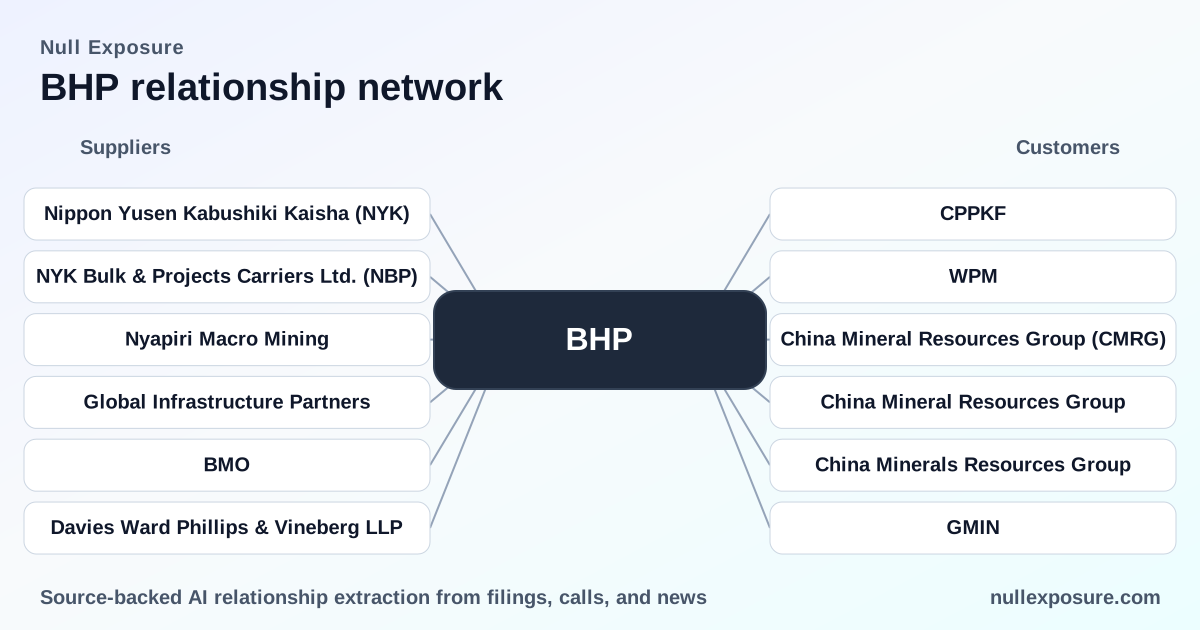
BHP supplier relationships: strategic partners, operational risk, and where value flows
BHP monetizes a global portfolio of raw materials by operating large-scale mines and integrated logistics chains and selling concentrates, ores, and refined products under long-term contracts and spot arrangements; its cash generation depends on commodity prices, scale economies, and the reliability of a diversified supplier and service ecosystem. For investors, the supplier map is as important as reserves—shipping, local contractors, infrastructure partners, and capital advisers all affect margins, execution risk, and ESG positioning. Explore deeper at https://nullexposure.com/.
How BHP buys operational certainty: contracting posture and commercial posture
BHP runs a procurement model built around scale, multi-year frameworks, and selective strategic partnerships. Procurement behavior shows three effective characteristics for investors:
- Contracting posture: BHP uses multi-year framework agreements and long-term infrastructure deals to lock in service availability and control costs during cyclical commodity markets. This reduces spot exposure for critical services such as shipping and power.
- Concentration and criticality: While BHP is broadly diversified across commodities and geographies, a small set of suppliers—shipping integrators, infrastructure investors, and local mine contractors—are operationally critical; disruptions in those lines transmit directly to production and sales.
- Maturity and sophistication: Relationships include global corporates (shipping, infrastructure) and specialized advisers (investment banks and law firms), indicating mature, transaction-driven supplier engagement rather than ad-hoc purchasing.
These are company-level signals: they describe BHP’s operating model rather than any single counterparty.
Supplier relationship rollcall: what the public record shows
Nippon Yusen Kabushiki Kaisha (NYK) — shipping copper concentrate with a low-carbon fuel upgrade
NYK announced that its group operated the methanol dual-fuel bulk carrier used to move copper concentrate for BHP and achieved roughly a 65% reduction in well-to-wake GHG emissions versus conventional fuel on that voyage. This underscores BHP’s shift to lower-carbon logistics partners for high-volume commodity flows (NYK press release, 12 February 2026; https://www.nyk.com/english/news/2026/20260212_01.html).
NYK Bulk & Projects Carriers Ltd. (NBP) — the vessel-level operator deploying methanol fuel
NBP, a member of the NYK Group, operated the vessel “Green Future” on the copper-concentrate voyage for BHP, demonstrating operational implementation of low-carbon marine fuel on an active trade lane and reinforcing logistics decarbonization as part of BHP’s supply chain (NYK announcement, FY2026; https://www.nyk.com/english/news/2026/20260212_01.html).
Nyapiri Macro Mining — Indigenous-owned local contractor at Mount Goldsworthy
BHP Macro Metals disclosed a multi-year framework with Nyapiri Macro Mining, a majority Indigenous-owned contractor, for work at Mount Goldsworthy, signaling greater local-content and social-license integration in regional operations (reporting cited in March 2026; ts2.tech, FY2026).
Global Infrastructure Partners — inland power network partnership for WA iron ore
Filings describe an infrastructure agreement with Global Infrastructure Partners related to Western Australia Iron Ore’s inland power network, indicating BHP’s use of third-party infrastructure capital and expertise to de-risk plant power supply and transfer operational responsibility to specialized investors (SEC filing reporting, FY2026; https://www.stocktitan.net/sec-filings/BHPLF/page-2.html).
BMO Capital Markets — financial adviser on a silver-streaming transaction
BMO Capital Markets is listed as BHP’s financial adviser on a reported silver-streaming transaction, which reflects transactional financing activity and the use of external capital markets advisers to structure non-traditional monetization of metals (research-tree report, FY2026).
Davies Ward Phillips & Vineberg LLP — legal counsel on structured metals deals
Davies Ward Phillips & Vineberg LLP is acting as legal counsel to BHP on the same silver-streaming transaction, illustrating the use of specialist legal counsel to manage complex commercial structures and regulatory considerations in commodity finance (research-tree report, FY2026).
What these relationships mean for investors: risks and opportunity vectors
Collectively, the supplier set reveals how BHP executes on three strategic priorities that matter to equity and credit investors:
- Decarbonization as a value driver. The NYK/NBP deployment of methanol-fuelled shipping is a visible example of BHP paying for lower-emission logistics that protect offtake access and respond to customer and regulatory demands—this can support pricing power with ESG-conscious buyers.
- Local partnerships underpin social licence. Multi-year frameworks with Indigenous majority contractors like Nyapiri Macro Mining reduce community risk and can accelerate permitting and labour stability near operating assets—this has direct implications for production profile certainty.
- Outsourced infrastructure and transactional finance. Agreements with infrastructure investors and the use of advisers for streaming transactions show BHP is willing to transfer capital intensity and contractually monetize future production; that reduces capex but introduces counterparty and contractual exposure that investors should monitor.
For a structured view of counterparty exposure and supplier risk, see https://nullexposure.com/ for deeper supplier analytics and historical relationship tracking.
Signals to watch next quarter
Investors should monitor a few near-term indicators that will change the risk/return calculus:
- Scale-up of low-carbon logistics: frequency and volume of voyages using alternative fuels; repeat engagements with NYK or other carriers will indicate whether this was a pilot or a broader shift.
- Contract terms and duration: public disclosures of the Nyapiri multi-year framework and GIP infrastructure deal terms—especially availability guarantees, payment structures, and termination rights—will determine how much operational risk BHP has retained.
- Transaction cadence: additional streaming or monetization transactions and the advisers appointed will signal management’s appetite for off-balance-sheet monetization versus traditional capex funding.
- Regulatory and community outcomes: permits, workforce stability, and Indigenous partnership developments at Mount Goldsworthy will affect throughput and schedule risk.
BHP’s scale (market capitalization around $179 billion with trailing revenue near $54 billion) gives management considerable leverage in contracting, but that scale also concentrates operational impact into a few high-priority supplier relationships.
Explore supplier risk and counterparty disclosures further at https://nullexposure.com/.
Investment conclusion and actions
BHP’s supplier evidence shows a procurement strategy that balances operational continuity, decarbonization, and financial engineering. Shipping decarbonization and infrastructure partnerships lower certain execution risks but create new contract and counterparty exposures investors must price. Monitor the cadence of low-carbon logistics, the terms of infrastructure deals, and further monetization transactions to refine forward earnings and capital intensity assumptions.
If you want a regular, structured running view of BHP’s counterparties and supplier evolution, visit https://nullexposure.com/ to subscribe and receive supplier-centric intelligence tailored for investors.