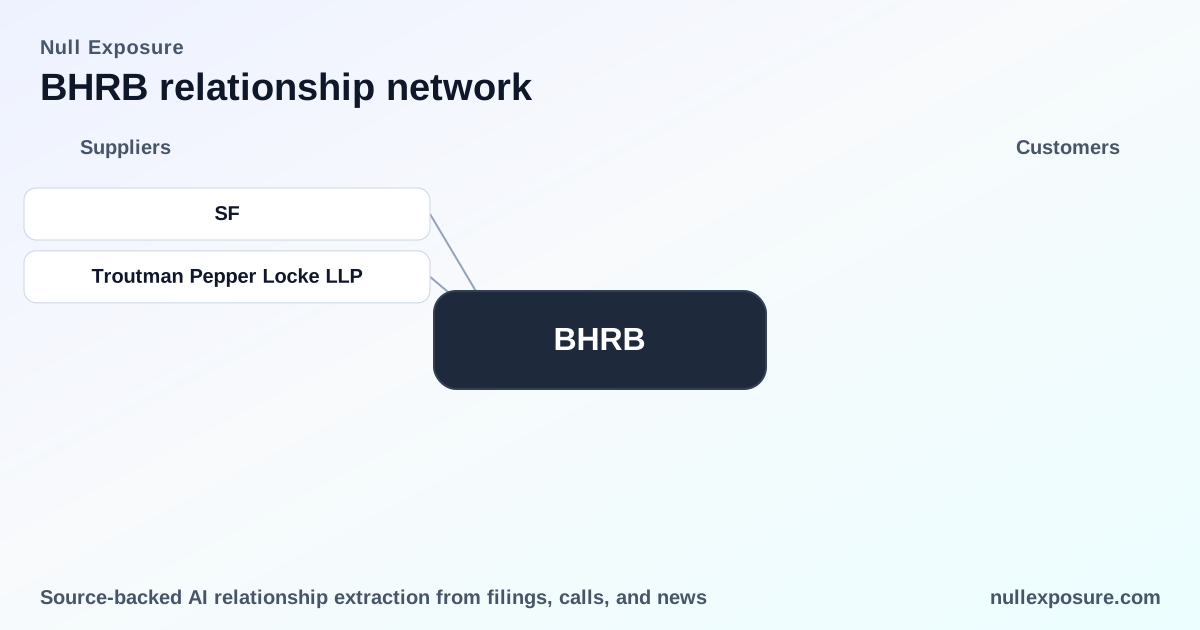
Burke & Herbert (BHRB) — Supplier Relationships and Operational Risk Snapshot
Burke & Herbert Financial Services Corp. operates as a regional community bank headquartered in Alexandria, Virginia, monetizing through net interest income, lending spreads, and fee income across retail and commercial banking products; its public metrics (market cap ≈ $943M, revenue TTM $338.5M, trailing P/E 8.12, dividend yield 3.55%) reflect a profitable, capital-light banking model with steady margins and a strong return on equity (14.8%). This review focuses on the supplier relationships disclosed in recent reporting and press, how those relationships influence execution risk around a strategic transaction, and what investors should watch in counterparty contracting and regulatory posture. For a deeper supplier-risk workflow, start here: https://nullexposure.com/
Why these supplier relationships matter for investors
Burke & Herbert executed a strategic transaction in FY2025 that required both financial advisory and legal counsel. Execution of M&A and capital transactions concentrates operational risk around a small set of external partners, and the quality of those partners has direct bearing on timing, regulatory clearance, and integration cost. The two counterparties cited in public coverage are a financial advisor (investment bank) and outside legal counsel — classic services for a bank-level transaction that are transaction-critical but non-operational post-close.
Key takeaway: Investors should treat these counterparties as tactical dependencies tied to transaction success rather than routine infrastructure vendors, but the company-level use of third parties for core business infrastructure is an ongoing governance signal that affects regulatory exposure and vendor risk management.
The advisory and counsel relationships reported in press
-
Keefe, Bruyette & Woods, A Stifel Company — Keefe Bruyette acted as exclusive financial advisor to Burke & Herbert in the LinkBancorp transaction, guiding deal structure and execution. This relationship was reported in CityBiz on March 9, 2026 (coverage of the Burke & Herbert and LinkBancorp merger): https://www.citybiz.co/article/786645/burke-herbert-financial-services-corp-and-linkbancorp-to-merge/
-
Troutman Pepper Locke LLP — Troutman Pepper served as legal counsel to Burke & Herbert for the same transaction, providing regulatory and transactional legal work. CityBiz reported this engagement on March 9, 2026 as part of its merger coverage: https://www.citybiz.co/article/786645/burke-herbert-financial-services-corp-and-linkbancorp-to-merge/
Each relationship listed above comes from the same CityBiz transaction report and reflects normal advisor/counsel roles for a bank pursuing M&A. Both firms are external professional services providers retained for the transaction rather than ongoing operational vendors.
Operational posture and vendor-risk implications
Burke & Herbert discloses that it relies on third parties for key components of its business infrastructure and that third-party relationships are under rising regulatory scrutiny. That company-level signal should be evaluated alongside the transaction-level advisor roster:
-
The company statement — “We rely on third parties to provide key components of our business infrastructure” — is a clear service-provider posture: Burke & Herbert leverages external expertise rather than building all capabilities in-house. This drives a contracting posture that favors short-term, outcomes-oriented engagements for discrete events (e.g., M&A) while retaining critical operational dependencies elsewhere.
-
A separate disclosure — “Our use of third-party vendors and our other ongoing third-party business relationships are subject to increasing regulatory requirements and attention” — is a governance red flag for vendor risk and compliance oversight. This implies heightened regulatory criticality of vendor controls and an expectation that vendors meet bank-grade compliance and continuity standards.
From an investor lens, those excerpts translate into practical constraints: higher compliance costs, tighter contracting terms, and the need for robust vendor oversight. Those are company-level signals and not specific to any single counterparty unless a filing explicitly names them.
How supplier concentration and maturity influence value
Burke & Herbert’s strategic reliance on external advisors for M&A indicates a pragmatic approach to capability gaps, but it also concentrates event risk:
-
Contracting posture: engagements are tactical and likely fee-based, increasing near-term cash spend but limiting long-term fixed-cost commitment. This conserves capital and preserves flexibility in a regional-bank operating model.
-
Concentration: M&A outcomes hinge on a handful of advisors; poor execution from any advisor could delay or increase the transaction cost, with downstream effects on realized synergies and capital planning.
-
Criticality: these relationships are high-impact for discrete events. Outside counsel affects regulatory clearance and documentation; financial advisors affect valuation, buyer outreach, and timetable.
-
Maturity: the use of established, well-known firms (an investment bank and a major law firm) signals mature vendor selection practices intended to reduce execution risk and reassure regulators.
Financial context that amplifies supplier risk
Burke & Herbert’s financial profile supports measured risk-taking around transactions, but vendor governance remains material:
-
Solid profitability: profit margin ~34.6% and operating margin ~54.2% create a buffer for transactional fees and integration costs.
-
Attractive valuation metrics: trailing P/E 8.12 and price-to-book ~1.10 position the stock as reasonably valued relative to earnings and tangible equity.
-
Dividend support: a 3.55% yield and recent dividend dates show capital return discipline that could be constrained by M&A-related capital needs.
Investors should weigh transaction execution risk against these strengths; a well-run vendor program reduces integration tail risk, while failures in oversight would translate directly into delayed synergies or regulatory friction.
If you want a structured vendor-risk briefing tailored to BHRB’s public disclosures and press coverage, see how our analysis maps to corporate filings at https://nullexposure.com/
Practical signals for monitoring
-
Review subsequent filings for formal disclosures of advisor fees, indemnities, and post-close services; these reveal the economic and legal exposure to counterparties.
-
Track regulatory notices and state banking communications for any vendor-related compliance actions; those are the clearest real-world indicators of vendor control failures.
-
Monitor integration milestones and cost synergies tied to the LinkBancorp transaction; missed milestones implicitly point back to advisory and legal execution.
Key investor action: prioritize governance and vendor oversight disclosures in upcoming 10-Q/8-K filings and proxy statements.
Conclusion — what investors should do now
Burke & Herbert engaged reputable financial advisory and legal counsel for a material transaction; that choice reduces execution risk but does not eliminate company-level vendor governance obligations. The two reported suppliers — Keefe, Bruyette & Woods (Stifel) and Troutman Pepper — served transaction-critical roles, and the company’s own disclosures flag increasing regulatory scrutiny of third-party relationships. Investors should watch vendor disclosure granularity, fee structures, and post-close integration performance as leading indicators of realized deal value.
For a focused supplier-risk scorecard and ongoing monitoring of BHRB counterparties, visit https://nullexposure.com/ — our platform consolidates press and filing signals into actionable supplier intelligence.
If you want a tailored briefing on how these supplier engagements affect capital allocation and regulatory exposure for Burke & Herbert, get in touch through https://nullexposure.com/ and we’ll prepare a concise investor memo.