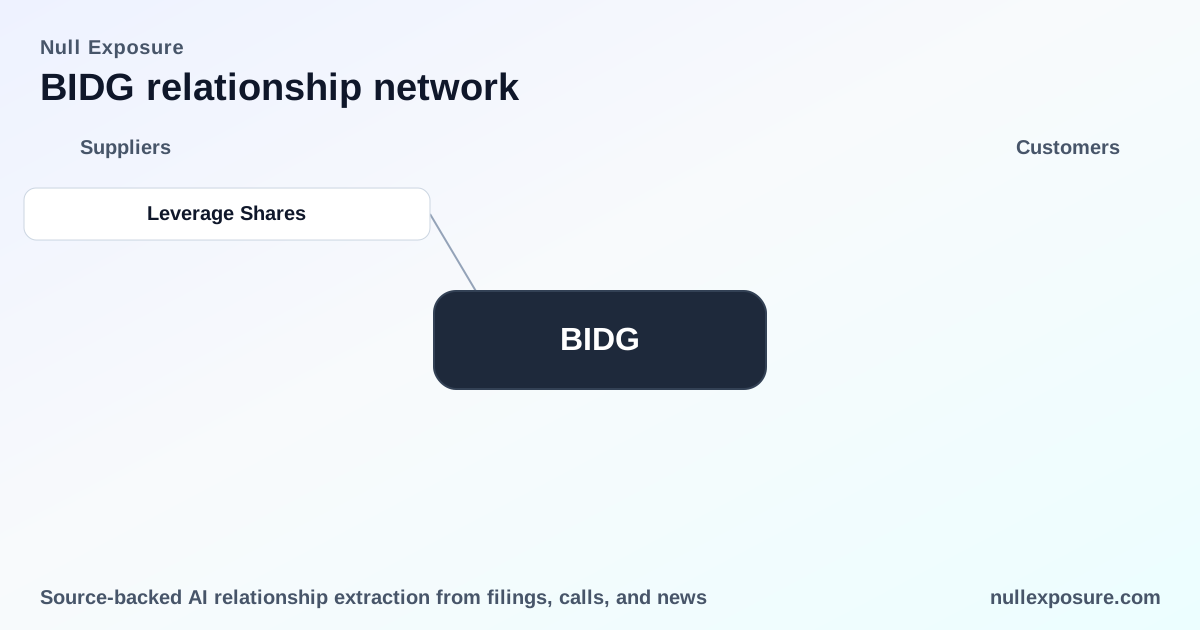
BIDG supplier relationships: what the market signal tells investors
BIDG trades as a 2x long equity product tied to Baidu (BIDU) under the Leverage Shares wrapper and monetizes through ETF-style mechanisms: management and platform fees, trading spreads, and liquidity/custody arrangements tied to creation/redemption activity. For investors and operators evaluating supplier exposure, the most consequential relationship visible in public coverage is the issuer/brand relationship with Leverage Shares, and short-term trading flow is the primary observable signal of product health and counterparty activity.
If you are conducting commercial due diligence or monitoring counterparty risk for BIDG, start with the issuer economics and observable market flows on the ticker. For an overview of monitoring capabilities and supplier intelligence, visit https://nullexposure.com/.
One-line scoreboard: the relationship list you need to read
- Leverage Shares — public market coverage identifies Leverage Shares as the issuer/brand associated with BIDG; market commentary shows active trading and price movement for the 2x Long BIDU product. According to a market post on Futunn dated March 9, 2026, the $2x Long BIDU ETF (BIDG.US) printed a +9.02% move with a $727,300 intraday trading volume (Futunn, 2026). Source: https://news.futunn.com/en/post/66801039/us-stock-etf-tracker-silver-rebounds-strongly-2x-long-silver
This single reported relationship is the direct, actionable supplier tie in the provided results; treat it as the focal point for credit, operational and market-liquidity assessments.
Why a single relationship matters more than it looks
A lone visible supplier relationship in public signals is not a sign of simplicity — it is a signal that issuer concentration and brand control dominate BIDG’s supply chain. When one entity both designs and distributes a leveraged ETF product, commercial terms, custody arrangements, and risk controls are concentrated and therefore critical to counterparty resilience. From an investor perspective, that concentration translates into a small set of levers to push for better disclosure, operational transparency, and fee clarity.
The March 9, 2026 price and volume snapshot is useful because leveraged products amplify flow — sharp price moves and concentrated volumes are the fastest early warning signs of distribution stress or rapid rebalancing. That single news entry confirms active secondary market trading and gives a short, verifiable window into liquidity conditions for BIDG.
What the Futunn trade snapshot actually tells you
The Futunn post reported the following for BIDG on March 9, 2026: price +9.02% and trading volume of $727,300. Those are discrete, verifiable market facts that reflect end-investor traction and intraday liquidity. For an ETF structure, intraday volume of this scale for a single product indicates sufficient retail and/or professional flow to support secondary-market pricing, but it is not by itself a guarantee of deep liquidity for large block trades or institutional redemptions. Source: Futunn market post (March 9, 2026).
Use these kinds of snapshots as signal events: they identify when to request more granular data from the issuer (creation/redemption activity, AP panel composition, custody counterparties) and when to stress-test operational arrangements with prime brokers and custodians.
Operating-model constraints and company-level signals
There are no explicit constraint excerpts provided in the results set. As a company-level readout, this absence is itself instructive: public disclosure on supplier-level constraints is limited in the visible record, so investors must infer operational posture from market behavior and standard industry practice.
- Contracting posture: issuer-led — BIDG’s economics and distribution are controlled by a single visible brand, implying contract terms (fees, custody, AP agreements) concentrate negotiating leverage with the issuer rather than a decentralised supplier pool.
- Concentration: high — the dataset shows one principal relationship; that concentration raises counterparty risk and operational single points of failure.
- Criticality: product-critical — as a packaged leveraged exposure, BIDG’s continuity depends on the issuer’s operational capability (rebalancing, hedging, compliance).
- Maturity: trade-active — the Futunn snapshot demonstrates live market trading, signaling an operational level consistent with a commercially active ETF rather than a stalled or legacy product.
These signals should inform vendor due diligence, where you prioritize contractual protections around custody, fee escalation, and emergency liquidity provisions. For vendor risk frameworks and ongoing monitoring, see the services at https://nullexposure.com/.
Practical implications for investors and operators
The relationship profile and market snapshot lead to a concise set of actions:
- Demand issuer-level transparency: request the latest creation/redemption ledger, Authorized Participant list, and fee schedule to quantify upstream counterparty risk.
- Scale stress tests to realistic blocks: evaluate whether a $0.5–1.0m intraday volume is representative of expected flows for institutional-sized orders; if not, enforce tighter execution and settlement controls.
- Monitor rebalancing mechanics: leveraged products require daily rebalancing; confirm the hedging counterparties, margining arrangements, and intraday liquidity facilities the issuer uses.
These are operational priorities that protect investors from liquidity squeezes and protect operators from margin and settlement shocks.
Key risks to monitor
- Concentration risk: a single issuer connection amplifies business continuity and reputational exposure.
- Liquidity fracture: intraday volume spikes do not guarantee block liquidity; redemption mechanics can be the weak link.
- Regulatory and product risk: leveraged ETFs face heightened scrutiny and potential restrictions in some jurisdictions, which can change distribution economics or access.
Each of these risk vectors is manageable if contractual and monitoring levers are in place with the issuer and service providers.
Closing view and next steps
The public record for BIDG in this review is short but actionable: Leverage Shares is the visible issuer and the product traded actively on March 9, 2026 with a notable intraday move. For investors and operators, the commercial priority is to convert market signals into contractual protections and operational visibility — especially around creation/redemption mechanics, AP counterparties, and custody. Accessing those documents and maintaining a rolling monitoring cadence are the fastest ways to convert one-off market noise into disciplined risk controls.
If you want a structured vendor-risk assessment and automated monitoring plan for BIDG and similar supplier relationships, start at https://nullexposure.com/. For immediate support mapping supplier contracts to market signals, request an engagement through https://nullexposure.com/ and secure continuous intelligence on your counterparty exposures.