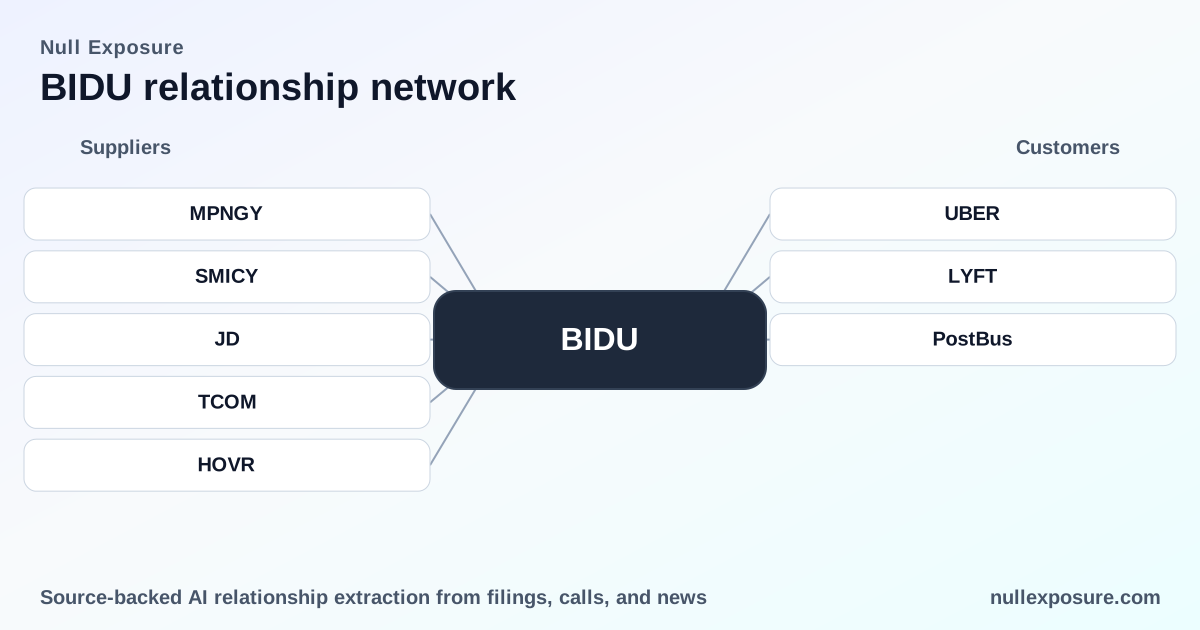
Baidu Inc (BIDU): Supplier relationships that shape AI distribution and AV deployment
Baidu operates as China’s leading search and AI company, monetizing through advertising, cloud and AI services, and platform licensing tied to its Ernie family of models and Apollo autonomous-driving stack. The company pushes growth by embedding Ernie Assistant into major consumer platforms and by outsourcing operational scale for autonomous fleets, while relying on domestic semiconductor supply for advanced chips—a supplier posture that creates both commercial leverage and concentrated operational risk. For investors and operators evaluating BIDU as a supplier or counterparty, the current relationship map highlights strategic integrations, third‑party fleet operators, and foundry dependency that materially influence execution and downside exposure. For a deeper look at supplier signals and how they affect underwriting and contracting, visit https://nullexposure.com/.
Why these relationships matter for revenue and risk
Baidu’s relationships in the market are not incidental integrations; they are distribution and execution channels. Embedding Ernie Assistant inside large consumer apps multiplies user reach with marginal incremental cost, while third‑party fleet operators and foundry partners determine the pace at which hardware and real‑world services scale. The supply-side picture therefore affects monetization velocity, capital intensity, and counterparty concentration — the exact variables underwritten in premium finance and supplier-risk models.
What the relationship list contains (quick map)
The snapshot contains five distinct relationship entries: Meituan, JD.com, Trip.com, SMIC, and New Horizon (the latter referenced twice across sources). Each entry is a signal of either a distribution partnership (Ernie integrations), a manufacturing dependency (SMIC), or an operational outsourcing arrangement (New Horizon for Apollo Go). Below I cover every relationship reported in the results with concise, sourced notes.
Meituan — Ernie Assistant integration expands consumer reach
Baidu’s Ernie Assistant connects directly with Meituan to assist with food ordering and other on‑platform tasks, expanding product distribution into everyday consumer flows. According to a Finviz report on March 9, 2026, Ernie Assistant now connects with major applications including Meituan, increasing monthly active usage and embedding Baidu functionality inside third‑party commerce and service apps. (Finviz, 2026-03-09)
JD.com — Commerce integration for AI‑driven user journeys
Ernie Assistant’s connection to JD.com positions Baidu to capture engagement and commerce-driven value inside a top e‑commerce environment. The same March 9, 2026 Finviz coverage notes JD.com as a launch partner for Ernie Assistant, enabling ordering and transactional assistance inside JD’s ecosystem and broadening Baidu’s route-to-market for AI features. (Finviz, 2026-03-09)
Trip.com — Travel bookings and vertical reach for Ernie
Trip.com is an Ernie Assistant integration point for booking flights and travel services, bringing Baidu into travel‑transaction flows. Finviz reported on March 9, 2026 that Trip.com is among the major applications connected to Ernie Assistant, signaling Baidu’s push to embed AI in vertical consumer experiences. (Finviz, 2026-03-09)
SMIC — Foundry dependency for advanced process nodes
Baidu’s hardware and AI chip plans confront a supplier constraint in domestic foundry capacity, with SMIC cited as a potential bottleneck for 7nm and 5nm production. A FinancialContent piece (TokenRing, Jan 27, 2026) flagged reliance on SMIC for advanced process nodes as a limiting factor for China’s AI chip ambitions, underscoring a supply-side risk for companies like Baidu that accelerate on-premise AI hardware initiatives. (FinancialContent, 2026-01-27)
New Horizon — Third‑party operator for Apollo Go fleet in Dubai
Baidu will deploy Apollo Go autonomous vehicles in Dubai with fleet management handled by third‑party operator New Horizon, outsourcing local operations while retaining technology leadership. Just‑Auto reported on March 9, 2026 that Baidu and Uber will deploy Apollo Go in Dubai with New Horizon managing fleet operations; a secondary report on March 9 echoes that fleet management responsibilities rest with New Horizon. (Just‑Auto, 2026-03-09; StockTitan, 2026-03-09)
What these links say about Baidu’s operating model and supplier posture
- Contracting posture: Baidu operates through strategic integrations and outsourced operational execution. The Ernie integrations show a platform licensing/distribution approach, while the Apollo deployments use local third‑party operators to scale services without building a global operating arm.
- Concentration: Foundry dependency creates supplier concentration risk; SMIC’s role in advanced process nodes is a company‑level signal that hardware scaling is concentrated and potentially capacity‑constrained.
- Criticality: The relationships are functionally critical to commercialization: Ernie partnerships drive user engagement and revenue channels, and New Horizon is critical to real‑world AV deployment timelines.
- Maturity: Integrations with Meituan, JD.com, and Trip.com indicate mature go‑to‑market models for AI feature distribution; by contrast, advanced-node foundry dependency and nascent AV rollouts reflect earlier stage operational risk that requires monitoring.
There are no supplier‑constraint excerpts embedded in this snapshot that directly alter contractual terms, indemnities, or credit posture; the constraints field returned empty. Treat that absence as a data point: no supplier contract limitations were surfaced here, but operational dependencies and concentration risks are visible through the relationship map.
Investor and operator implications — what to underwrite and watch
- Underwrite channel economics for Ernie integrations. Pricing, revenue share, and user‑data access inside Meituan, JD.com and Trip.com will determine whether integrations drive incremental revenue or are primarily distribution with limited monetization.
- Stress-test foundry scenarios. Model the impact of constrained SMIC capacity on chip timelines and incremental capex needs; this is the most actionable supplier risk for hardware‑heavy initiatives.
- Contract terms for AV operators. Confirm delegation of operational liability, performance SLAs, and insurance coverage with third‑party operators like New Horizon before underwriting exposure.
- Monitor adoption metrics. Monthly active users for Ernie and fleet uptime/performance for Apollo Go will be leading indicators of commercial success.
Key items to track:
- Commercial terms and revenue share with Meituan/JD/Trip.com.
- Any public updates on SMIC capacity or alternative foundry partnerships.
- Details of the New Horizon operating agreement and liability allocation.
For a structured supplier risk brief and to compare these signals against counterparty scorecards, see our analysis hub at https://nullexposure.com/.
Bottom line
Baidu is executing a two‑track supplier strategy: platform integrations to scale AI distribution and outsourced operational partners to accelerate real‑world AV deployment, while remaining exposed to concentrated foundry risk for advanced chips. That combination creates attractive distribution leverage and measurable supplier-side vulnerabilities that underwriters and operators must quantify when evaluating exposure to BIDU. For ongoing tracking of Baidu’s supplier relationships and tailored supplier risk models, visit https://nullexposure.com/.