Biogen Inc (BIIB) — Supplier relationships and operational constraints investors should price in
Biogen monetizes neurological therapies through a mix of proprietary product sales and licensed commercialization rights, capturing revenue from finished drug sales while outsourcing key manufacturing and packaging functions. With a market capitalization of roughly $26.9 billion and trailing revenue near $9.9 billion, Biogen’s earnings profile is driven by branded product demand and partner-licensed assets; that same model concentrates operational risk in third‑party manufacturers and long‑dated supply commitments. For a concise supplier-risk snapshot and continuous tracking, see https://nullexposure.com/.
How Biogen contracts and runs its supply base
Biogen’s public disclosures make its operating model clear: critical manufacturing steps are outsourced to a concentrated set of contract manufacturing organizations (CMOs), and the company holds at least one explicit long‑term supply agreement for a flagship product. Company filings state: “We principally use third parties to manufacture the active pharmaceutical ingredient and the final product…,” and the company also notes a supply agreement with Eisai to manufacture LEQEMBI drug substance and drug product through the end of 2031. These are not peripheral arrangements — they are structural elements of the business model and should be treated as such in valuation and operational diligence.
- Contracting posture: long‑term agreements for key products (explicit for LEQEMBI through 2031) reduce spot vulnerability but increase counterparty exposure.
- Concentration: fill‑finish, assembly, labeling and storage are centralized among a small group of providers, raising supplier concentration risk.
- Criticality: third‑party manufacturing is mission‑critical, covering APIs, final product and significant packaging operations.
- Maturity: disclosure language indicates these are established, active relationships rather than transient ad hoc contracts.
What the company disclosures signal for investors
The combination of long-term supply commitments and reliance on third-party CMOs creates a trade-off: supply stability on contractually secured products versus elevated single‑vendor and operational concentration risk. For investors modeling downside scenarios, factor in potential supplier disruption, remediation costs, and timeline risk for manufacturing transfers. For deeper supplier-level analytics visit https://nullexposure.com/.
Recent relationship mentions in the news — what they actually say
Below are the relationship items surfaced in recent coverage; each entry is presented plainly with its source.
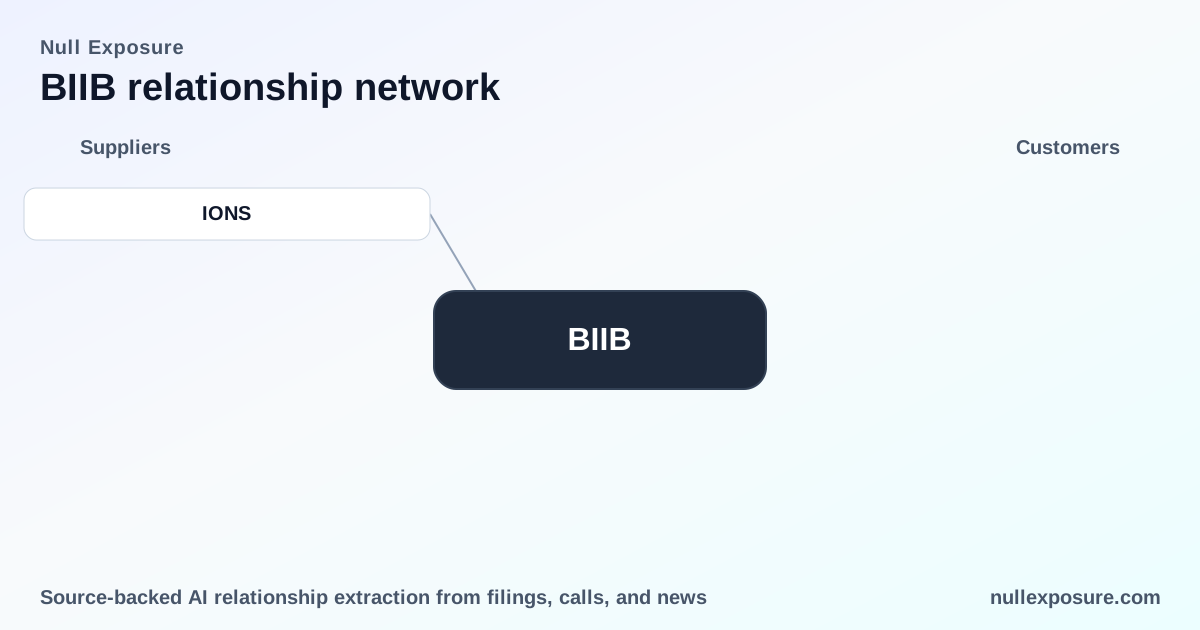
- Biogen licensed the global rights to develop, manufacture and commercialize SPINRAZA from Ionis Pharmaceuticals, Inc. in connection with spinal muscular atrophy programs, as highlighted in recent company communications. According to a GlobeNewswire release on March 5, 2026, the announcement framed ongoing program activity for SMA data sharing and commercialization cooperation (GlobeNewswire, March 5, 2026).
- Biogen also holds global development, manufacturing and commercialization rights for salanersen licensed from Ionis Pharmaceuticals, Inc., referenced alongside other SMA-related program updates. This was likewise reported in the GlobeNewswire release (March 5, 2026) describing Biogen’s licensed portfolio and program status.
Both items reflect licensing relationships in which Biogen is the commercial and development lead for Ionis-originated assets — a common element of Biogen’s monetization approach that shifts R&D sourcing risk into a partner-licensed pipeline (GlobeNewswire, Mar 5, 2026).
Why these relationships matter to valuation and operational risk
Biogen’s licensing of Ionis compounds (SPINRAZA-related and salanersen rights) expands revenue optionality but also entangles the company in third‑party clinical and manufacturing dependencies. When licensed assets scale to commercial volumes, manufacturing footprint, fill‑finish capacity, labeling throughput and distribution contracts become determinants of time‑to‑revenue and margin capture. Meanwhile, the explicit supply agreement with Eisai for LEQEMBI through 2031 signals predictable supply for a core product but concentrated counterparty exposure.
Financial context underlines the operational picture: Biogen’s operating margin (about 19.6% TTM) and profit margin (13.1%) are contingent on steady product supply and pricing; an interruption at a key CMO or a failure to secure alternate capacity would rapidly compress margins. Institutional ownership sits at ~98%, indicating market consensus sensitivity to execution and supply continuity.
Due diligence checklist for investors and operators
Practical actions to convert these observations into investment or procurement decisions:
- Validate contract terms and termination / supply continuity clauses for long‑dated supply agreements (LEQEMBI/Eisai example).
- Assess single‑sourcing concentration for fill‑finish and packaging; confirm existence and feasibility of qualified secondary suppliers.
- Review audit schedules, regulatory inspection histories and CAPA closure rates for named CMOs.
- Model revenue sensitivity to a 30/60/90‑day manufacturing disruption for top products.
- Confirm contractual responsibility for recall, lot failures, and remediation costs.
These steps translate supplier commentary into quantitative downside scenarios and operational contingency plans.
For an operationally focused supplier intelligence feed and to benchmark Biogen’s supplier concentration against peers, visit https://nullexposure.com/.
Bottom line: operational strengths with concentrated supplier risk
Biogen’s commercial model—monetizing licensed and proprietary neurologic therapies while outsourcing critical manufacturing tasks—delivers scalable revenue upside but creates concentrated counterparty exposure. The company’s explicit long‑term supply agreement for LEQEMBI and its reliance on a concentrated group of CMOs for fill‑finish, labeling, and assembly are strategic advantages for supply continuity on covered products and simultaneous risk factors if a counterparty underperforms. Investors should price in the trade‑off: stable contractual coverage for core products versus a non‑trivial supplier‑concentration premium to protect downside.
To convert this analysis into an actionable monitoring plan or to subscribe to continuous supplier-risk signals, start at https://nullexposure.com/.