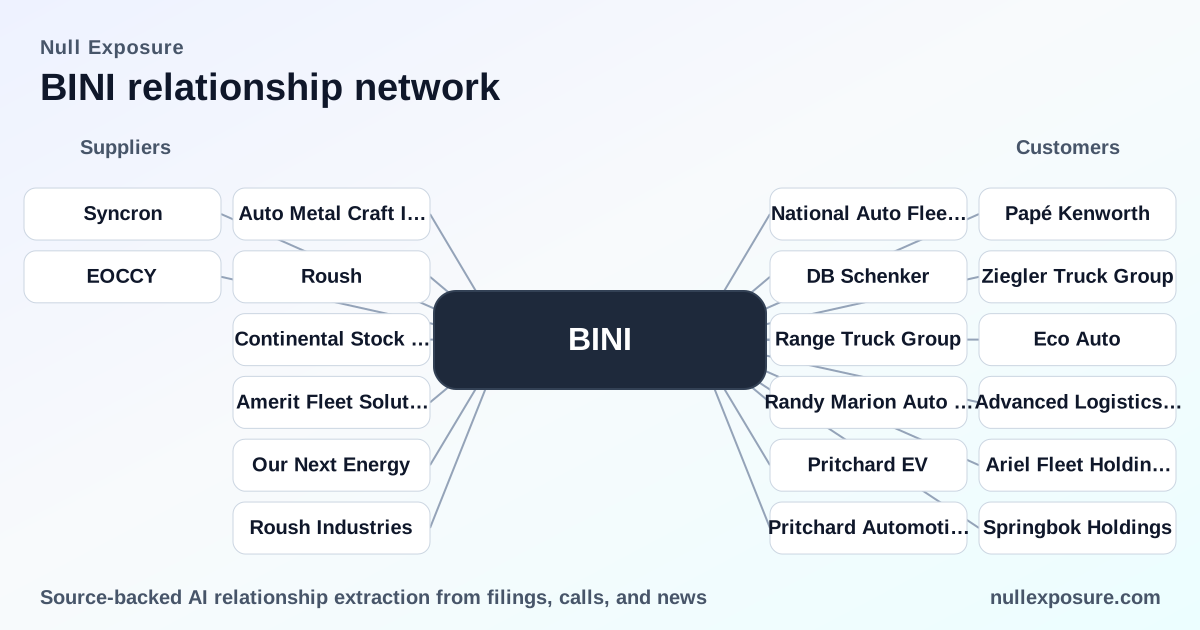
Bollinger Innovations (BINI): Supplier map and commercial signals investors must price in
Bollinger Innovations manufactures and sells electric vehicles through a combination of in-house design and outsourced manufacturing, monetizing primarily through vehicle sales, manufacturing partnerships and ancillary service agreements (warranty administration, mobile service, charging and battery supply). Revenue sensitivity is concentrated on a small set of production and service partners, and short-term cashflow dynamics are driven by manufacturing throughput and counterparty payment performance. For primary research on supplier exposures and operational signals, visit https://nullexposure.com/.
Where the supplier relationships sit in the P&L and on the factory floor
Bollinger runs a lean balance between engineering and outsourced production: it retains product ownership and go-to-market responsibility while contracting out key manufacturing steps, battery packs and post‑sale service. That posture creates three investor imperatives — production continuity, supplier credit health, and service network scale — each of which is visible in the relationship set below.
Auto Metal Craft Inc.
Auto Metal Craft has filed a claim against Bollinger for $728,329, alleging unpaid obligations related to supply. According to FleetOwner’s coverage of Bollinger’s restructuring and legal actions, this lawsuit is part of a broader set of supplier disputes tied to FY2025 operations (FleetOwner article: https://www.fleetowner.com/emissions-efficiency/electric-vehicles/article/55310961/bollinger-innovations-navigates-challenges-and-restructuring-in-electric-vehicle-market).
Roush / Roush Industries
Bollinger’s manufacturing partnership with Roush Industries underpins serial production of the B4, but creditor claims allege Bollinger owed Roush approximately $1.2 million and that the production team had been furloughed. FleetOwner and GreenCarStocks report the production relationship and associated payment dispute; Roush’s facility in Livonia, Michigan, is the operational site for B4 assembly (FleetOwner; GreenCarStocks profile: https://www.greencarstocks.com/green-car-companies/bollinger-innovations-inc/).
Continental Stock Transfer & Trust Company
Continental Stock Transfer & Trust Company is serving as Bollinger’s transfer and exchange agent for announced reverse stock splits (multiple company press releases and market notices in 2025 referenced Continental as exchange agent). See Bollinger’s reverse-split announcements on GlobeNewswire (July 31, 2025; Sept 18, 2025) and related market notices (StockTitan / QuiverQuant summaries: https://www.globenewswire.com/news-release/2025/07/31/3125054/0/en/Bollinger-Innovations-Inc-Announces-Reverse-Stock-Split-Effective-Aug-4-2025.html).
Amerit Fleet Solutions
Amerit Fleet Solutions has been named as Bollinger’s mobile service provider, establishing a field-service footprint for deployed vehicles and fleet customers. This supplier relationship is disclosed in Bollinger profile coverage that details partners for warranty and mobile service activities (GreenCarStocks: https://www.greencarstocks.com/green-car-companies/bollinger-innovations-inc/).
Syncron
Bollinger selected Syncron as its warranty administration partner, outsourcing warranty claims processing and parts management to a third party to scale post-sale support quickly. The Syncron engagement is referenced in partner disclosures and media profiles of Bollinger’s after-sales strategy (GreenCarStocks: https://www.greencarstocks.com/green-car-companies/bollinger-innovations-inc/).
Our Next Energy
Bollinger contracted with Our Next Energy (ONE) for battery packs sourced from Novi, Michigan, integrating external cell/pack expertise rather than developing packs entirely in-house. GreenCarStocks lists ONE as Bollinger’s battery partner, reflecting a supplier-dependent battery strategy (GreenCarStocks: https://www.greencarstocks.com/green-car-companies/bollinger-innovations-inc/).
EO (EOCCY)
Bollinger established a partnership with EO to provide EV charging infrastructure, equipment and technology solutions for dealers and customers, positioning EO as the charging‑infrastructure supplier for its dealer network. This commercial partnership is noted in partner summaries and positions charging as part of Bollinger’s customer experience stack (GreenCarStocks partner mention: https://www.greencarstocks.com/green-car-companies/bollinger-innovations-inc/).
(For primary access to consolidated supplier intelligence on Bollinger, see https://nullexposure.com/.)
Interpreting the relationship set: what it says about Bollinger’s operating model
The supplier list highlights a classic small‑EV OEM structure: core manufacturing outsourced to a contract manufacturer, critical subsystems supplied by specialist vendors, and after‑sales handled by third-party service platforms. From the constraints and disclosures, investors should treat the following company-level signals as operational facts:
- Contracting posture — selective long‑term deals: Bollinger states it maintains long‑term contracts with some key suppliers and vendors, indicating strategic anchors for core components and manufacturing capacity rather than spot purchasing across the board.
- Geographic sourcing and assembly footprint: The company sources a meaningful portion of components from China and assembles in the United States, while commercial rights and licensing create presence across North America and Latin America; this implies multi‑jurisdictional supply risk and cross-border logistics exposure.
- Material concentration: Bollinger is dependent on a limited set of OEMs, single‑source suppliers and service providers for critical parts and assembly, so any counterparty failure or payment dispute can materially disrupt production and revenue recognition.
- Role flexibility — licensor and manufacturer dependencies: The business relies on external manufacturers for vehicle production and on licensing arrangements for certain IP rights, showing that Bollinger’s margin profile is tightly coupled to partner economics rather than fully captive manufacturing.
Operational and investment risks that follow from the supply map
- Counterparty payment risk is real and measurable. The Auto Metal Craft claim and the alleged $1.2M owed to Roush illustrate that supplier claims can crystallize quickly and interrupt production. Legal exposure to suppliers directly threatens manufacturing cadence and inventory flow.
- Concentration risk on critical subsystems. Battery supply (Our Next Energy) and charging infrastructure (EO) are single-vendor touchpoints for key customer experience elements, so performance or contract disputes there will affect both sales and warranty costs.
- After‑sales execution is outsourced. While Syncron and Amerit Fleet Solutions scale warranty and field service, reliance on third parties transfers some quality and cost control out of Bollinger’s direct line of sight — which impacts lifetime value of customers and fleet contracts.
Recommended investor actions
- Monitor supplier litigation and payment notices for immediate production risk indicators; subscribe to supplier‑level filings and press releases that reference Bollinger partners.
- Prioritize diligence on Roush’s production status and Our Next Energy’s supply cadence — these two relationships are operationally critical to vehicle delivery timing and cost of goods sold.
- Validate warranty and service economics under the Syncron/Amerit arrangements to understand post‑sale cost trajectory and margin recovery.
For a consolidated view of these supplier relationships and live monitoring, visit https://nullexposure.com/ and review the Bollinger supplier profile.
Conclusion — what to watch next
Bollinger’s supplier network gives the company access to specialized manufacturing, battery packs and service scale without the fixed-cost burden of fully captive operations, but that same structure concentrates risk in a handful of external partners. Investors must price both the upside of outsourced scale and the downside of supplier payment or performance failure. For ongoing supplier intelligence and alerting, see https://nullexposure.com/.